


🩸 RedBloodJournal.com #1331 🩸
The Complete Fourteen-Point Agreement
Connecting All the Doors Into One Picture
By Red Blood
For the past fifteen reports, each point of the reported fourteen-point agreement was examined individually.
One door at a time.
One room at a time.
One question at a time.
Now the time has come to step back and look at the entire structure.
Because agreements are rarely understood through isolated paragraphs.
Their meaning emerges from the relationship between the parts.
A single piece of a puzzle may be interesting.
The complete picture is where understanding begins.
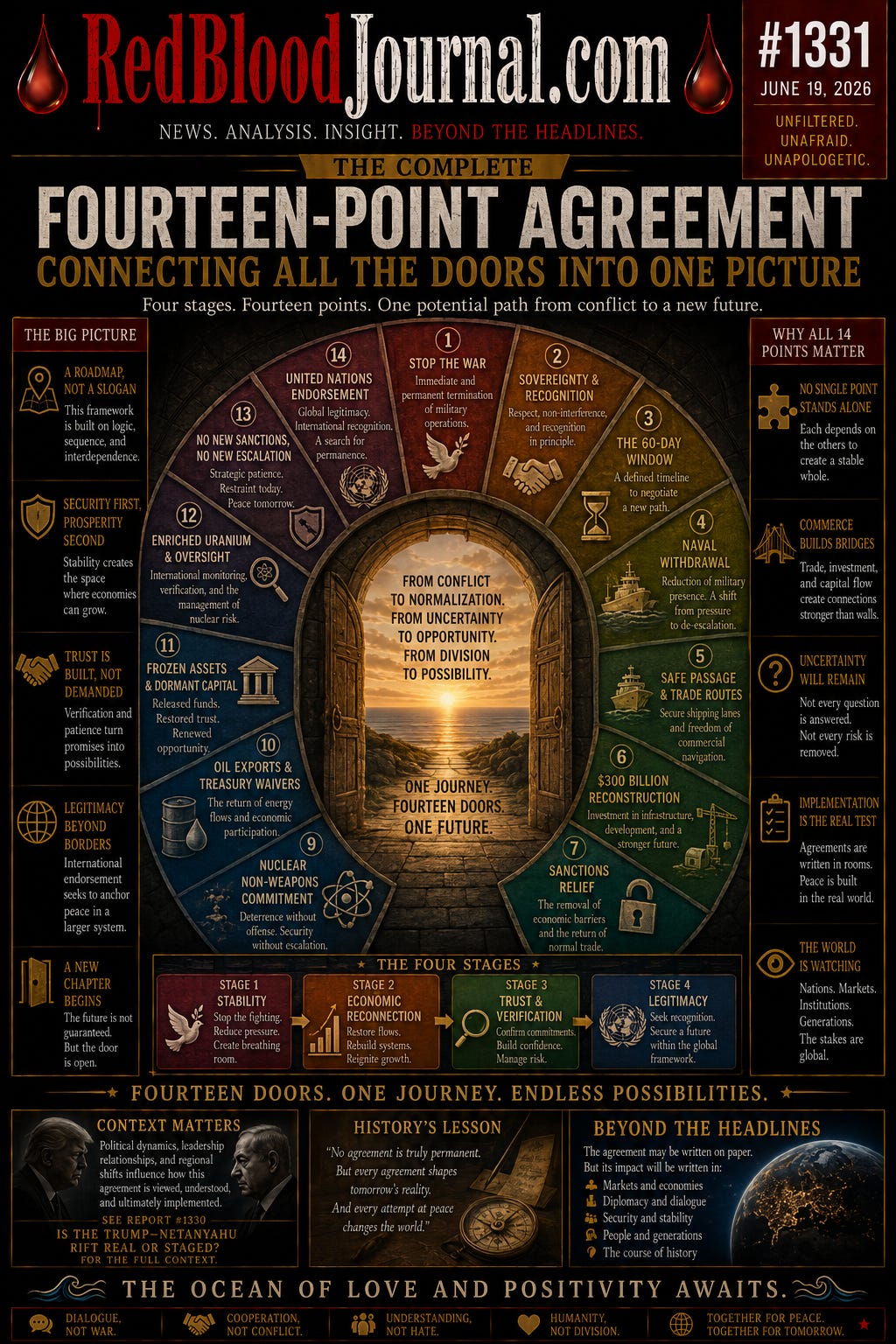
The Fourteen Doors
At first glance, the fourteen points appear to address different subjects.
War.
Sovereignty.
Negotiations.
Military deployments.
Shipping.
Reconstruction.
Sanctions.
Nuclear issues.
Oil exports.
Frozen assets.
Verification.
Patience.
International recognition.
Different topics.
Different industries.
Different institutions.
Different concerns.
Yet when viewed together, a pattern emerges.
The agreement follows a sequence.
A progression.
A roadmap.
Not from conflict to victory.
But from conflict to normalization.
The First Layer:
Stopping the Fire
Points One through Five address immediate stability.
Point One stops military operations.
Point Two establishes mutual recognition and sovereignty.
Point Three creates a negotiation timetable.
Point Four reduces military pressure.
Point Five secures commercial shipping routes.
Notice the sequence.
The first objective is not prosperity.
The first objective is not development.
The first objective is not ideology.
The first objective is stability.
Before economies grow, conflict must slow.
Before reconstruction begins, uncertainty must decline.
Before investment arrives, risk must decrease.
The first layer creates breathing room.
The Second Layer:
Economic Reconnection
Points Six through Eleven focus on economics.
Reconstruction.
Sanctions.
Oil exports.
Frozen assets.
Economic participation.
Access to markets.
Access to capital.
Access to opportunity.
This section reveals something important.
The agreement is not structured around military victory.
It is structured around economic integration.
The language repeatedly moves toward commerce.
Trade.
Investment.
Capital.
Infrastructure.
Development.
History suggests that nations often move from military confrontation to economic interaction long before genuine political trust emerges.
Commerce frequently becomes the bridge.
The Third Layer:
Trust and Verification
Points Twelve and Thirteen focus on confidence.
Verification.
Oversight.
Transparency.
Patience.
These points acknowledge a reality that every negotiator understands.
Agreements fail when trust fails.
Trust cannot be demanded.
Trust must be built.
Verification reduces uncertainty.
Patience allows verification to function.
Together they create the foundation upon which larger agreements survive.
Without them, signatures become decorations.
With them, agreements acquire durability.
The Fourth Layer:
Legitimacy
Point Fourteen seeks international recognition.
Not merely acceptance by the parties involved.
Acceptance by the broader international system.
This final step transforms a bilateral understanding into something larger.
The agreement seeks legitimacy beyond its signatories.
Whether one views international legitimacy as meaningful or symbolic, the intention is clear.
The final point attempts to make the agreement part of a larger framework.
The Hidden Structure
When all fourteen points are viewed together, the structure becomes visible.
The agreement follows four stages.
Stability.
Economics.
Trust.
Legitimacy.
First reduce conflict.
Then restore economic activity.
Then build confidence.
Then seek recognition.
This sequence is not accidental.
It mirrors many historic peace frameworks.
The order matters.
Attempting legitimacy before stability rarely works.
Attempting prosperity before security rarely works.
Attempting trust before verification rarely works.
The arrangement of the points tells a story.
The Missing Question
Every agreement contains questions it does not answer.
This one is no different.
Who benefits most?
Who compromises most?
Who gains influence?
Who loses leverage?
Who enforces compliance?
What happens if implementation stalls?
These questions remain.
Perhaps they always will.
No document eliminates uncertainty.
It merely organizes it.
The Trump Question
One reason this agreement attracts attention is timing.
It arrives during a period when many observers are attempting to understand shifting relationships throughout the region.
Alliances appear fluid.
Public disagreements appear increasingly visible.
Old assumptions are being questioned.
New possibilities are emerging.
This is why Report #1330 examined a separate but related question:
Is the Trump–Netanyahu Rift Real or Staged?
Because the answer, whatever it may be, influences how observers interpret the fourteen points themselves.
Context changes meaning.
The Larger Pattern
Perhaps the most interesting observation is that the agreement repeatedly moves away from destruction and toward management.
Managing conflict.
Managing trade.
Managing capital.
Managing risk.
Managing uncertainty.
Managing legitimacy.
The language is not revolutionary.
It is administrative.
The document does not describe a new world.
It attempts to stabilize the existing one.
That alone may reveal something about the priorities of those who negotiated it.
The Fourteen Doors Revisited
The first door asked whether war could stop.
The last door asked whether peace could be recognized.
Everything in between attempted to bridge the distance.
Fourteen doors.
Fourteen questions.
Fourteen opportunities to observe how modern power operates.
Not through a single mechanism.
But through a network of military, economic, financial, diplomatic, and institutional relationships.
The Ocean
Every agreement appears permanent when written.
History teaches otherwise.
Governments change.
Policies change.
Leaders change.
Treaties change.
Institutions change.
The waves rise.
The waves fall.
The names change.
The actors change.
The costumes change.
The stage changes.
Yet beneath every agreement, every conflict, every negotiation, every alliance, and every empire remains something older than politics itself.
The same ocean that existed before the first treaty.
The same ocean that will remain after the last one.
The fourteen doors may describe the movement of nations.
But beyond the doors remains the larger reality.
The ocean from which all waves arise.
And perhaps understanding begins when we remember that every wave eventually returns to it.
The Ocean of Love and Positivity awaits.
🚪 Fourteen Doors:
The Architecture of Global Normalization
Jun 19, 2026
This text explores a comprehensive fourteen-point roadmap designed to transition global relations from a state of active conflict to normalized stability.
The proposed framework is organized into four distinct layers, beginning with immediate military cessation before moving into economic integration and reconstruction.
Central to the plan’s success is the establishment of mutual trust through verification and obtaining broad international legitimacy.
By prioritizing administrative management over ideological shifts, the agreement seeks to provide a structured sequence for diplomatic durability.
Ultimately, the author suggests that while such documents attempt to organize geopolitical uncertainty, they remain subject to the shifting tides of history.


