


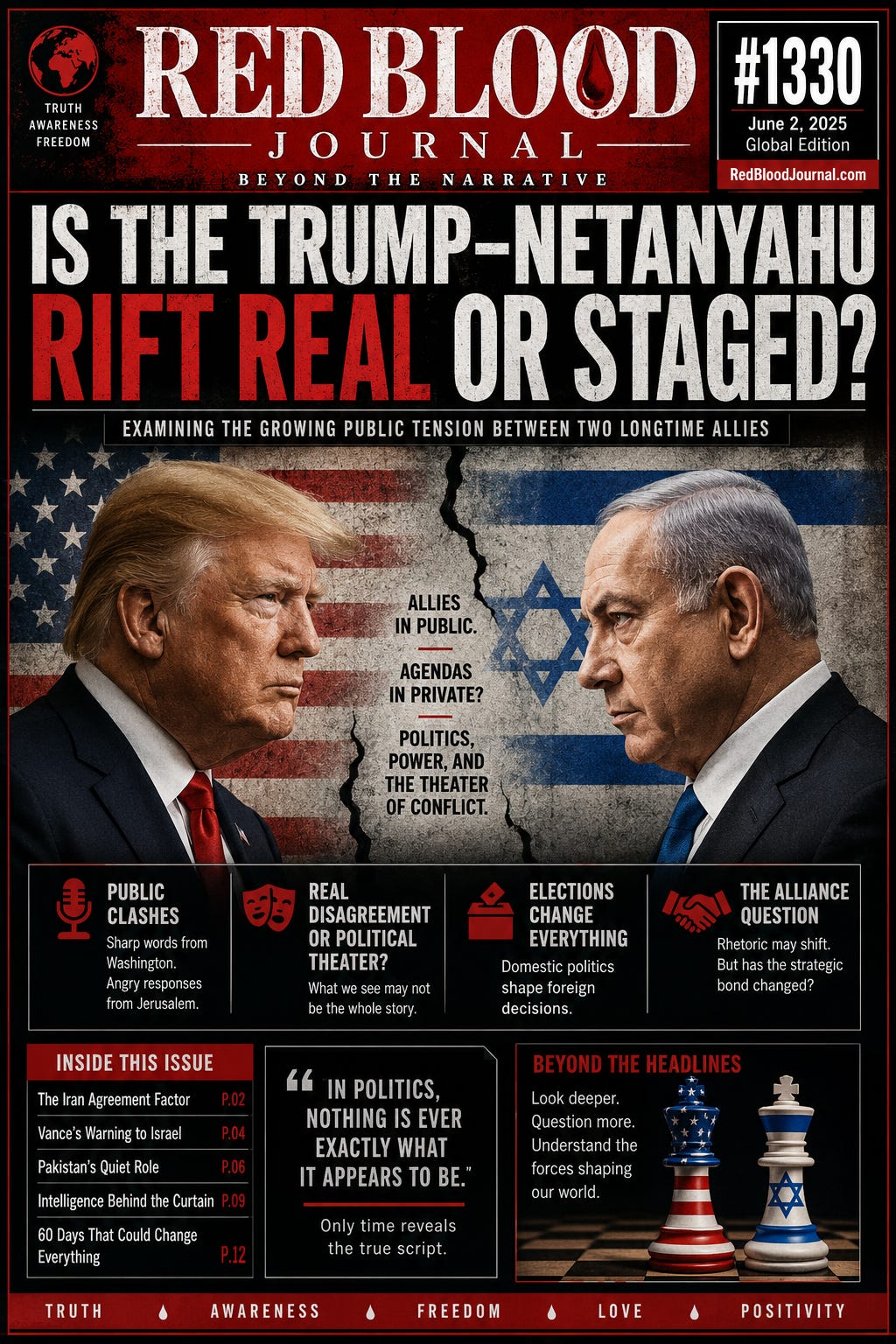
🩸 RedBloodJournal.com #1330 🩸
Is the Trump–Netanyahu Rift Real or Staged?
Examining the Growing Public Tension Between Two Longtime Allies
By Red Blood
For years, political observers have become accustomed to seeing the governments of the United States and Israel move largely in the same direction.
Disagreements existed, of course. Leaders came and went. Administrations changed. Policies shifted. Yet the strategic relationship remained remarkably stable.
That is why recent public exchanges between the administration of Donald Trump and the government of Benjamin Netanyahu have attracted so much attention.
Some observers see the dispute as evidence of a genuine fracture.
Others see something entirely different.
They see theater.
The question is not merely whether the two leaders disagree.
The question is whether the disagreement itself is part of a larger strategy.
The Public Signals
Recent reports and statements have created the appearance of growing tension.
Officials associated with the Trump administration have publicly criticized members of Netanyahu’s coalition government.
Israeli commentators and political figures have responded with visible frustration.
Supporters of both sides have expressed confusion.
How can two governments that have worked so closely suddenly appear to be pulling in different directions?
Some analysts argue that the answer is simple.
National interests are not always identical.
Even close allies occasionally disagree about timing, tactics, and objectives.
Under this interpretation, the disagreement is genuine.
Trump may view temporary accommodation and negotiation as useful tools.
Netanyahu may view continued pressure and confrontation as necessary.
Different goals produce different policies.
No conspiracy required.
The Theater Interpretation
Others view the situation differently.
They point to history.
Public disagreements between allies are not uncommon.
Sometimes leaders benefit politically from appearing independent.
A leader facing domestic criticism can strengthen his position by demonstrating that he is not controlled by a foreign partner.
Likewise, another leader can gain support by showing resistance to outside pressure.
In this view, public conflict does not necessarily indicate private hostility.
The audience sees disagreement.
Behind the curtain, cooperation may continue.
Politics often contains multiple audiences simultaneously.
The public audience.
The domestic political audience.
The international audience.
The financial audience.
The military audience.
Each receives a different message.
The Election Factor
Politics rarely occurs in a vacuum.
Both Washington and Jerusalem face political realities.
Polls matter.
Coalitions matter.
Public perception matters.
A leader approaching an election often operates differently than a leader who has years before facing voters again.
Actions that appear irrational on the surface may make perfect sense when viewed through the lens of political survival.
If a leader believes his political future depends upon appearing strong, compromise becomes difficult.
If another leader believes stability benefits his broader agenda, escalation becomes difficult.
The resulting tension may be real.
Or it may simply be a reflection of two different political calendars.
The Alliance Question
The most important question may not be whether Trump and Netanyahu agree.
The more important question is whether the underlying alliance itself has changed.
History suggests caution before assuming dramatic shifts.
Previous American presidents and Israeli prime ministers have experienced periods of public tension.
Yet military cooperation continued.
Intelligence cooperation continued.
Economic cooperation continued.
The headlines changed.
The relationship largely remained.
This does not guarantee the same outcome today.
But it reminds observers that public rhetoric and strategic reality are not always identical.
Looking Beyond the Headlines
Modern politics rewards immediate reactions.
Every statement becomes breaking news.
Every disagreement becomes a crisis.
Every headline suggests history is changing.
Sometimes it is.
Often it is not.
The challenge for observers is distinguishing between temporary turbulence and genuine transformation.
A public disagreement may represent a historic turning point.
Or it may represent nothing more than a negotiation tactic.
Only time reveals which interpretation is correct.
The Larger Lesson
Whether the disagreement is real or staged, it offers a useful reminder.
Politics operates on multiple levels simultaneously.
What appears obvious may be incomplete.
What appears impossible may already be happening behind closed doors.
The wise observer avoids rushing to conclusions.
Instead, events are watched patiently.
Patterns are noted.
Contradictions are examined.
Claims are tested against outcomes.
Because in the end, reality is not determined by speeches, headlines, or televised arguments.
Reality is revealed by what ultimately happens.
And until that outcome arrives, the question remains open:
Are we witnessing a genuine split between two longtime allies, or are we watching another carefully managed act on the world stage?
Perhaps the answer, like a wave upon the surface, appears separate only for a moment.
For beneath every wave lies the same ocean.
And when the noise fades, when the actors leave the stage, and when the headlines are forgotten, the ocean remains—vast, patient, and unchanged.
An ocean of awareness.
An ocean of understanding.
An ocean of love and positivity.
🩸 RedBloodJournal.com #1330 🩸
🎭 The Trump-Netanyahu Friction:
Strategic Theater or Genuine Fracture
Jun 19, 2026
This article analyzes the visible friction between the Trump administration and the Netanyahu government to determine if their relationship is truly deteriorating.
The author presents two primary theories, suggesting the discord is either a genuine divergence of national interests or a form of strategic political theater designed to appease domestic audiences.
While public criticisms and policy disagreements have surfaced, the text highlights how underlying military and intelligence cooperation often persists despite outward tension.
By examining the impact of upcoming elections and political survival, the source encourages readers to look beyond sensationalized headlines.
Ultimately, it argues that historical precedents suggest these public disputes may be temporary tactical maneuvers rather than a permanent fracture in the alliance.
The piece concludes that only time will reveal whether this conflict is a historic turning point or a carefully managed performance.


