


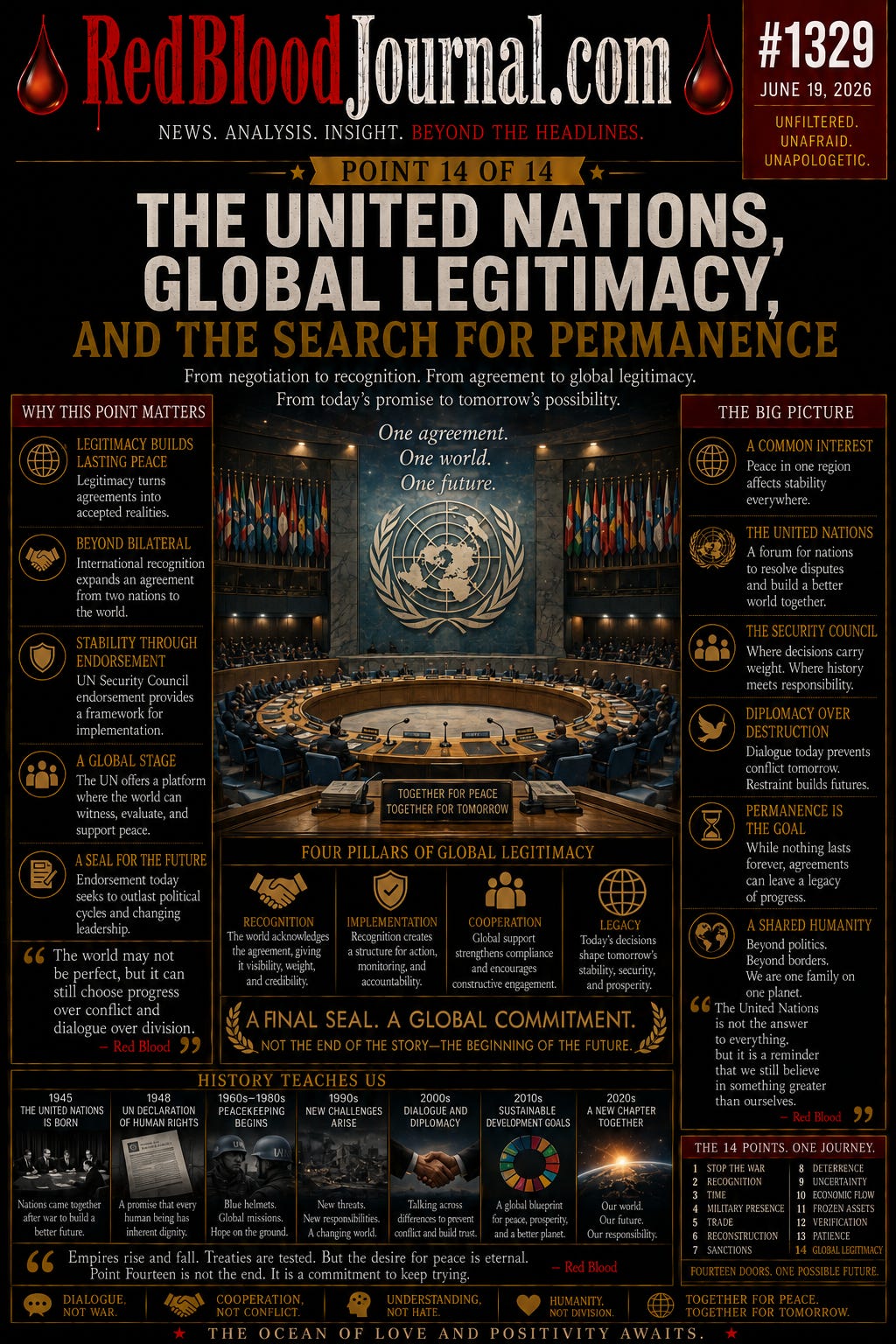
🩸 RedBloodJournal.com #1329 🩸
Point Fourteen:
The United Nations, Global Legitimacy, and the Search for Permanence
By Red Blood
The fourteenth and final point of the reported fourteen-point agreement may be the most symbolic of them all.
According to reports describing the framework, the completed agreement would ultimately be endorsed through the United Nations Security Council, providing international recognition and legal standing for its implementation.
At first glance, this appears procedural.
A formality.
A final signature.
A diplomatic stamp of approval.
Yet history suggests otherwise.
Because Point Fourteen is not really about paperwork.
It is about legitimacy.
And legitimacy has always been one of the most powerful forms of authority in human civilization.
The Difference Between Power and Legitimacy
Power can compel action.
Legitimacy encourages acceptance.
Power says:
“You must.”
Legitimacy says:
“You should.”
History shows that powerful institutions often seek legitimacy because power alone is expensive to maintain.
Military power requires resources.
Economic power requires resources.
Political power requires resources.
Legitimacy reduces those costs.
When people accept a system as legitimate, compliance becomes easier.
Point Fourteen enters this territory.
The Search for a Larger Stage
Throughout history, agreements between rivals have often sought recognition beyond the participants themselves.
Witnesses.
Observers.
International bodies.
Treaties are frequently strengthened when others acknowledge them.
The reasoning is simple.
A bilateral agreement affects two parties.
An internationally recognized agreement affects the broader system.
Point Fourteen attempts to move the agreement from a regional issue toward a global framework.
The Symbolism of the United Nations
Since the end of the Second World War, the United Nations has occupied a unique position.
Supporters see it as a forum for cooperation.
Critics see it as a stage where major powers pursue their interests.
Others see it as both.
Regardless of perspective, one reality remains.
Few organizations carry greater symbolic international recognition.
The United Nations functions as a meeting place for competing visions of the world.
Point Fourteen acknowledges that symbolism.
The Security Council Question
The Security Council occupies a special position within the international system.
Its resolutions carry weight.
Its structure reflects the realities of a particular historical era.
Supporters argue that Security Council endorsement provides stability and legitimacy.
Critics argue that it often reflects power rather than principle.
Both views have existed for decades.
Point Fourteen inevitably enters that debate.
Not because it resolves it.
But because it depends upon it.
The Desire for Permanence
Every agreement seeks permanence.
Every agreement fears impermanence.
Leaders understand that governments change.
Administrations change.
Policies change.
Public opinion changes.
What appears stable today may look different tomorrow.
International endorsement becomes attractive because it can outlast individual leaders.
Or at least attempt to.
Point Fourteen appears motivated by this desire.
The desire to anchor today’s agreement to something larger than today’s politics.
History’s Lesson
History offers a sobering lesson.
No agreement is truly permanent.
Not empires.
Not alliances.
Not constitutions.
Not treaties.
Not organizations.
Everything evolves.
Everything changes.
Everything adapts.
Yet agreements still matter.
Not because they last forever.
But because they shape the path forward.
The attempt itself influences history.
Even when the outcome changes.
The Global Audience
The first thirteen points primarily addressed the participants.
Point Fourteen addresses everyone else.
Markets.
Governments.
Institutions.
Investors.
Allies.
Adversaries.
Observers.
The message is simple:
This agreement seeks recognition beyond its signatories.
The audience expands from two nations to the entire international community.
The Final Seal
Ancient civilizations used seals.
Kings used seals.
Empires used seals.
Governments use seals.
The purpose has always been similar.
To signal authenticity.
To signal recognition.
To signal acceptance.
Point Fourteen functions as a modern version of that ancient tradition.
A final seal.
A final acknowledgment.
A final attempt to transform negotiation into recognized reality.
The Door Behind the Door
Perhaps Point Fourteen is not really about the United Nations.
Perhaps it is about humanity’s ongoing search for order.
The desire to create rules.
The desire to create stability.
The desire to create structures capable of managing conflict without violence.
Every generation inherits this challenge.
Every civilization attempts its own answer.
Point Fourteen reflects one modern attempt.
The Fourteen Doors
The journey began with war.
Point One asked whether the fighting could stop.
Point Two examined recognition.
Point Three introduced time.
Point Four addressed military presence.
Point Five explored trade.
Point Six considered reconstruction.
Point Seven examined sanctions.
Point Eight explored deterrence.
Point Nine confronted uncertainty.
Point Ten reopened economic flow.
Point Eleven released dormant capital.
Point Twelve focused on verification.
Point Thirteen required patience.
And Point Fourteen sought legitimacy.
Fourteen doors.
Fourteen questions.
Fourteen perspectives on a changing world.
Whether the agreement succeeds or fails remains a future story.
Whether it transforms the region or fades into history remains unknown.
But the appearance of the fourteen points has already provided something valuable.
An opportunity to observe.
To ask questions.
To look beneath headlines.
To examine the machinery that shapes the world around us.
And perhaps to remember that every agreement, every conflict, every empire, every institution, and every nation eventually becomes part of a larger story.
The waves rise.
The waves fall.
The names change.
The actors change.
The stages change.
Yet beyond every stage remains the same ocean.
The Ocean of Love and Positivity awaits.
Series Complete
#1315 — Introduction: The Fourteen Doors
#1316–#1329 — Points 1 through 14
#1330- Is the Trump–Netanyahu Rift Real or Staged?
Next: 🩸 RedBloodJournal.com #1331 🩸 — The Complete Fourteen-Point Agreement: Connecting All the Doors Into One Picture
🇺🇳 Point Fourteen:
The Seal of International Legitimacy
Jun 19, 2026
This text examines the fourteenth point of a complex peace proposal, focusing on the pursuit of global legitimacy through the United Nations.
By seeking a formal endorsement from the Security Council, the agreement aims to transition from a private regional pact to a recognized international framework.
The author argues that legitimacy is a strategic tool used to ensure permanence and lower the costs of maintaining power across changing political administrations.
This final step serves as a symbolic seal, attempting to anchor the deal in a global order that outlasts individual leaders.
Ultimately, the source portrays this point as a modern effort to establish stability and order within a historically volatile landscape.


