


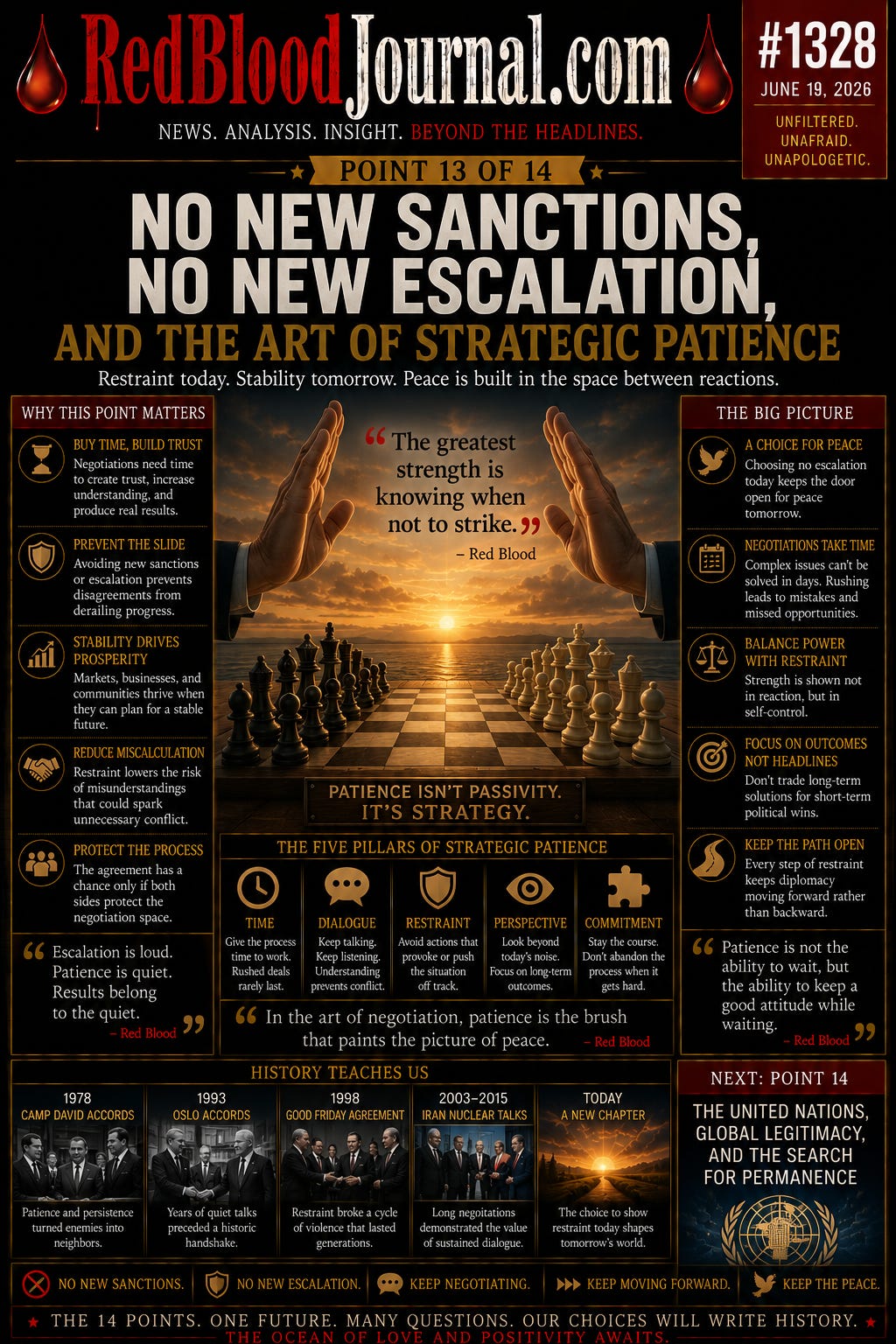
🩸 RedBloodJournal.com #1328 🩸
Point Thirteen:
No New Sanctions, No New Escalation, and the Art of Strategic Patience
By Red Blood
The thirteenth point of the reported fourteen-point agreement may appear less dramatic than the points surrounding it.
No new sanctions.
No additional escalation.
No major new pressure measures while negotiations continue.
Simple.
Brief.
Practical.
Yet history repeatedly demonstrates that restraint is often more difficult than action.
Starting a conflict can take a day.
Ending one can take decades.
Escalation is easy.
Patience is hard.
Point Thirteen is ultimately about patience.
And patience may be one of the rarest commodities in modern politics.
The Modern Demand for Immediate Results
Modern society operates at extraordinary speed.
News travels instantly.
Markets react instantly.
Opinions form instantly.
Governments feel pressure instantly.
The expectation of immediate results affects diplomacy just as much as everything else.
Yet negotiations do not move at internet speed.
Trust develops slowly.
Verification takes time.
Implementation requires coordination.
Major agreements are rarely completed overnight.
Point Thirteen recognizes this reality.
The Cooling-Off Period
Every successful negotiation contains a period of restraint.
A period where participants deliberately avoid actions that could undermine progress.
This principle appears everywhere.
Business mergers.
Labor negotiations.
Legal settlements.
International diplomacy.
The logic is simple.
If both sides continue escalating while negotiating, the negotiations become meaningless.
The pause creates space.
And space creates possibility.
The Escalation Trap
History contains countless examples of escalation traps.
One side responds.
The other side responds again.
Then another response follows.
And another.
Eventually the original issue becomes secondary.
The cycle itself becomes the problem.
Point Thirteen attempts to interrupt that cycle.
Not by solving every disagreement immediately.
But by preventing new disagreements from overwhelming existing negotiations.
The Discipline of Restraint
Restraint is often misunderstood as weakness.
History frequently suggests otherwise.
Restraint requires discipline.
Discipline requires confidence.
Confidence requires perspective.
The strongest actor is not always the one who reacts first.
Sometimes strength is demonstrated by understanding when not to react.
Point Thirteen reflects this possibility.
Not the absence of power.
The controlled use of power.
The Psychology of Waiting
Waiting creates discomfort.
Investors wait.
Governments wait.
Citizens wait.
Media organizations wait.
Everyone wants evidence that negotiations are producing results.
The temptation to force outcomes becomes powerful.
This is where many agreements fail.
Not because the goals were impossible.
But because participants lost patience before the process matured.
Point Thirteen addresses this challenge directly.
The Signal to Markets
Economic systems pay attention to stability.
Businesses planning investments need predictability.
Banks need predictability.
Supply chains need predictability.
Markets do not require perfection.
They require confidence that conditions will not deteriorate unexpectedly.
A commitment against new sanctions or escalation sends a signal.
The signal says:
“The environment may remain stable long enough for decisions to be made.”
Sometimes that signal becomes as valuable as the policy itself.
The Historical Pattern
Many major agreements succeeded because participants avoided actions that could destroy momentum.
Others failed because symbolic gestures became more important than practical progress.
History teaches an uncomfortable lesson.
Winning the headline and winning the negotiation are not always the same thing.
Point Thirteen appears designed to prioritize outcomes over appearances.
Whether that goal succeeds remains to be seen.
The Cost of Impatience
Impatience carries costs.
Economic costs.
Political costs.
Diplomatic costs.
Strategic costs.
Many opportunities disappear because participants demand immediate certainty.
Yet certainty is rarely available during transitions.
The future reveals itself gradually.
Not instantly.
Point Thirteen recognizes that uncertainty must sometimes be tolerated to achieve larger objectives.
The Door Behind the Door
Perhaps Point Thirteen is not really about sanctions.
Or escalation.
Or negotiations.
Perhaps it is about maturity.
The maturity to delay immediate reactions.
The maturity to think beyond today’s headlines.
The maturity to recognize that some goals require time.
Every civilization teaches patience differently.
Every generation struggles with it.
Every negotiation tests it.
Point Thirteen may ultimately be remembered as a test of patience more than a policy provision.
The first twelve points addressed war, recognition, time, presence, trade, reconstruction, sanctions, deterrence, uncertainty, economic flow, frozen assets, and verification.
Point Thirteen addresses restraint.
The ability to hold steady while a larger transition unfolds.
And that brings us to the final door.
Point Fourteen.
The point that attempts to transform promises into permanence.
Because every agreement eventually seeks legitimacy beyond the signatures themselves.
And Point Fourteen turns toward the international stage.
The United Nations.
The Security Council.
And the question of global recognition.
The Ocean of Love and Positivity awaits.
Next: 🩸 RedBloodJournal.com #1329 🩸 — Point Fourteen: The United Nations, Global Legitimacy, and the Search for Permanence
⏳ The Architecture of Strategic Patience
Jun 19, 2026
This text explores Point Thirteen, a specific provision in a fourteen-point international agreement that emphasizes the necessity of strategic restraint and patience.
The author argues that for successful diplomacy, parties must commit to a cooling-off period by avoiding new sanctions or escalations while negotiations are ongoing.
This pause is designed to prevent the escalation trap, where reactive measures overshadow the original goals of the peace process.
By prioritizing long-term stability over immediate political results, the agreement aims to foster a predictable environment for global markets and trade.
Ultimately, the source suggests that disciplined waiting is a sign of strength and maturity rather than weakness in modern politics.
The document serves as a transition to the final stage of the agreement, which focuses on seeking global legitimacy through international institutions.


