


🩸 RedBloodJournal.com #1327 🩸
Point Twelve:
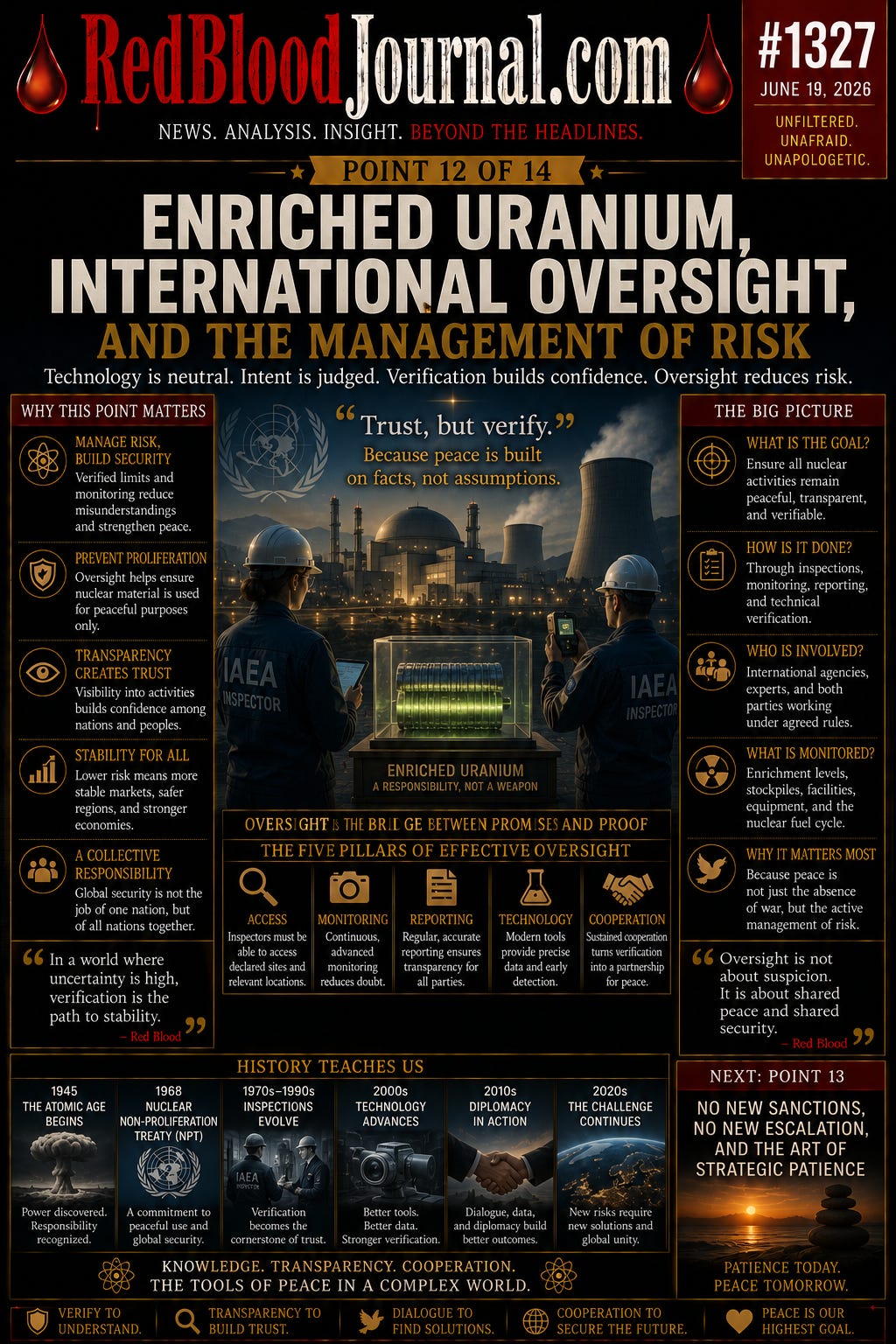
Enriched Uranium, International Oversight, and the Management of Risk
By Red Blood
The twelfth point of the reported fourteen-point agreement enters perhaps the most technical territory of the entire document.
Enriched uranium.
International monitoring.
Verification procedures.
Scientific measurements.
Inspection regimes.
For many readers, these subjects feel distant.
Complex.
Difficult to follow.
Yet beneath the technical language lies a simple question that has shaped international relations for generations:
How does the world manage risk?
According to reports describing the agreement, Point Twelve addresses Iran’s stockpile of highly enriched uranium through a process involving international oversight and negotiations regarding monitoring, disposition, storage, or downblending of material.
The language may sound scientific.
The implications are geopolitical.
The Atom and the World
Few discoveries altered history as dramatically as the atom.
What began as a scientific breakthrough eventually became a military reality.
Then a political reality.
Then a diplomatic reality.
Then a permanent feature of international relations.
The same technology that can generate electricity can also raise concerns about weaponization.
This dual nature has defined nuclear diplomacy for decades.
The technology itself is neither friend nor enemy.
The debate revolves around trust.
The Question of Enrichment
Most people hear the word uranium and immediately think of nuclear weapons.
The reality is more nuanced.
Uranium exists in different forms and different enrichment levels.
Some enrichment supports civilian energy programs.
Higher levels raise strategic concerns.
The disagreement has rarely centered on physics alone.
It centers on intention.
What is the material for?
Who controls it?
Who verifies its use?
How much trust exists between the parties involved?
These questions transform a technical subject into a political one.
The Verification Problem
International agreements often face the same challenge.
How do participants verify compliance?
Promises matter.
Verification matters more.
History demonstrates that trust without verification can become fragile.
Verification without trust can become confrontational.
Successful agreements attempt to balance both.
Point Twelve exists largely within this space.
Not merely asking whether commitments are made.
But whether commitments can be observed.
The Role of Inspectors
Modern diplomacy often relies upon institutions that operate between nations.
Inspectors.
Monitors.
Observers.
Technical experts.
Verification agencies.
Their role is unique.
They do not negotiate policy.
They measure compliance.
They provide information.
They reduce uncertainty.
In a world filled with competing narratives, independent measurement becomes valuable.
Point Twelve reflects this principle.
The Mathematics of Confidence
Confidence is not always built through speeches.
Sometimes it is built through measurements.
Records.
Reports.
Data.
Monitoring systems.
Scientific verification.
Numbers can reduce fear.
Not eliminate it.
But reduce it.
International oversight attempts to transform assumptions into observations.
The goal is simple.
Replace speculation with information.
The Challenge of Neutrality
Every verification system faces a difficult test.
Can it remain neutral?
Can it remain credible?
Can it remain trusted by all participants?
Institutions derive their effectiveness from confidence.
Once confidence disappears, their influence weakens.
This reality extends beyond nuclear agreements.
It applies to courts.
Banks.
Governments.
Media.
And international organizations.
Point Twelve quietly depends upon this principle.
The Human Dimension
Behind every technical discussion lies a human concern.
Security.
People want safety.
Nations want stability.
Leaders want predictability.
Citizens want confidence that tomorrow will be peaceful.
The technical details matter because they connect to these larger goals.
The uranium itself is only part of the story.
The larger story is risk management.
The effort to reduce uncertainty in an uncertain world.
The History of Oversight
Throughout history, societies developed systems to verify trust.
Weights and measures.
Audits.
Inspections.
Treaties.
Contracts.
Independent observers.
Every system emerged from the same realization.
Trust grows stronger when supported by transparency.
Point Twelve continues that tradition.
Applying an ancient principle to a modern challenge.
The Door Behind the Door
Perhaps Point Twelve is not really about uranium.
Perhaps it is about confidence.
The confidence that agreements can be monitored.
The confidence that risks can be managed.
The confidence that transparency may reduce fear.
Every civilization eventually confronts the same dilemma.
How much trust is enough?
How much verification is necessary?
How much uncertainty can be tolerated?
Point Twelve does not fully answer those questions.
But it attempts to create a framework for addressing them.
The first eleven points addressed war, recognition, time, presence, trade, reconstruction, sanctions, deterrence, uncertainty, economic flow, and frozen assets.
Point Twelve addresses verification.
The bridge between promises and proof.
And once verification enters the picture, another question naturally follows.
What happens during the transition period itself?
Because Point Thirteen concerns restraint.
Patience.
And the decision not to escalate while the future is still being negotiated.
The Ocean of Love and Positivity awaits.
Next: 🩸 RedBloodJournal.com #1328 — Point Thirteen: No New Sanctions, No New Escalation, and the Art of Strategic Patience
⚛️ Point Twelve:
The Bridge Between Promises and Proof
Jun 19, 2026
This text examines Point Twelve, a specific component of a broader fourteen-point international agreement centered on nuclear oversight and the management of geopolitical risk.
It explores how technical processes like uranium enrichment and scientific monitoring serve as essential tools for transforming fragile promises into verifiable proof.
The author emphasizes that transparency and independent inspections are the primary mechanisms used to bridge the gap between national mistrust and global stability.
By focusing on data-driven verification, the agreement aims to replace political speculation with objective information to ensure compliance.
Ultimately, the source argues that these rigorous oversight systems are less about physics and more about building the confidence necessary for long-term peace.


