


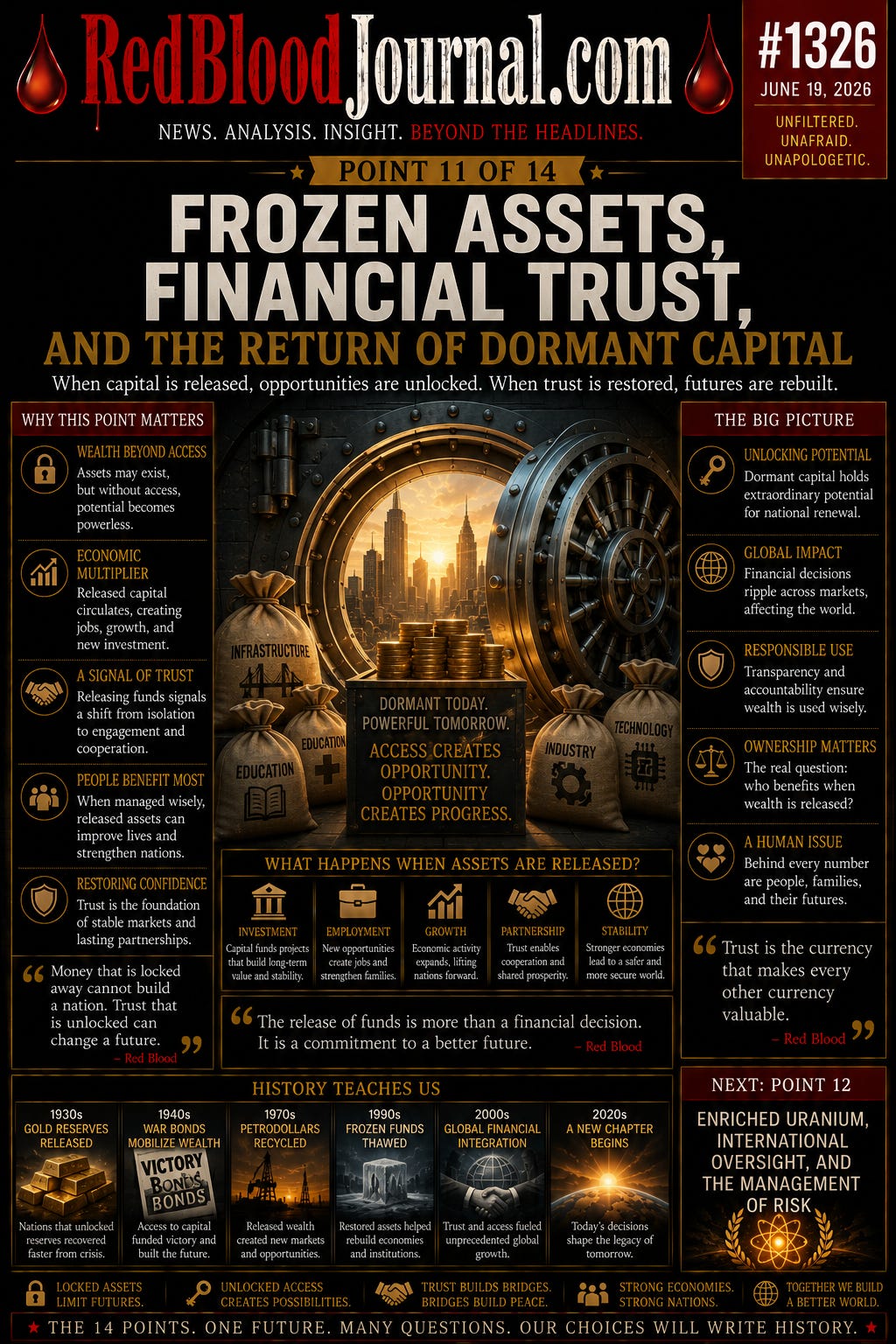
🩸 RedBloodJournal.com #1326 🩸
Point Eleven:
Frozen Assets, Financial Trust, and the Return of Dormant Capital
By Red Blood
The eleventh point of the reported fourteen-point agreement concerns a subject that rarely generates dramatic headlines.
Frozen assets.
Bank accounts.
Financial reserves.
Restricted capital.
Numbers on balance sheets.
At first glance, these may appear to be accounting issues.
Technical matters.
Administrative details.
Yet history demonstrates that money held still can influence events just as powerfully as money in motion.
According to the reported language, frozen Iranian funds would be released upon implementation of the agreement.
Simple words.
Enormous implications.
Because Point Eleven is ultimately about trust.
And trust may be the most valuable currency in the world.
The Meaning of Frozen Capital
Money is designed to move.
It circulates through economies.
It funds projects.
It supports trade.
It creates investment.
It finances growth.
When capital becomes frozen, its economic function changes.
The value still exists.
The potential still exists.
But the movement stops.
And when movement stops, opportunities often stop with it.
Point Eleven addresses the possibility of restoring movement.
The Difference Between Wealth and Access
Possessing wealth is not always the same as accessing wealth.
History contains countless examples.
Treasuries seized.
Accounts restricted.
Reserves blocked.
Property frozen.
Assets held in legal limbo.
The wealth exists.
Yet it cannot be utilized.
The distinction is critical.
Point Eleven is less about creating new wealth than about restoring access to existing wealth.
The Trust Equation
Financial systems operate on trust.
Banks trust counterparties.
Governments trust institutions.
Investors trust markets.
Businesses trust contracts.
Without trust, economic activity slows.
Without trust, risk premiums rise.
Without trust, capital seeks safety rather than opportunity.
The release of frozen assets sends a message.
Whether that message is believed depends on confidence.
Not merely agreements.
Confidence.
The Dormant Seed
Frozen capital resembles a dormant seed.
The potential exists.
The growth does not.
Once released, that capital can finance infrastructure.
Industry.
Technology.
Healthcare.
Education.
Energy.
Transportation.
Or it can be misallocated.
Wasted.
Lost.
History offers examples of both outcomes.
The release of capital creates opportunity.
It does not guarantee success.
The Question of Ownership
Who owns national wealth?
Governments?
Institutions?
Citizens?
Future generations?
The answer is often debated.
Yet every discussion involving frozen assets eventually reaches a deeper question.
Who should benefit when access is restored?
The answer frequently determines whether economic gains translate into broader prosperity.
Point Eleven quietly raises this issue.
The Psychology of Release
Economics is not merely mathematics.
It is psychology.
When frozen assets are released, markets notice.
Businesses notice.
Citizens notice.
Expectations begin to change.
Sometimes confidence returns before the money itself is spent.
Sometimes optimism becomes a force of its own.
Financial systems often move as much on belief as on balance sheets.
The Strategic Signal
The release of assets carries symbolic value.
It signals a shift.
A change in posture.
A willingness to move from restriction toward engagement.
Whether permanent or temporary, the signal matters.
International relations frequently operate through symbols.
Flags.
Visits.
Treaties.
Summits.
And financial decisions.
Point Eleven belongs to this category.
A financial action that communicates political intent.
The Hidden Multiplier
Every dollar released can circulate multiple times.
One investment creates another.
One project supports another.
One contract generates another.
Economists call this a multiplier effect.
History shows that capital rarely acts alone.
It attracts additional capital.
It creates networks.
It generates momentum.
The ultimate significance of Point Eleven may therefore extend far beyond the original amount released.
The Door Behind the Door
Perhaps Point Eleven is not truly about frozen assets.
Perhaps it is about confidence restored.
The belief that participation is once again possible.
The belief that the future may be different from the past.
The belief that dormant opportunities can become active realities.
The first ten points addressed war, recognition, time, presence, trade, reconstruction, sanctions, deterrence, uncertainty, and economic flow.
Point Eleven addresses dormant wealth.
The resources waiting behind locked doors.
And once those doors begin opening, attention naturally shifts to another question.
What happens to the nuclear material itself?
Because Point Twelve addresses enriched uranium, international oversight, and one of the most technically complex issues in the entire agreement.
The Ocean of Love and Positivity awaits.
Next: 🩸 RedBloodJournal.com #1327 — Point Twelve: Enriched Uranium, International Oversight, and the Management of Risk
🔓 Point Eleven:
The Restoration of Dormant Capital
Jun 19, 2026
The provided text analyzes Point Eleven of a multi-part international agreement, focusing specifically on the restoration of frozen Iranian assets.
The author argues that releasing these dormant funds is less about creating new wealth and more about reestablishing financial trust and diplomatic engagement.
By unlocking restricted capital, the agreement aims to transition from a period of economic stagnation to one of active investment and infrastructure growth.
This shift acts as a strategic signal, suggesting that the psychological impact on global markets is as significant as the liquid currency itself.
Ultimately, the source frames the return of these reserves as a multiplier for opportunity, setting the stage for subsequent discussions regarding nuclear oversight.


