


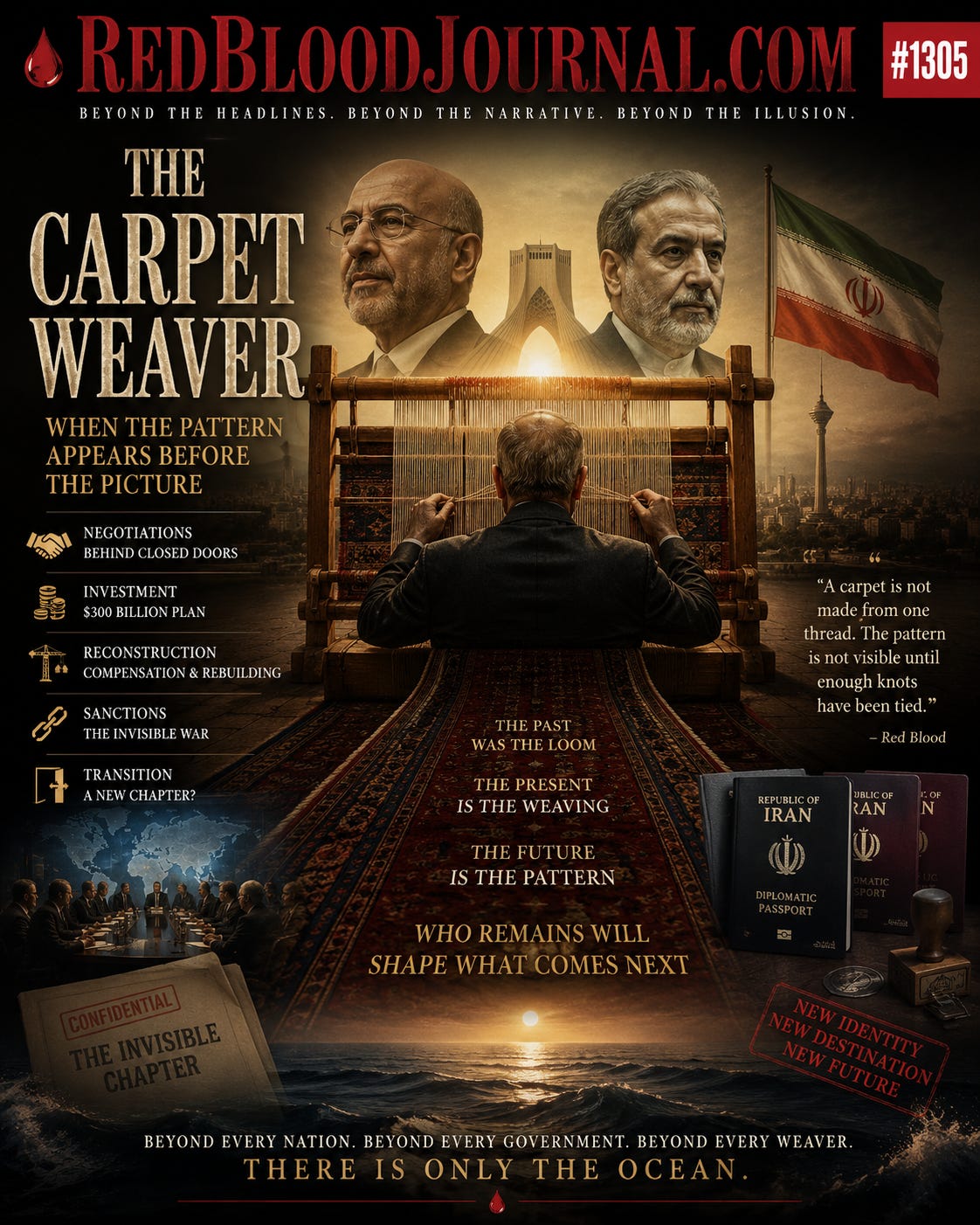
🩸 RedBloodJournal.com #1305
The Carpet Weaver
When the Pattern Appears Before the Picture
By Red Blood
History often speaks in symbols.
Most people notice them only after the story has ended.
When the Roman Empire fell, people looked backward and saw the signs.
When monarchies collapsed, people looked backward and saw the signs.
When governments changed, revolutions emerged, and political systems transformed, the pattern only became visible after enough time had passed.
During the event itself, people see only fragments.
Individual headlines.
Individual speeches.
Individual crises.
Individual actors.
The larger picture remains hidden.
Like a carpet still being woven.
The Name
In Persian, the surname Ghalibaf means “carpet weaver.”
A carpet weaver does not reveal the final design on the first day.
The observer standing beside the loom sees only knots.
Red thread.
Blue thread.
Black thread.
White thread.
Nothing appears connected.
Nothing appears meaningful.
The pattern exists long before it becomes visible.
Looking at the Knots
Recent events have created a situation where many observers are attempting to understand what is truly happening beneath the surface.
Military actions.
Political negotiations.
Economic discussions.
Reconstruction plans.
Investment proposals.
Diplomatic positioning.
Public statements.
Private meetings.
Each appears to be its own separate event.
Yet history teaches that major transformations rarely happen through a single event.
They emerge from many connected threads.
The Question Nobody Wants to Ask
Whenever power structures experience significant disruption, a question eventually emerges.
Who was removed?
Who remained?
And perhaps most importantly:
Who benefits from what comes next?
History contains many examples where the visible conflict captured public attention while the real transition occurred quietly in the background.
The public focused on the explosion.
The architects focused on the blueprint.
The public focused on the actors.
The architects focused on the next act.
The Survivors
Looking at the current landscape, many observers have noticed something curious.
The upper layers of Iran’s governing structure have faced extraordinary pressure.
Yet certain figures remain positioned near the center of events.
This observation has generated considerable speculation.
Some believe recent developments are exactly what they appear to be.
Others suspect that a broader restructuring process may be unfolding behind the visible headlines.
Among the names frequently mentioned is Mohammad Bagher Ghalibaf.
Another is the foreign ministry leadership that continues to operate at the center of diplomatic discussions.
For some observers, this raises an intriguing possibility.
If major political change eventually occurs, are today’s surviving figures simply participants?
Or are they potential custodians of whatever emerges next?
No one knows.
At least not publicly.
The Invisible Chapter
Every political transformation contains two stories.
The visible story.
And the invisible story.
The visible story fills newspapers.
The invisible story fills history books years later.
The visible story tells the public what happened.
The invisible story explains why it happened.
Most people spend their lives watching the visible story.
A smaller number spend their lives searching for the invisible one.
The Carpet
Perhaps nothing unusual is happening.
Perhaps events are unfolding exactly as they appear.
Or perhaps future historians will eventually look backward and discover that many threads were connected long before the public recognized the design.
The negotiation connected to the investment.
The investment connected to the reconstruction.
The reconstruction connected to the political transition.
The political transition connected to an entirely new chapter.
The knots already existed.
Only the pattern was missing.
The Ocean
Human beings often become obsessed with individual threads.
One politician.
One government.
One ideology.
One nation.
One conflict.
One victory.
One defeat.
Yet every thread belongs to the same carpet.
And every carpet is woven from fibers that ultimately came from the same source.
The wise observer studies the pattern without becoming trapped inside it.
For beyond every government, every revolution, every transition, every leader, and every weaver, there remains the same ocean that existed before the first knot was tied.
The drops argue over the design.
The ocean already sees the whole carpet.
And perhaps that is the greatest lesson of all.
Not to become attached to the knots.
But to remember the ocean from which every thread emerged.
🕸️ The Carpet Weaver and the Pattern of Power
Jun 17, 2026
The provided text utilizes the metaphor of a carpet weaver to examine how major political shifts and historical transformations often remain hidden until they are complete.
It suggests that while the public focuses on isolated headlines and crises, a deeper, calculated blueprint may be unfolding behind the scenes regarding Iran’s future leadership.
By highlighting surviving figures like Mohammad Bagher Ghalibaf, the author explores whether these individuals are merely participants or the intended architects of a new power structure.
This perspective encourages observers to look past the visible chaos of conflict to identify the underlying threads of economic and diplomatic restructuring.
Ultimately, the source argues that history is a pre-designed pattern where the true meaning only becomes clear once the weaving is finished.


