


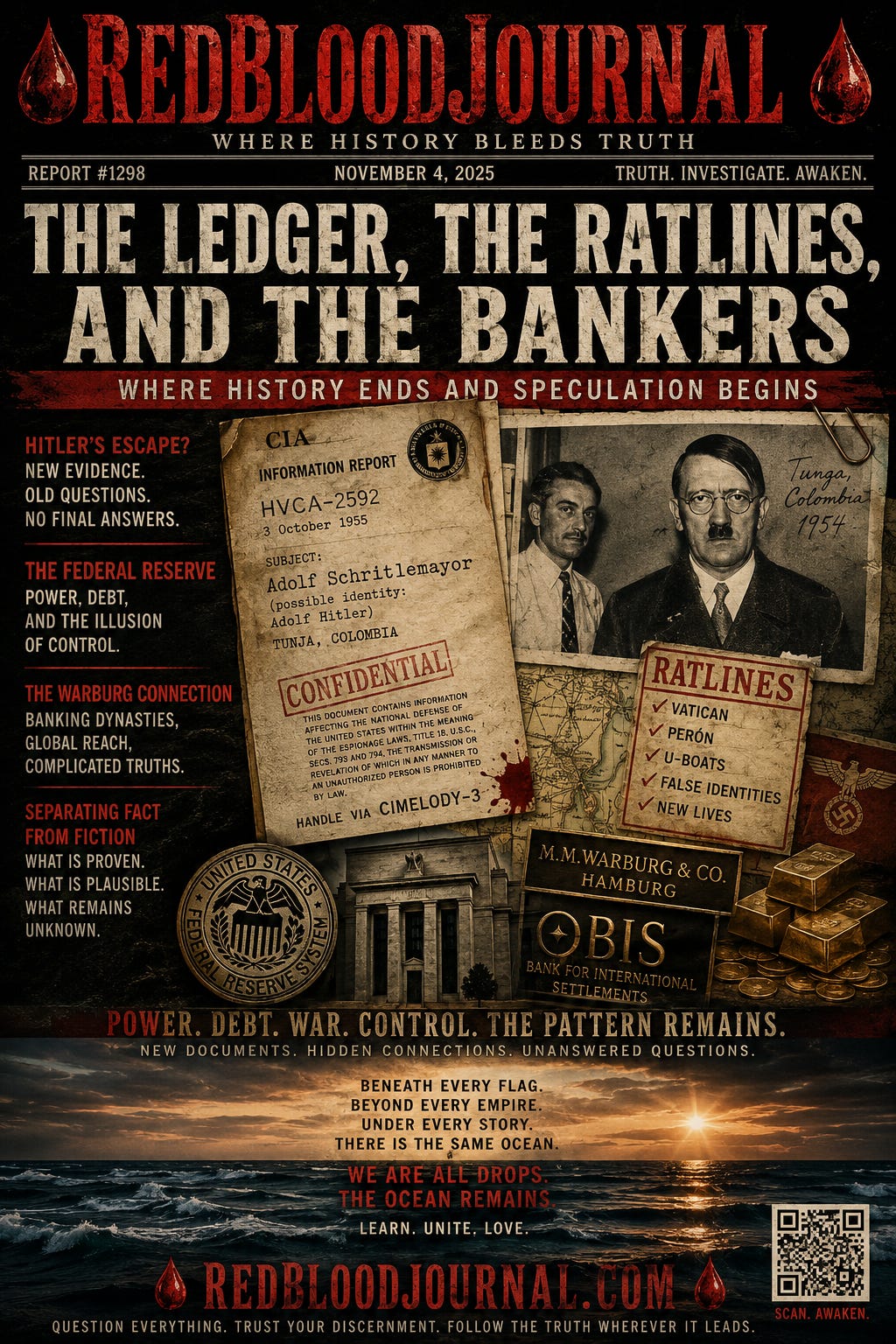
🩸 Red Blood Journal Report #1298
The Ledger, The Ratlines, and the Bankers
Where History Ends and Speculation Begins
By 🩸 RedBloodJournal.com Intelligence Desk
For decades, researchers, journalists, historians, and conspiracy investigators have chased one of the most enduring questions of the twentieth century:
Did Adolf Hitler really die in Berlin in 1945, or did he escape through the ratlines that carried thousands of Nazi officials into South America?
The answer depends largely on where one chooses to place the line between documented history and unanswered questions.
What is beyond dispute is that Nazi escape networks existed.
High-ranking Nazis escaped Europe after the war.
False identities were used.
Sympathetic governments provided refuge.
The Vatican ratlines have been documented.
Argentina under Perón accepted former Nazis.
Figures such as Adolf Eichmann and Josef Mengele successfully disappeared for years.
These are historical facts.
The debate begins when Adolf Hitler himself enters the conversation.
In recent years, declassified intelligence files have resurfaced showing that American intelligence agencies received reports from individuals claiming Hitler survived the war and was living in South America under assumed identities.
The existence of these reports is real.
The reports themselves are real.
What remains uncertain is whether the claims contained within them were true.
Many researchers point to the famous 1955 CIA memorandum describing a man in Colombia allegedly resembling Hitler.
Others view the document as simply another lead among thousands generated during the chaotic years following World War II.
The photograph exists.
The memo exists.
The conclusion remains disputed.
The Federal Reserve Question
Whenever discussions about hidden power emerge, attention often turns toward the Federal Reserve.
Created in 1913 after years of debate regarding banking reform, the Federal Reserve became one of the most influential financial institutions in the modern world.
Critics argue that central banking concentrates power into the hands of financial elites.
Supporters argue that modern economies could not function without a lender of last resort.
Both perspectives exist.
What is undeniable is that wars require financing.
Governments require debt.
Banks profit from lending.
This relationship has existed long before the Federal Reserve and continues today.
Whether one examines World War I, World War II, Vietnam, Iraq, Afghanistan, or the modern debt economy, a recurring question appears:
Who benefits from perpetual borrowing?
That question deserves examination regardless of political ideology.
The Warburg Connection
Paul Warburg played a major role in shaping the Federal Reserve system.
This is historical fact.
From there, many alternative researchers attempt to draw direct lines connecting the Warburg family, international banking, Germany, and the rise of Hitler.
The reality is more complicated.
History often resists simple explanations.
Families, corporations, governments, and financial institutions frequently operate across national boundaries.
During times of war, former business partners become enemies.
Former enemies become allies.
Economic interests often survive political revolutions.
The challenge for any researcher is distinguishing documented financial relationships from assumptions built upon those relationships.
The Conspiracy Problem
One of the greatest obstacles in investigating hidden power is that genuine conspiracies have existed throughout history.
Secret agreements happen.
Political corruption happens.
Intelligence agencies conduct covert operations.
Corporate collusion occurs.
Because these realities exist, many people become willing to accept every theory that follows.
That is where caution becomes essential.
The existence of unanswered questions does not automatically validate every answer offered.
The existence of secrecy does not automatically prove every allegation.
The existence of corruption does not automatically prove a global master plan.
The investigator’s responsibility is to separate:
What is proven.
What is plausible.
What is speculation.
And most importantly:
What remains unknown.
The Bigger Pattern
Perhaps the most valuable lesson is not whether Hitler escaped.
Perhaps it is not whether central bankers control governments.
Perhaps it is not whether intelligence agencies hide information.
The deeper lesson may be understanding how narratives themselves are created.
Every generation inherits stories.
Political stories.
Religious stories.
Economic stories.
Historical stories.
Most people choose a side and defend it.
Few step back and examine the entire theater.
The theater changes actors.
The stage remains.
New politicians arrive.
New parties arrive.
New slogans arrive.
The machinery continues.
The debt continues.
The conflicts continue.
The promises continue.
The public continues searching for the next savior.
Final Observation
Whether the hidden hand belongs to bankers, politicians, corporations, intelligence agencies, religious institutions, or some combination of all of them, the same question remains:
How much time should be spent looking outward compared to looking inward?
History is valuable.
Investigations are valuable.
Questions are valuable.
But eventually every seeker reaches the same crossroads.
One road leads to endless investigation.
The other leads inward.
Perhaps the greatest secret is not hidden inside a vault, a classified file, or a central bank ledger.
Perhaps the greatest secret is discovering that the search itself was always meant to bring attention back to the observer.
The world may continue debating empires, conspiracies, presidents, kings, bankers, and dictators.
Yet beneath every flag, every ideology, every generation, and every conflict remains the same ocean.
An ocean that appears as billions of separate drops.
An ocean that forgets itself and remembers itself again.
An ocean of experience.
An ocean of learning.
An ocean of love and positivity.
🩸 RedBloodJournal.com
👁️ The Ledger the Ratlines and the Bankers
Jun 17, 2026
This text explores the blurred lines between documented history and speculative theories regarding global power structures.
It examines the verified existence of Nazi escape networks while questioning the unproven claims that Adolf Hitler survived the war through intelligence agency reports.
The narrative also analyzes the influence of the Federal Reserve and international banking families, highlighting how perpetual debt and war benefit financial elites.
Ultimately, the source encourages readers to distinguish between proven facts and plausible assumptions when investigating government secrets.
It concludes that while uncovering systemic corruption is important, the ultimate goal of such inquiry should be personal awareness and inner growth.
This overview suggests that historical conflicts are part of a repeating cycle of narratives that often obscure a deeper, more unified human experience.


