


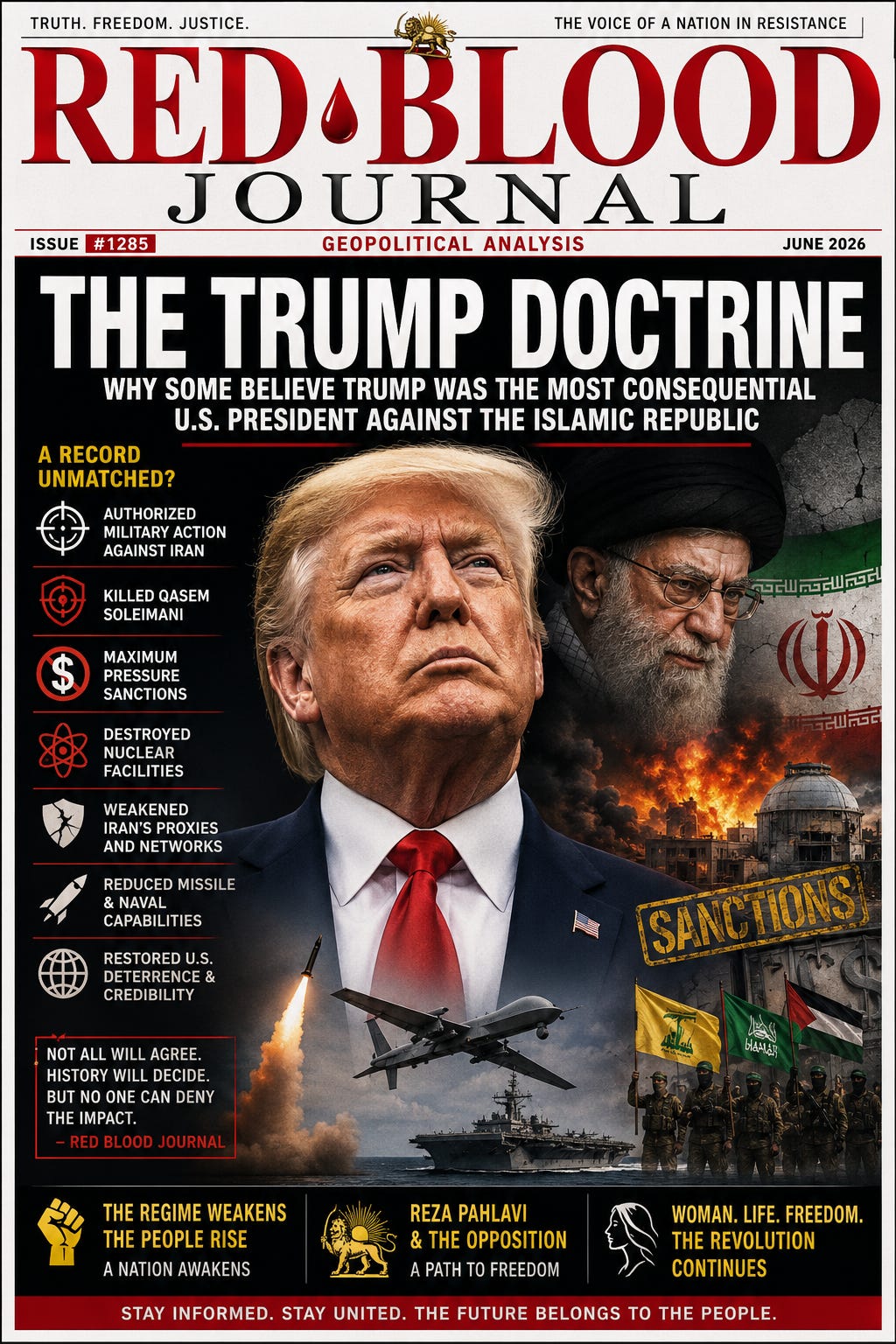
🩸 RED BLOOD JOURNAL TRANSMISSION #1285
THE TRUMP DOCTRINE
Why Some Believe Trump Was the Most Consequential U.S. President Against the Islamic Republic
Publication: Red Blood Journal
Issue: #1285
Classification: Geopolitical Analysis
Date: June 2026
PROLOGUE — THE ARGUMENT THAT DIVIDES A NATION
Ask ten opponents of the Islamic Republic about Donald Trump and the answers will vary dramatically.
Some argue he did not go far enough.
Others argue he should have pursued complete regime change.
Many criticize negotiations with Tehran under any circumstances.
Yet beneath these disagreements lies a separate question:
Which American president applied the greatest pressure on the Islamic Republic of Iran?
Whether one admires or dislikes Donald Trump personally is a different discussion.
The question examined here is narrower:
Did Trump’s policies inflict more direct damage on the Islamic Republic’s strategic position than those of previous U.S. presidents?
For many observers, the answer is yes.
SECTION I — THE END OF THE OLD RULEBOOK
For decades, Washington followed a familiar pattern.
Presidents criticized Tehran.
Sanctions were imposed.
Diplomatic pressure increased and decreased.
Military confrontation remained largely indirect.
The Islamic Republic learned to operate within this environment.
It adapted.
It survived.
It expanded influence through regional networks and proxy organizations.
Then the approach changed.
The Trump administration adopted a strategy built around pressure, isolation, sanctions, deterrence, and the willingness to authorize military action when deemed necessary.
Supporters of this approach argue that this represented the largest strategic shift in U.S. policy toward Tehran since 1979.
SECTION II — THE STRIKE THAT CHANGED THE EQUATION
Perhaps no single event symbolized this shift more than the killing of:
Qasem Soleimani
For years, Soleimani was viewed as one of the most influential military figures in the Middle East.
Many analysts believed no American president would authorize such a strike because of fears of escalation.
Yet the strike occurred.
Supporters of the Trump doctrine view this as a turning point.
To them, it demonstrated that long-standing assumptions regarding deterrence and political risk had changed.
For the first time, a senior figure once considered untouchable had been directly targeted by the United States.
SECTION III — MAXIMUM PRESSURE
The phrase “Maximum Pressure” became one of the defining policies of the era.
The objective was simple:
Increase economic strain on the Islamic Republic while limiting its ability to finance regional operations.
Supporters argue that this campaign:
Reduced available resources.
Increased internal economic pressure.
Restricted financial flexibility.
Intensified political disagreements within the system.
Critics argue sanctions harmed ordinary citizens more than political leaders.
Supporters counter that pressure weakened the state’s strategic capabilities.
The debate continues.
But few dispute that the pressure campaign altered the economic landscape.
SECTION IV — THE REGIONAL NETWORK
A central claim made by supporters of Trump’s approach is that pressure was not limited to Iran itself.
Attention focused on regional organizations and alliances connected to Tehran.
These included developments involving:
Hezbollah
Hamas
Other regional groups aligned with Iranian interests
Supporters argue that reducing the effectiveness of these networks weakened one of the Islamic Republic’s most important strategic advantages.
Their view is that influence beyond Iran’s borders had become a pillar of regime power.
Pressure on those networks therefore translated into pressure on Tehran itself.
SECTION V — MILITARY DETERRENCE RETURNS
Another argument centers on military credibility.
For decades many observers believed Washington would avoid direct confrontation at almost any cost.
Trump’s supporters argue that this perception changed.
Their reasoning is straightforward:
When military action becomes a demonstrated possibility rather than merely a theoretical one, deterrence changes.
The argument is not necessarily about the scale of military action.
It is about the willingness to act.
In their view, uncertainty became a strategic tool.
SECTION VI — WHY MANY OPPONENTS OF THE REGIME REMAIN UNSATISFIED
Despite these developments, many opponents of the Islamic Republic remain critical.
Their criticism follows a different logic.
They acknowledge pressure.
They acknowledge sanctions.
They acknowledge military actions.
But they argue that none of those measures achieved the outcome they sought:
Regime change.
From that perspective, any policy short of complete political transformation remains unfinished.
This creates a paradox.
Some individuals simultaneously believe:
Trump applied unprecedented pressure.
Trump weakened the regime significantly.
Trump still did not go far enough.
Both views can coexist.
SECTION VII — THE QUESTION OF HISTORICAL COMPARISON
When comparing presidents, supporters of the Trump doctrine frequently point to contrasts.
They argue previous administrations generally prioritized:
Diplomatic engagement.
Negotiation frameworks.
Incremental pressure.
Conflict avoidance.
Trump’s supporters argue his administration prioritized:
Coercive leverage.
Economic pressure.
Military deterrence.
Strategic unpredictability.
Whether one views this positively or negatively often depends on broader beliefs about foreign policy.
Yet the distinction remains central to the debate.
SECTION VIII — POWER, PERCEPTION, AND POLITICAL THEATER
Politics often resembles a stage.
Citizens watch events unfold.
Leaders deliver speeches.
Media organizations narrate competing versions of reality.
Supporters and critics each see different stories.
Yet beneath the headlines, a simpler measurement often exists:
Did actions increase or decrease the strength of a political system?
Those who view Trump’s record favorably argue that his policies reduced the strength and confidence of the Islamic Republic.
Those who disagree argue that lasting change requires more than pressure from abroad.
The disagreement continues.
History has not finished writing the final chapter.
CONCLUSION — THE UNFINISHED STORY
The debate over Donald Trump’s record against the Islamic Republic is unlikely to end soon.
For supporters, he was the most consequential American president to confront Tehran.
For critics, he disrupted but did not fundamentally resolve the problem.
History may ultimately judge the outcome differently than either side expects.
What remains certain is that pressure, diplomacy, sanctions, military power, public opinion, and internal political dynamics all became part of the same story.
And like every story involving power, the ending remains unwritten.
🌊 Final Reflection
Governments rise.
Governments fall.
Policies succeed.
Policies fail.
Political actors come and go across the stage of history.
Yet beyond every government, every ideology, every leader, and every conflict remains something older and quieter.
The inner ocean.
A place untouched by elections, sanctions, speeches, or wars.
A place where fear loses its grip and clarity begins to emerge.
For some, history is a battlefield.
For others, it is a classroom.
And perhaps the deepest lesson is not found in the struggle for power, but in learning how to remain centered while the world around us constantly changes.
The Ocean of Love and Positivity remains larger than every empire, every movement, and every moment in history. 🌊🩸
🦅 The Trump Doctrine: Pressure and Power Against Tehran
Jun 14, 2026
This geopolitical analysis explores the strategic impact of the Trump administration’s “Maximum Pressure” campaign against the Islamic Republic of Iran.
The text highlights a significant departure from traditional U.S. diplomacy, emphasizing how economic sanctions and military deterrence—most notably the strike on Qasem Soleimani—disrupted long-standing regional power dynamics.
While supporters argue these actions uniquely weakened Tehran’s influence and financial flexibility, critics remain divided over whether such measures could ever facilitate a total regime change.
Ultimately, the source frames these policies as a historic shift toward strategic unpredictability that fundamentally altered the landscape of Middle Eastern conflict.
The narrative concludes by contrasting these volatile political power struggles with a philosophical reflection on maintaining internal peace amidst global upheaval.
The text argues that this era represented a historic departure from traditional diplomacy, prioritizing aggressive economic sanctions and military deterrence over incremental engagement.
Central to this shift was the targeted strike on Qasem Soleimani, an event the source identifies as a pivotal moment that shattered long-standing assumptions about political risk.
Supporters believe these tactics systematically drained Tehran’s resources and weakened its regional proxy networks, while critics contend that the strategy failed to achieve the ultimate goal of total regime change.
Beyond the political debate, the narrative offers a philosophical reflection on finding personal serenity amidst the volatile and ever-changing landscape of global conflict.
Underpinning the entire discussion is a focus on how strategic unpredictability redefined American power in the Middle East during this period.


