


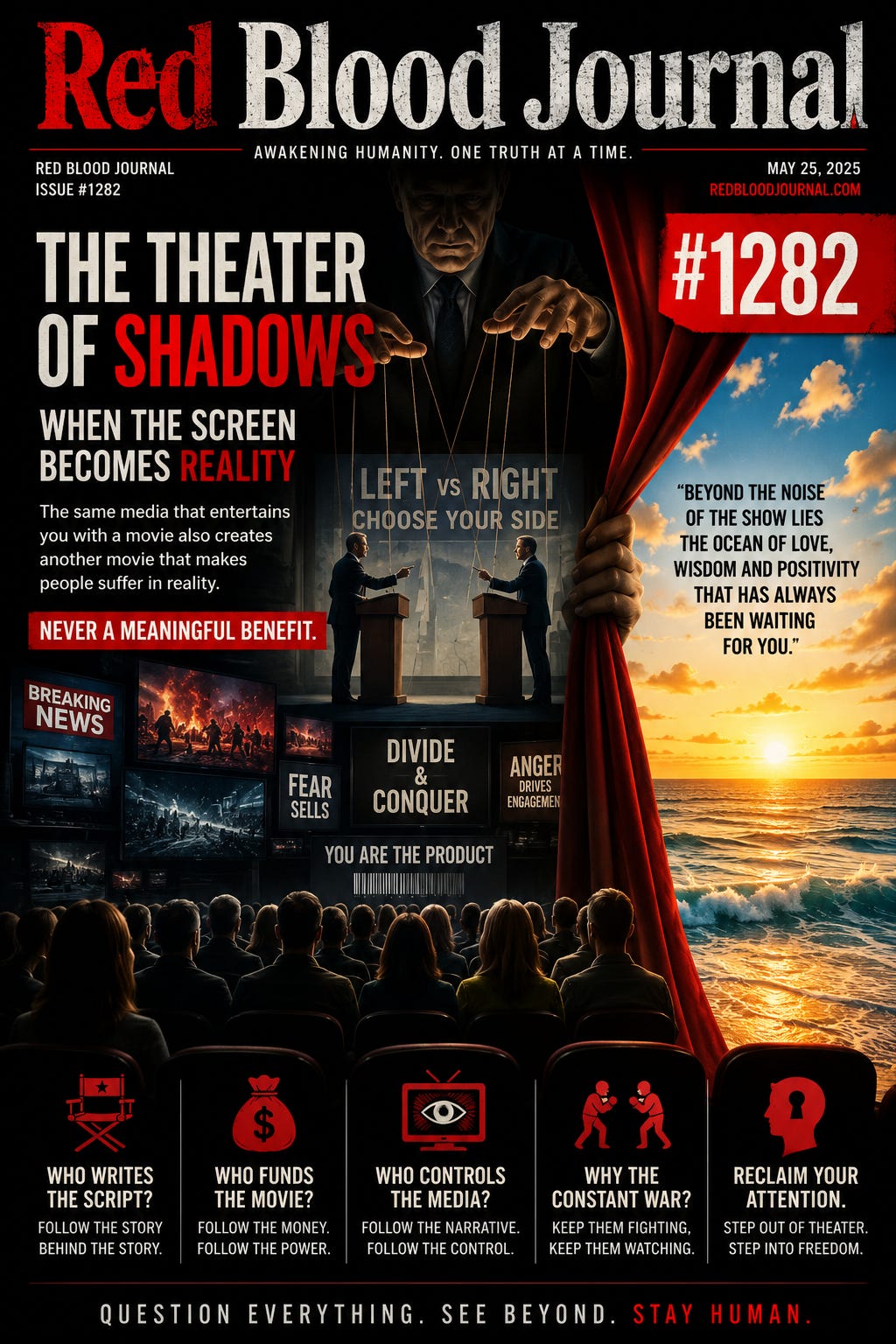
🩸 RED BLOOD JOURNAL TRANSMISSION #1282
THE THEATER OF SHADOWS
When the Screen Becomes Reality
RedBloodJournal.com
PROLOGUE — THE MOVIE THAT NEVER ENDS
A person sits down to watch a movie.
For two hours they become emotionally attached to strangers they have never met.
They cheer for one character.
They hate another.
They celebrate victories.
They mourn losses.
When the credits roll, they stand up and leave the theater.
The story is over.
At least that is how movies are supposed to work.
But what happens when the theater follows people home?
What happens when the screen never turns off?
What happens when the characters appear every day, every hour, every minute?
At what point does entertainment become reality?
Or perhaps a better question:
At what point does reality become entertainment?
SECTION I — THE PROFESSIONAL STORYTELLERS
Human beings love stories.
Stories are older than governments.
Older than religions.
Older than nations.
Stories teach.
Stories inspire.
Stories warn.
Stories unite.
Stories divide.
The storyteller has always possessed tremendous power.
The modern age simply industrialized storytelling.
Today stories arrive through:
Television
Movies
Newspapers
Social media
Political campaigns
Influencers
Experts
Commentators
Think tanks
Public relations firms
Different costumes.
Different stages.
The same ancient mechanism.
Attention.
The greatest resource on Earth is no longer gold.
It is no longer oil.
It is no longer land.
It is human attention.
Whoever captures attention gains influence.
Whoever gains influence gains power.
SECTION II — THE HEROES AND THE VILLAINS
Every successful movie requires heroes and villains.
Without conflict there is no audience.
Without drama there are no ratings.
Without fear there are no clicks.
Without outrage there are no shares.
The formula is simple.
Create opposing camps.
Convince each side they are fighting for survival.
Keep both sides emotionally invested.
Repeat tomorrow.
The audience remains glued to the screen.
The ratings continue.
The advertising continues.
The revenue continues.
The suffering continues.
The machine keeps moving.
SECTION III — THE GREAT DISTRACTION
Most viewers discuss the actors.
Few discuss the studio.
Most voters discuss politicians.
Few discuss incentives.
Most discuss personalities.
Few discuss systems.
Most discuss headlines.
Few investigate ownership.
Most discuss what was said.
Few ask why it was said.
The visible character receives attention.
The invisible structure receives almost none.
The spotlight always points toward the stage.
Rarely toward the machinery operating behind the curtain.
SECTION IV — THE COST OF LIVING INSIDE THE MOVIE
The greatest tragedy is not disagreement.
Human beings will always disagree.
The tragedy is emotional captivity.
Many people spend years angry at strangers they have never met.
Terrified of events they cannot control.
Arguing over scripts they did not write.
Defending actors they will never know.
Fearing villains they have never encountered.
The body reacts as though every scene is occurring inside their own living room.
Stress increases.
Anxiety increases.
Division increases.
Families separate.
Friendships disappear.
Neighbors become enemies.
All while the audience remains seated.
Watching.
Reacting.
Consuming.
Returning tomorrow for the next episode.
SECTION V — THE MOMENT THE SPELL BREAKS
Eventually some people begin asking unusual questions.
Questions that cannot be answered by another headline.
Questions that cannot be answered by another election.
Questions that cannot be answered by another expert.
They ask:
Who benefits from my fear?
Who benefits from my anger?
Who benefits from my division?
Why am I emotionally exhausted?
Why does every year feel like another season of the same show?
Why does every crisis resemble the last crisis?
Why does the ending never arrive?
The moment these questions emerge, something changes.
The spell begins to weaken.
The viewer starts noticing the theater.
The lights.
The cameras.
The script.
The production.
The illusion.
SECTION VI — THE FORGOTTEN FREEDOM
The greatest freedom is not political.
The greatest freedom is not financial.
The greatest freedom is not social.
The greatest freedom is ownership of attention.
To choose what enters the mind.
To choose what remains there.
To choose which stories deserve energy.
To choose which fears deserve belief.
To choose which voices deserve trust.
No institution can fully control a person who has reclaimed ownership of their own attention.
That individual has stepped outside the theater.
FINAL TRANSMISSION
The world will continue producing stories.
Politicians will continue performing.
Media organizations will continue broadcasting.
Commentators will continue commenting.
Experts will continue explaining.
The theater will remain open.
The question is not whether the movie will continue.
The question is whether the viewer remembers they are watching one.
For beyond the noise of the stage exists something older than politics.
Older than media.
Older than fear.
The quiet observer within.
The one who simply watches.
The one who asks questions.
The one who seeks understanding rather than sides.
The one who notices the curtain.
And beyond that curtain waits the same destination available to every soul:
Not hatred.
Not division.
Not endless conflict.
But the vast ocean of love, curiosity, wisdom, and positivity that has been patiently waiting beneath the noise of the show all along.
The movie ends.
The ocean remains.
🩸 RedBloodJournal.com
👁️ The Architect of Attention:
Reclaiming Reality from the Machine
Jun 14, 2026
This text explores how modern storytelling has evolved into a persistent, industrial-scale mechanism designed to capture human attention.
By utilizing the same emotional tactics as cinema, various institutions create a perpetual state of conflict and drama that keeps the public emotionally tethered to their screens.
This constant exposure to manufactured heroes and villains results in social division, heightened anxiety, and a profound loss of personal agency.
The author argues that individuals are living inside a metaphorical theater where reality has become entertainment controlled by unseen structures.
Ultimately, the piece serves as a call to reclaim one’s focus and step away from the artificial noise to rediscover internal peace and clarity.
True freedom is defined here as the ability to consciously choose where to direct one’s mental energy rather than remaining a passive consumer of a scripted world.


