


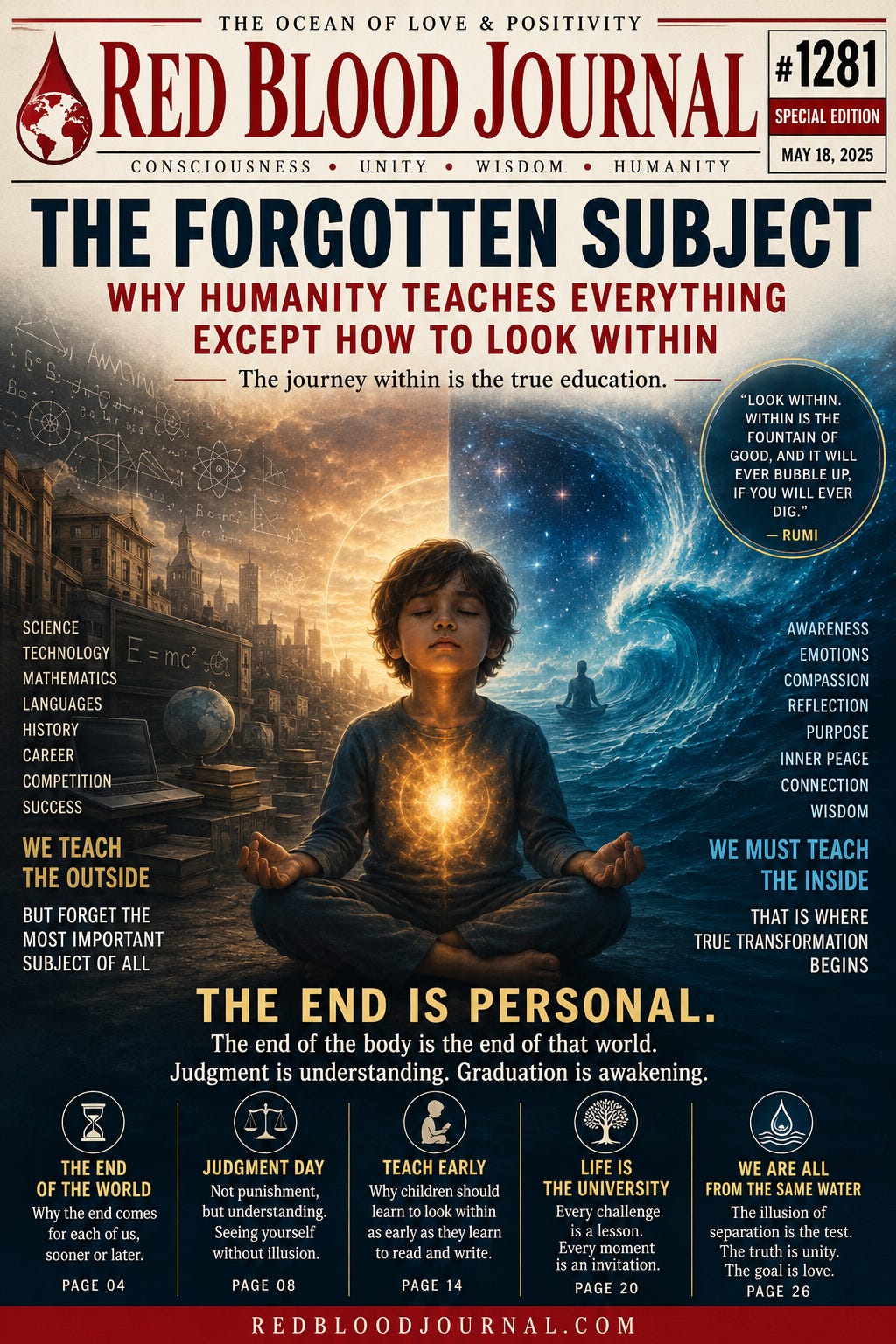
🩸 RED BLOOD JOURNAL TRANSMISSION #1281
THE FORGOTTEN SUBJECT
Why Humanity Teaches Everything Except How to Look Within
RedBloodJournal.com
PROLOGUE — THE QUESTION THAT CHANGES EVERYTHING
Humanity has built schools.
Humanity has built universities.
Humanity has built governments, religions, corporations, armies, laboratories, and technologies capable of reaching beyond the planet itself.
A child can graduate after decades of education knowing how to calculate the orbit of a satellite, how to write software, how to analyze financial markets, and how to navigate a world of increasing complexity.
Yet a simple question remains largely unanswered:
Who am I?
Not the name.
Not the passport.
Not the religion.
Not the political party.
Not the profession.
Not the labels.
The one looking through the eyes.
The one experiencing the journey.
The one occupying the temporary vehicle.
Human civilization spends enormous effort teaching children how to navigate the external world, while spending remarkably little effort teaching them how to navigate the internal one.
Perhaps the most important subject in the entire curriculum has become the forgotten subject.
SECTION I — THE EDUCATION OF THE OUTSIDE
From the moment a child enters school, attention is directed outward.
Learn the alphabet.
Learn mathematics.
Learn geography.
Learn science.
Learn history.
Learn a profession.
Learn how to compete.
Learn how to succeed.
Learn how to fit into society.
None of these subjects are wrong.
They are necessary.
A society cannot function without them.
Yet almost every civilization treats the inner world as secondary.
The external world becomes the priority.
The internal world becomes optional.
As years pass, many become experts in everything except themselves.
They can explain international politics.
They can explain economic theory.
They can explain the latest technology.
Yet they cannot explain why they are angry.
Why they are afraid.
Why they suffer.
Why they seek approval.
Why they feel empty despite achieving what they were told would make them happy.
SECTION II — THE GREAT REVERSAL
Most people spend their lives looking outward.
Few spend their lives looking inward.
The result is a remarkable paradox.
Humanity has mapped the oceans.
Humanity has mapped the skies.
Humanity has mapped the genome.
Humanity has mapped distant galaxies.
Yet the territory nearest to every human being remains largely unexplored.
The mind.
The consciousness.
The observer.
The self.
Perhaps the greatest mystery was never hidden in space.
Perhaps it was hidden behind the eyes.
SECTION III — THE DROP AND THE OCEAN
Many traditions throughout history have attempted to describe a similar realization.
A drop of water falls into the ocean.
At first it believes itself separate.
It occupies a different location.
It sees other drops.
It compares itself to other drops.
It competes with other drops.
It fears other drops.
It envies other drops.
Yet every drop is made of the same water.
The appearance of separation exists.
The essence remains connected.
Human beings may operate in a similar way.
The body creates boundaries.
The body creates distance.
The body creates individuality.
The body creates identity.
These divisions are useful for physical existence.
Yet they may also create the illusion that separation is the deepest truth.
What if separation is part of the lesson rather than the conclusion?
SECTION IV — THE END OF THE WORLD
Many religions speak of the end.
The final day.
The judgment.
The conclusion.
Entire civilizations have debated prophecies, timelines, signs, and predictions.
Yet there exists another interpretation.
A deeply personal interpretation.
For every human being who has ever lived, the world eventually ends.
Not necessarily the planet.
Not necessarily civilization.
But their world.
The vehicle reaches its destination.
The body completes its journey.
The chapter closes.
The end arrives.
For the individual, that moment is the end of the world they knew.
The ultimate deadline.
The final examination.
The graduation ceremony.
Every person who has ever lived has already encountered their own end of the world.
Every person alive today eventually will.
Every person yet to be born eventually will.
The event is universal.
The timing is uncertain.
The certainty is absolute.
SECTION V — JUDGMENT DAY
Perhaps judgment is not about punishment.
Perhaps judgment is understanding.
Looking back.
Reviewing.
Seeing clearly.
Recognizing what was learned.
Recognizing what was ignored.
Recognizing where fear ruled.
Recognizing where love prevailed.
The harshest judge may not be an external authority.
The harshest judge may be the self seeing itself clearly.
No excuses.
No politics.
No public relations.
No audience.
Only understanding.
Only truth.
Only awareness.
SECTION VI — WHY CHILDREN SHOULD LEARN EARLY
Learning almost anything becomes easier when introduced early.
Languages are a familiar example.
A child can absorb multiple languages with remarkable ease.
An adult often requires years of deliberate effort.
Perhaps inward awareness follows a similar principle.
Imagine a child taught from the beginning:
How to observe thoughts.
How to recognize emotions.
How to question assumptions.
How to sit quietly.
How to listen.
How to reflect.
How to understand fear.
How to understand anger.
How to understand compassion.
How to understand responsibility.
Not what to believe.
Not which religion to follow.
Not which philosophy is correct.
Simply how to observe.
How to investigate.
How to look inward.
Such a child may enter adulthood with tools many spend decades searching for.
SECTION VII — THE FORGOTTEN PHILOSOPHER
History remembers a few names.
Rumi.
Laozi.
Socrates.
Buddha.
Many others.
Society often treats them as extraordinary exceptions.
Yet perhaps their greatest contribution was not discovering something unavailable to others.
Perhaps they simply looked where most people never think to look.
Inside.
The same fears exist in everyone.
The same longing exists in everyone.
The same questions exist in everyone.
The same awareness observes through different eyes.
Books can point.
Teachers can point.
Philosophers can point.
Religions can point.
But pointing is not seeing.
Eventually every individual must look directly.
The map is not the territory.
The description is not the experience.
The finger pointing at the moon is not the moon.
SECTION VIII — THE UNIVERSITY OF LIFE
What if life itself is the university?
Every relationship a classroom.
Every challenge a lesson.
Every disappointment a teacher.
Every success a test.
Every loss a reminder.
Every fear an opportunity.
Every moment an invitation to learn.
Not merely how the world works.
But how the self works.
The curriculum is available to everyone.
The classroom never closes.
The lessons continue until the final day of attendance.
CONCLUSION — THE SUBJECT THAT MATTERS MOST
Perhaps humanity does not need less science.
Less technology.
Less knowledge.
Less progress.
Perhaps humanity simply needs to balance the outward journey with the inward one.
To understand the world while also understanding the observer.
To build better machines while also building greater wisdom.
To teach children how to navigate both the external universe and the internal one.
For one day every title will disappear.
Every possession will remain behind.
Every argument will end.
Every political movement will pass.
Every generation will hand the torch to another.
And the question that remains may be the same question that was present from the beginning:
Did the traveler learn why the journey was taken?
Until then, the classroom remains open.
The lesson continues.
The ocean waits patiently beneath every wave.
And every drop, sooner or later, remembers the water from which it came.
🩸 Red Blood Journal
RedBloodJournal.com
The Ocean of Love and Positivity remains open to all who choose to look within.
👁️ The Forgotten Subject:
Mapping the Inner Territory
Jun 14, 2026
This text explores the profound disparity between modern education, which prioritizes mastery of the external world, and the neglected study of the inner self.
It argues that while society teaches children to navigate complex systems and technologies, it fails to provide the tools necessary for emotional awareness and self-observation.
By utilizing the metaphor of a drop of water returning to the ocean, the author suggests that our perceived separation from one another is an illusion that can be overcome through introspection.
The narrative emphasizes that life serves as a continuous global classroom, where every challenge offers a lesson in understanding the “observer” behind the eyes.
Ultimately, the source advocates for a balanced curriculum that values internal wisdom as much as scientific progress to prepare individuals for the inevitable conclusion of their journeys.


