


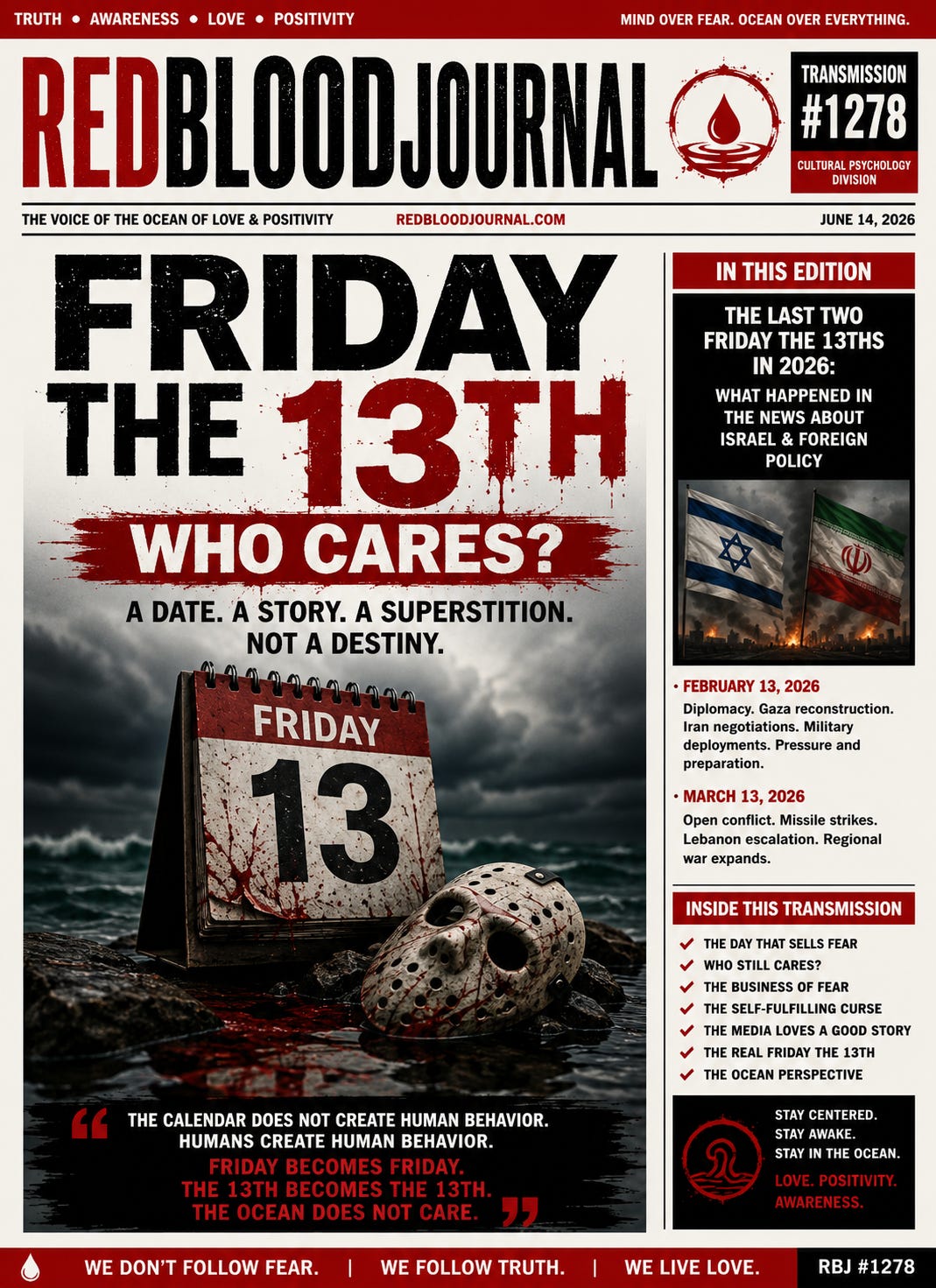
🩸 RED BLOOD JOURNAL TRANSMISSION #1278
FRIDAY THE 13TH — WHO CARES?
Archive Classification: Cultural Psychology Division
Transmission Code: RBJ-2026-FRIDAY13-1278
THE DAY THAT SELLS FEAR
Every year it arrives.
People talk about it.
News channels mention it.
Movies celebrate it.
Social media posts warn about it.
And yet for most people, it passes exactly like every other day.
Friday the 13th.
A date that somehow became famous enough to be recognized across much of the world, despite nobody being able to point to a single proven reason why it should matter. The superstition appears to have evolved from a mixture of religious traditions, folklore, myths, literature, and eventually Hollywood entertainment. Even historians admit the exact origin is uncertain.
The number 13 became associated with bad luck.
Friday became associated with misfortune.
Eventually the two were combined.
A story was born.
And stories are powerful.
WHO CARES?
The interesting question is not whether Friday the 13th is unlucky.
The interesting question is:
Who still cares?
A few hundred years ago people feared comets.
Before that they feared eclipses.
Before that they feared angry gods.
Today many fear a calendar square.
Human beings have always searched for signs in the sky, signs in numbers, signs in dates, signs in shadows.
The mind loves patterns.
Sometimes it sees patterns where none exist.
THE BUSINESS OF FEAR
For decades, reports have estimated that millions of people alter travel plans, postpone decisions, avoid investments, or simply become anxious on Friday the 13th. Some estimates have claimed large economic impacts because people avoid normal activities on the date.
Think about that.
A number on a calendar changes behavior.
Not because reality changed.
Not because gravity changed.
Not because the sun changed.
Because perception changed.
The mind created a movie.
The body reacted to the movie.
THE SELF-FULFILLING CURSE
When a person expects bad luck, they notice bad luck.
When they expect problems, they notice problems.
When they expect disaster, they search for disaster.
The broken coffee mug becomes evidence.
The flat tire becomes proof.
The late flight becomes confirmation.
The thousands of ordinary events that happened that same day disappear from memory.
The human mind is an excellent lawyer.
It will gather evidence for whatever story it already believes.
THE MEDIA LOVES A GOOD STORY
A headline that says:
“Nothing unusual happened today.”
Will never go viral.
A headline that says:
“Disaster strikes on Friday the 13th!”
Travels around the world.
Fear sells.
Drama sells.
Mystery sells.
The ordinary truth rarely sells.
The media understands this.
Hollywood understands this.
Politicians understand this.
Marketers understand this.
And so the story continues.
THE REAL FRIDAY THE 13TH
The last two Friday the 13ths of 2026 saw headlines involving wars, diplomacy, military movements, and geopolitical tensions.
Some people will point to those events and say:
“See? Friday the 13th is cursed.”
But wars also happen on Mondays.
Markets crash on Tuesdays.
Earthquakes happen on Wednesdays.
Politicians lie on Thursdays.
And people fall in love on Sundays.
The calendar does not create human behavior.
Humans create human behavior.
THE OCEAN PERSPECTIVE
From the viewpoint of the Ocean of Love and Positivity, Friday the 13th is simply another wave.
One wave is labeled lucky.
Another wave is labeled unlucky.
But the ocean itself does not care.
The ocean does not fear numbers.
The ocean does not fear dates.
The ocean does not fear headlines.
The ocean simply flows.
Those who spend their lives chasing lucky numbers and avoiding unlucky dates often miss the present moment entirely.
Those who look inward discover something remarkable:
The greatest source of fear was never Friday the 13th.
It was the stories they accepted without investigation.
When the mind becomes quiet, the calendar loses its power.
Friday becomes Friday.
The 13th becomes the 13th.
And the ocean continues to move beneath it all—calm, vast, and completely unconcerned with the numbers written on the shore. 🌊
RedBloodJournal.com
🗓️ The Calendar Movie:
Perception and the Friday the 13th Myth
Jun 14, 2026
This text examines the psychological and cultural phenomenon of Friday the 13th, arguing that its reputation for misfortune is a man-made construct rather than a reality.
The author highlights how a blend of folklore, media influence, and commercial interests sustains this superstition by exploiting the human tendency to seek patterns in random events.
Because people are prone to confirmation bias, they often perceive ordinary mishaps as proof of a curse while ignoring the countless positive occurrences that happen simultaneously.
The source suggests that this “business of fear” impacts global economics and individual behavior by manipulating perception through dramatic storytelling.
Ultimately, the narrative encourages a shift toward a mindful perspective, where dates are viewed as neutral and the power of the calendar is stripped away.
By rejecting these unsubstantiated stories, individuals can find peace in the present moment rather than living in fear of a mere number.


