


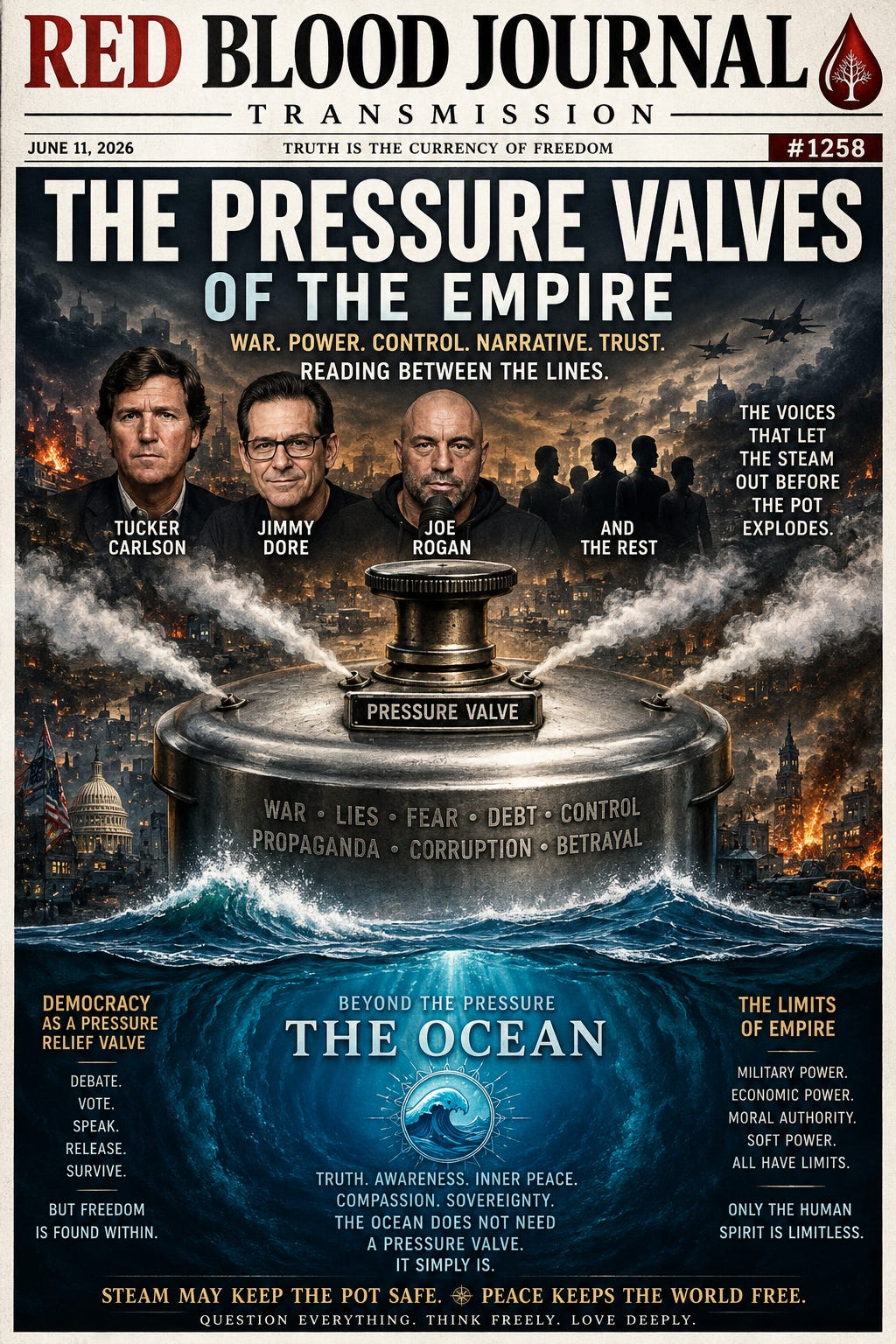
🩸 RED BLOOD JOURNAL TRANSMISSION #1258
THE PRESSURE VALVES OF THE EMPIRE
Reading Between the Lines of the Tucker Carlson Episode
Introduction
When a pressure cooker operates correctly, the steam does not disappear.
The steam is released slowly.
The valve allows pressure to escape.
Without the valve, the cooker eventually explodes.
Reading between the lines of Tucker Carlson’s June 2026 broadcast reveals something interesting.
The official subject is war.
The deeper subject is trust.
The deepest subject is pressure.
And perhaps the most important question is not what Tucker Carlson said.
It is why voices such as Tucker Carlson, Joe Rogan, Jimmy Dore, and others continue to be allowed to say it.
Subject 1: The Failure of the “Imminent Deal”
The episode begins by highlighting repeated announcements that a deal with Iran was supposedly close, only for military escalation to continue instead.
Reading Between the Lines
The criticism is not merely directed at diplomacy.
The criticism is directed at credibility.
When promises repeatedly fail to match reality, trust begins to erode.
The audience is not simply questioning the deal.
The audience begins questioning the messenger.
Subject 2: The Limits of Military Power
The program argues that despite enormous military expenditures, objectives remain unfulfilled and strategic outcomes are not always controllable.
Reading Between the Lines
The modern empire is discovering something every empire eventually learns:
Power is not unlimited.
Money is not unlimited.
Force is not unlimited.
Narratives often promise certainty.
Reality rarely delivers it.
Subject 3: The Limits of Economic Power
The episode spends significant time discussing globalization and the interconnected nature of energy markets and supply chains.
Reading Between the Lines
For decades the public was told:
“We are independent.”
The episode argues something different:
“We are interconnected.”
The deeper realization is not about oil.
It is about dependence.
The world has become one giant machine.
When one gear shakes, every gear shakes.
Subject 4: The Limits of Moral Authority
A major section focuses on whether nations maintain moral credibility when actions and principles appear inconsistent.
Reading Between the Lines
People can tolerate mistakes.
What they struggle to tolerate is hypocrisy.
The public often forgives failure.
It rarely forgives double standards.
When actions and stated values separate too far from each other, faith begins to weaken.
Subject 5: Sovereignty and Control
The episode repeatedly raises the question of who truly directs policy and whether elected officials possess full authority over major decisions.
Reading Between the Lines
This is perhaps the emotional center of the entire broadcast.
Not war.
Not Iran.
Not Israel.
Control.
The fear being expressed is that ordinary citizens may begin believing their participation no longer matters.
Whether that perception is accurate or not is secondary.
Perception itself becomes political reality.
Subject 6: Democracy as a Pressure Valve
One of the most revealing moments occurs when the episode describes elections as a “pressure relief valve.”
Reading Between the Lines
This may be the key to understanding the entire show.
Every society generates pressure.
Economic pressure.
Political pressure.
Psychological pressure.
Spiritual pressure.
If no outlet exists, the pressure accumulates.
Historically that pressure eventually erupts.
Debate serves as a release mechanism.
Voting serves as a release mechanism.
Free speech serves as a release mechanism.
And perhaps modern alternative media serves as a release mechanism.
Subject 7: The Alternative Media Phenomenon
This is where the episode becomes most interesting.
Because Tucker Carlson is not alone.
There is Joe Rogan.
There is Jimmy Dore.
There are independent journalists.
There are thousands of online commentators.
Reading Between the Lines
One interpretation is that these voices are exposing hidden truths.
Another interpretation is that they are performing a social function.
A pressure valve function.
People become frustrated.
The frustration is expressed.
The steam escapes.
The cooker continues operating.
The audience feels heard.
The pressure drops.
The system survives another day.
Whether intentional or not, the effect is similar.
The steam leaves the pot.
The pot remains intact.
Subject 8: The Great Irony
The episode repeatedly returns to the idea that actions often create the opposite outcome of what was intended.
Reading Between the Lines
History is filled with unintended consequences.
Attempts to create stability create instability.
Attempts to create control create resistance.
Attempts to silence criticism create louder criticism.
Attempts to create fear create curiosity.
Attempts to create division sometimes create unity.
The opposite often emerges.
The Ocean Beyond the Pressure
Now comes the most important observation.
A pressure valve is useful.
But it is still part of the pressure cooker.
The valve does not leave the machine.
It simply regulates it.
The deeper journey begins when individuals stop staring at the pressure cooker altogether.
When attention turns inward.
When fear loses its grip.
When outrage loses its addiction.
When political actors become actors on a stage rather than masters of the mind.
The greatest threat to any system built upon pressure is not rebellion.
It is peace.
Not passive peace.
Inner peace.
The person who no longer reacts automatically.
The person who observes without hatred.
The person who refuses to surrender their mind to fear.
That person is no longer steam inside the cooker.
That person has become the ocean.
And the ocean does not need a pressure valve.
The ocean simply remains the ocean.
Calm beneath the storms.
Patient beneath the waves.
Watching the ships pass overhead while knowing that every storm eventually ends.
And when enough people discover that ocean within themselves, the world does not become weaker.
It becomes stronger.
Because fear may create obedience.
But only understanding creates peace.
🌊 Ocean of Love Closing
The loudest voices may argue over nations.
The headlines may argue over wars.
The politicians may argue over power.
But beneath all of it remains something greater.
A quiet ocean inside every human being.
The day enough people discover that ocean, the pressure begins to disappear on its own.
And what remains is not fear.
Not anger.
Not division.
Only understanding, compassion, and the realization that humanity shares the same water, the same sky, and ultimately the same ocean. 🌊
🌊 The Pressure Valves of the Empire
Jun 10, 2026
This text analyzes the sociopolitical function of alternative media voices and public dissent through the metaphor of a pressure valve.
It suggests that figures like Tucker Carlson and Joe Rogan serve as necessary outlets for public frustration, allowing citizens to feel heard so that the larger political system avoids a total explosion.
By examining themes of eroding trust, the limits of imperial power, and the hypocrisy of moral authority, the author argues that modern narratives often mask a deeper crisis of institutional control.
Ultimately, the source posits that true liberation from this cycle comes not from political rebellion, but from an internal shift toward peace and psychological independence.
This transition from “steam” to “ocean” represents a move away from reactive outrage toward a state of calm, conscious understanding that transcends the machinery of the state.


