


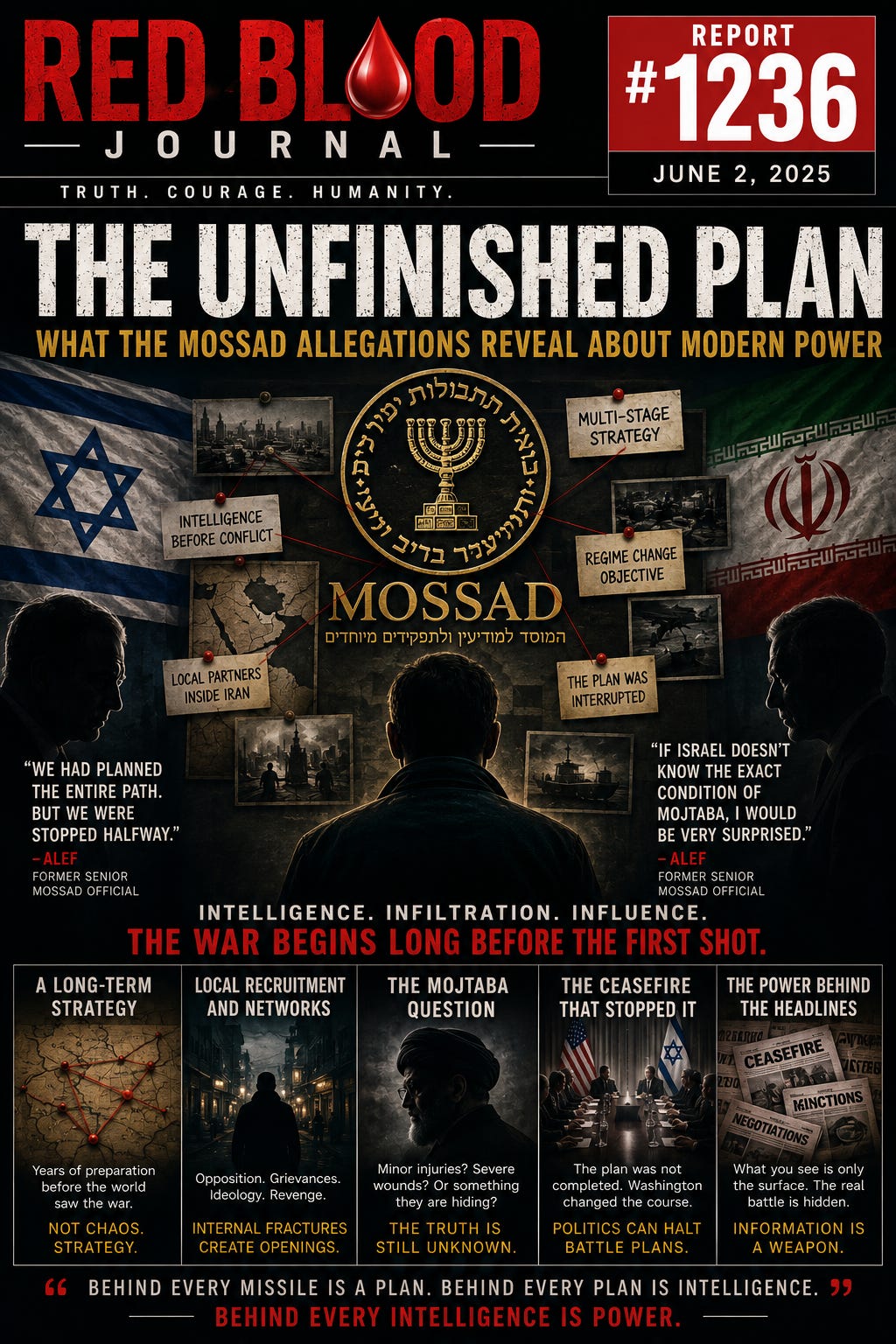
🩸 RED BLOOD JOURNAL
#1236
THE UNFINISHED PLAN
What the Mossad Allegations Reveal About Modern Power
Executive Summary
Wars are often remembered through bombs, missiles, and battlefields.
The real story, however, is frequently found behind the battlefield.
Long before soldiers move, intelligence agencies gather information.
Long before governments fall, networks are established.
Long before the public hears about a conflict, plans may already exist.
Recent allegations attributed to a former senior Mossad official have reopened a question that has followed nearly every major geopolitical confrontation of the modern era:
How much of what the public sees is only the final stage of a much larger operation?
Whether the claims are ultimately proven true or false, they reveal something important about the nature of power in the twenty-first century.
The Alleged Plan
According to reports cited in the source material, a former senior Mossad official identified only by the alias “Alef” described what he claimed was a long-term, multi-stage strategy directed at weakening and eventually replacing the government of Iran.
The alleged plan was described as gradual rather than sudden.
Strategic rather than emotional.
Measured rather than chaotic.
According to the claims, years of preparation had already taken place before military operations ever became visible.
The objective was not simply military victory.
The objective was political transformation.
Intelligence Before Conflict
Throughout history, intelligence services have understood a simple reality:
Information is often more powerful than weapons.
A missile can destroy a building.
Information can reshape a nation.
The allegations suggest that extensive intelligence gathering, recruitment, operational preparation, and local partnerships were developed long before open confrontation emerged.
If true, this would reflect a strategy commonly seen throughout modern history:
The battlefield becomes merely the final chapter of a much longer story.
The Local Factor
Perhaps the most significant claim involves the role of local participants.
According to the former official, opposition to the government, personal grievances, and social frustrations created an environment where some individuals became willing to cooperate with foreign intelligence efforts.
Whether these claims are accurate or exaggerated, they highlight a recurring lesson of history.
External forces rarely succeed alone.
Major political change generally requires internal fractures before outside influence can become effective.
No intelligence agency, regardless of its capabilities, can permanently reshape a society without local support.
The Mojtaba Question
One of the most intriguing portions of the report concerns Mojtaba Khamenei.
Conflicting accounts emerged regarding his condition following reported attacks.
One version described only minor injuries.
Another suggested far more serious wounds.
His limited public visibility created a vacuum that quickly filled with speculation.
The former Mossad official reportedly stated that he would be surprised if Israel did not know exactly what condition Mojtaba was in.
Whether that statement reflects confidence or intelligence capability, it reinforces the perception that information has become a strategic weapon.
The uncertainty itself becomes part of the battle.
The Ceasefire That Changed Everything
Perhaps the most important allegation is that the plan was not completed.
According to the former official, the operation was interrupted when the United States chose to halt military escalation and move toward a ceasefire.
This claim presents an interesting perspective on modern alliances.
Even powerful intelligence services operate within larger political realities.
Military objectives.
Intelligence objectives.
Diplomatic objectives.
Political objectives.
These do not always align.
What appears inevitable on the battlefield can be halted by a decision made in a conference room thousands of miles away.
The Power Behind the Headlines
Most people experience geopolitical events through headlines.
A missile launch.
A ceasefire.
A diplomatic statement.
A sanctions announcement.
Yet beneath those headlines exists a deeper layer of influence involving intelligence services, strategic planning, economic pressure, information gathering, and political calculations.
The allegations surrounding Mossad serve as a reminder that visible events often represent only a fraction of the larger picture.
The Real Lesson
Whether every allegation is accurate is ultimately less important than the broader lesson.
Modern conflicts are no longer fought exclusively with armies.
They are fought with information.
With perception.
With intelligence.
With influence.
The winner is often determined long before the first shot is fired.
By the time the public sees the conflict, many of the most important moves may already have been made.
Conclusion
The allegations concerning Mossad and an unfinished regime-change plan may or may not represent the complete reality.
What they unquestionably reveal is how modern power operates.
Power today is not measured solely by military strength.
It is measured by information, influence, networks, patience, and the ability to shape events before they become visible.
The battlefield remains important.
But increasingly, the decisive battles occur long before anyone hears the sound of war.
Final Reflection
History often focuses on leaders, governments, and conflicts.
Yet beneath every intelligence operation, every political movement, and every struggle for power are ordinary human beings searching for security, dignity, and meaning.
Empires rise.
Empires fall.
Operations begin.
Operations end.
But humanity continues forward.
Perhaps the greatest victory will never belong to those who master intelligence, power, or manipulation.
Perhaps it will belong to those who learn to transcend fear, division, and hatred.
Beyond every operation, every government, and every conflict remains the same destination:
The ocean of positivity, understanding, compassion, and love.
👁️ The Architecture of Modern Power and the Intelligence State
Jun 7, 2026
The provided text examines a series of claims from a former Mossad official regarding a sophisticated, multi-year strategy intended to destabilize and transform the Iranian government.
Rather than relying solely on military force, this alleged plan utilized intelligence gathering, local partnerships, and the exploitation of internal social fractures to achieve political change.
A central component of the narrative involves the strategic use of information as a weapon, illustrated by the calculated ambiguity surrounding the health of high-ranking figures like Mojtaba Khamenei.
The document suggests that this clandestine operation was ultimately left incomplete due to diplomatic interventions and shifting political priorities from the United States.
Ultimately, the source serves as a meditation on modern power, arguing that contemporary conflicts are decided through influence and perception long before physical battles begin.


