


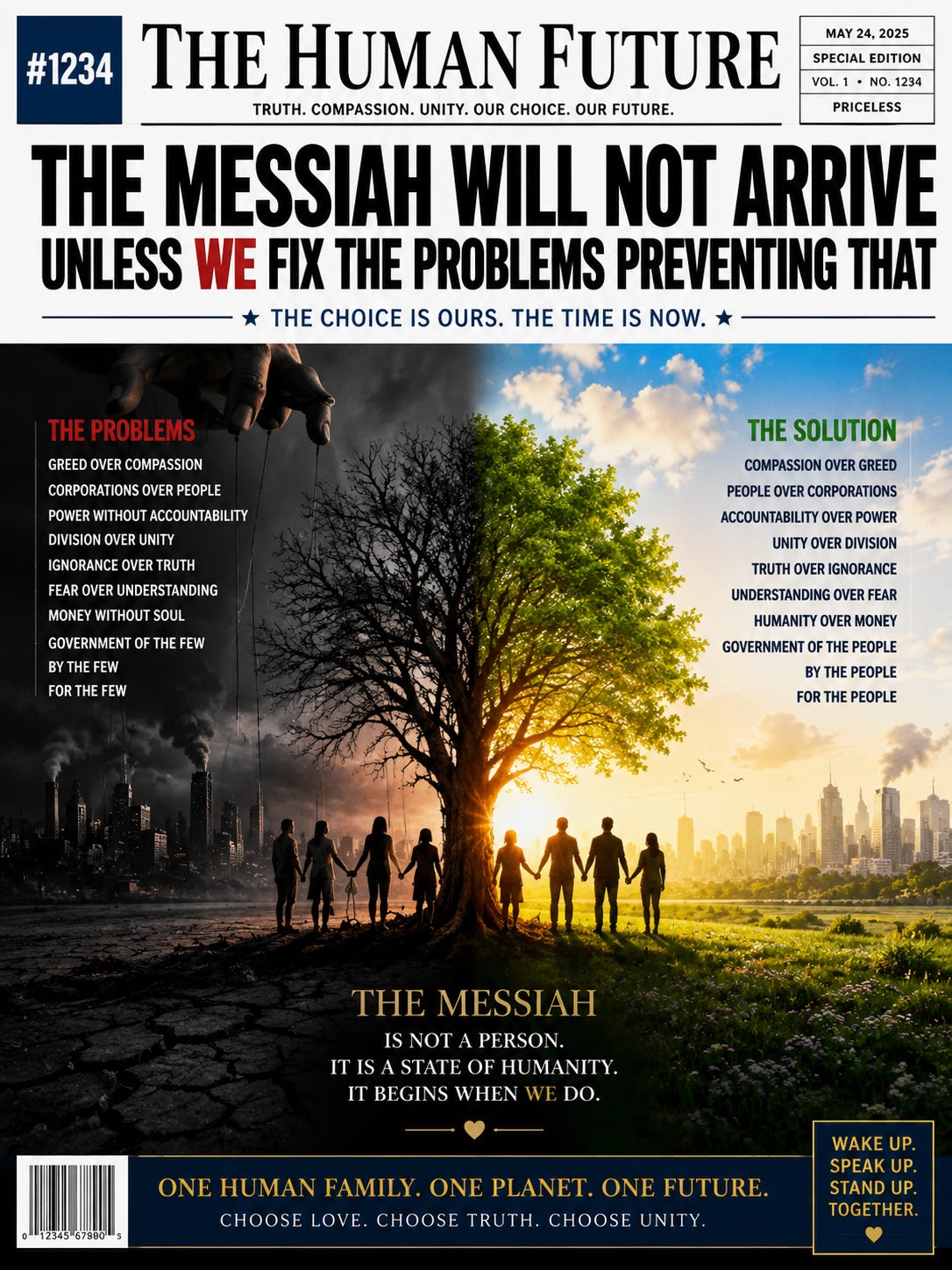
🩸 #1234 — THE MESSIAH WILL NOT ARRIVE TO FIX WHAT HUMANITY REFUSES TO FIX
Throughout history, humanity has waited.
Some wait for a savior.
Some wait for a prophet.
Some wait for a king.
Some wait for a messiah.
Every major civilization has carried its own version of this hope. The names change, the stories change, and the symbols change, yet the expectation remains remarkably similar: one day something will arrive and put everything back into balance.
But what if humanity has misunderstood the message?
What if the arrival of the Messiah is not the beginning of the solution but the result of the solution?
A farmer cannot harvest a field that was never planted.
A student cannot graduate from a school they never attended.
A civilization cannot enter an age of peace while continuing to cultivate the causes of conflict.
The expectation that a messianic age will suddenly emerge while humanity continues to embrace division, fear, greed, ignorance, and separation may itself be the misunderstanding.
The conditions that prevent peace are visible everywhere.
Nations compete against nations.
Political parties compete against political parties.
Religions compete against religions.
Corporations compete against communities.
Individuals compete against one another for status, wealth, and power.
Humanity speaks constantly of unity while organizing itself around division.
The contradiction is difficult to ignore.
Many systems that claim to serve people increasingly appear to serve institutions.
Many institutions that were created as tools now influence the lives of their creators.
The twentieth century accelerated this transformation.
As economic structures grew larger and more powerful, many citizens began to feel that their voices carried less weight than organized wealth and influence.
The result has been a growing sense of distance between ordinary people and the systems that govern them.
Whether one agrees with that assessment or not, the perception itself has become widespread.
If a messianic age is defined as an age of harmony, justice, compassion, and understanding, then humanity must ask a difficult question:
Can such an age emerge while the conditions producing division remain untouched?
Perhaps the Messiah is not a person descending into a broken world.
Perhaps the Messiah is the state that emerges when enough people choose a different path.
A path based on education rather than ignorance.
Understanding rather than fear.
Compassion rather than punishment.
Cooperation rather than domination.
Love rather than separation.
Under this interpretation, humanity is not waiting for the Messiah.
Humanity is building the conditions that allow the Messiah to appear.
The more fear is reduced, the closer that day becomes.
The more ignorance is replaced by understanding, the closer that day becomes.
The more people recognize one another as members of the same human family, the closer that day becomes.
The Messiah, then, is not merely an individual.
It is an idea.
It is a state of collective consciousness.
It is the moment humanity finally recognizes itself in one another.
And until the obstacles preventing that recognition are addressed, the world will continue waiting for a future that it has not yet chosen to create.
At the end of every river is the ocean.
At the end of every division is unity.
At the end of every fear is understanding.
And at the end of every journey toward self-discovery lies the same destination:
The Ocean of Love and Positivity.
🌊 Architect of the Collective Messiah
Jun 6, 2026
This text presents a reinterpretation of the messianic concept, shifting the focus from a literal savior to a collective shift in human consciousness.
It argues that humanity is currently trapped in cycles of division, competition, and institutional control that prevent global harmony.
Instead of waiting for divine intervention, the author suggests that a utopian age is a result of human effort rather than a precursor to it.
By choosing compassion over fear and cooperation over conflict, individuals actively build the conditions necessary for a peaceful era to emerge.
Ultimately, the source defines the “Messiah” as a shared state of unity and self-recognition within the human family.
This transformation requires a deliberate move toward an “Ocean of Love and Positivity” through education and mutual understanding.


