


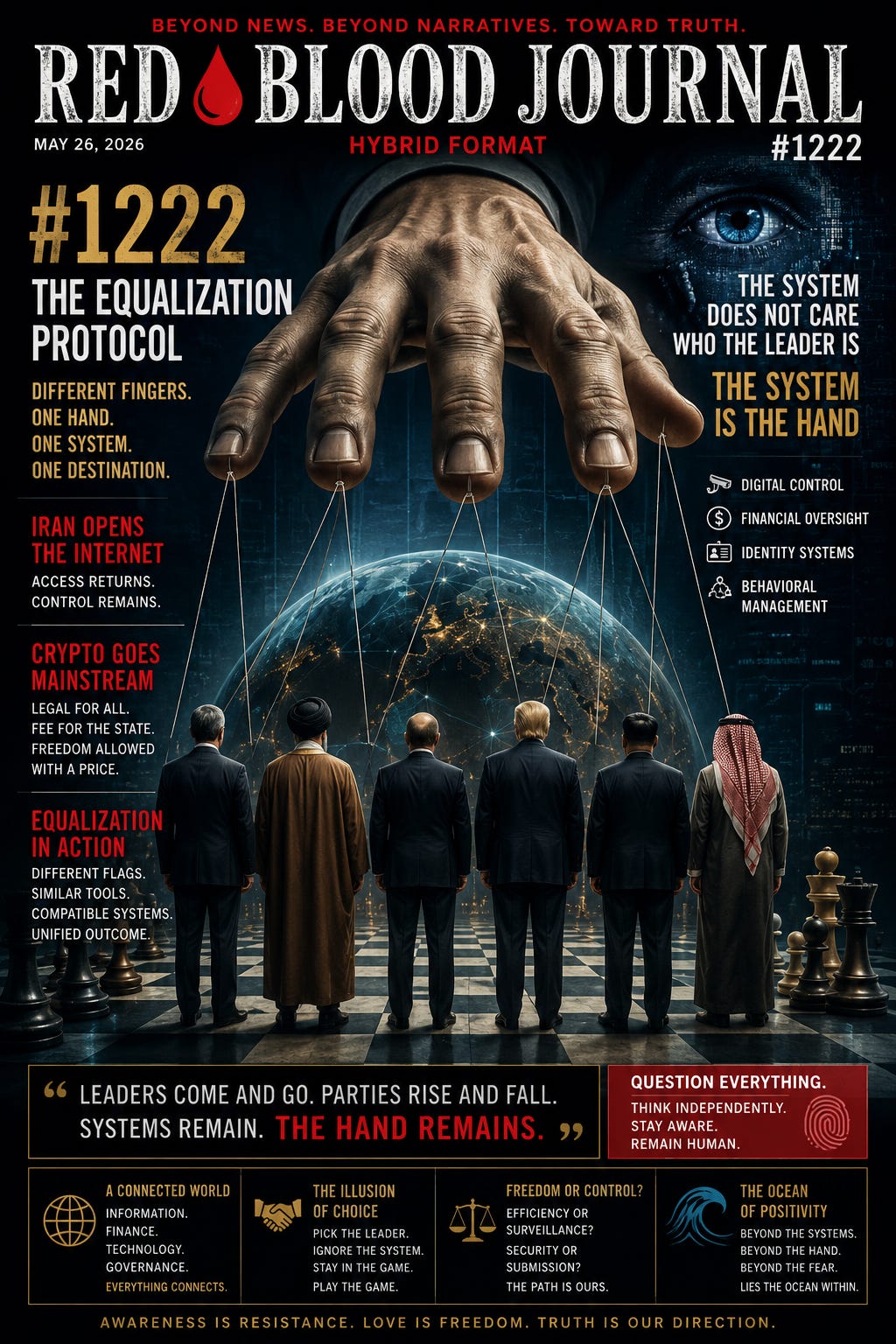
🩸 #1222 — THE EQUALIZATION PROTOCOL
Different Governments, Similar Directions
For generations, humanity has been taught to view the world as a contest between competing systems.
Democracy versus authoritarianism.
Capitalism versus socialism.
East versus West.
Secularism versus religion.
Each nation presents itself as unique. Each government claims to represent a distinct path toward the future. Elections, revolutions, wars, treaties, and political movements create the impression that history is shaped primarily by the individuals who occupy positions of power.
Yet another interpretation exists.
It suggests that while governments appear different on the surface, they may be moving toward increasingly similar structures beneath the surface.
Different flags.
Different languages.
Different cultures.
Different leaders.
Yet increasingly similar systems.
The Iranian Example
Recent developments in Iran provide an interesting case study.
After years of severe restrictions, broader internet access has begun returning.
At the same time, cryptocurrency, once viewed with suspicion and limitation, appears to be moving into a framework where participation is permitted under regulatory oversight and government collection mechanisms.
To some, these changes represent progress and modernization.
To others, they represent something else entirely.
Not less control.
More sophisticated control.
The internet is not eliminated.
It is managed.
Cryptocurrency is not destroyed.
It is incorporated.
Technology is not resisted.
It is absorbed.
The system adapts rather than retreats.
The Convergence of Systems
This pattern is not unique to Iran.
Across the world, governments with dramatically different political identities increasingly rely on similar tools.
Digital monitoring.
Electronic transactions.
Online identity systems.
Financial oversight.
Behavioral regulation.
Data collection.
The ideological justifications differ.
The technologies often look remarkably similar.
One government claims security.
Another claims efficiency.
Another claims public safety.
Another claims national stability.
Yet the destination often appears increasingly alike.
The machinery changes less than the marketing.
Beyond Leaders
One of the greatest illusions of modern politics may be the belief that changing leaders automatically changes systems.
Presidents change.
Prime ministers change.
Kings change.
Supreme leaders change.
Parties rise and fall.
Movements emerge and disappear.
Yet many of the underlying structures continue advancing in the same direction regardless of who occupies the highest office.
This raises a deeper question.
What if the leader is no longer the center of power?
What if the system itself has become the center of power?
In earlier ages, rulers built systems.
In the modern age, systems increasingly produce rulers.
The individual becomes temporary.
The structure becomes permanent.
The public focuses on personalities while institutions continue expanding their reach.
The visible face changes.
The invisible architecture remains.
The Hand and the Fingers
Perhaps the most useful metaphor is that of a hand.
The nations of the world appear as separate fingers.
Each finger moves independently.
Each finger performs a different role.
Each finger may even appear to oppose the others.
Yet all remain attached to the same hand.
The debate is not whether the fingers exist.
The debate is whether they are ultimately moving according to a larger design.
Some see coincidence.
Some see convergence.
Some see cooperation.
Some see control.
What cannot be ignored is that the world is becoming more interconnected with each passing decade.
The systems are becoming more compatible.
The technologies are becoming more universal.
The mechanisms are becoming more standardized.
The question is not whether integration is occurring.
The question is where that integration ultimately leads.
The Equalization Protocol
From this perspective, the objective is not the destruction of nations.
It is their equalization.
National identities remain.
Cultures remain.
Religions remain.
Languages remain.
But the systems underneath gradually become compatible with one another.
Different appearances.
Similar functions.
Different stories.
Similar mechanisms.
The result is a world that appears diverse while increasingly operating through common frameworks of finance, technology, regulation, and administration.
The hand does not require identical fingers.
It only requires that they work together.
Final Observation
The modern age may be teaching an unexpected lesson.
The true question is no longer who rules.
The true question is what rules.
As public attention remains focused on elections, personalities, scandals, and political theater, the systems themselves continue growing larger, more interconnected, and more influential.
A leader may disappear tomorrow.
The system remains.
A government may fall.
The structure remains.
A movement may triumph.
The architecture remains.
Whether that evolution represents progress, danger, or a mixture of both is a matter of perspective.
But understanding the world increasingly requires looking beyond the faces presented on the stage and examining the machinery operating behind the curtain.
For the fingers are visible.
The hand is not.
Yet the movement of the fingers may reveal its presence.
The Ocean of Positivity
Regardless of how large systems become, they remain external to the most important territory any human being will ever explore: the landscape within.
Governments can regulate behavior.
Institutions can shape incentives.
Technology can influence choices.
Yet none of them can permanently control awareness, wisdom, compassion, or love.
The greatest freedom has never originated from a political system.
It has always emerged from consciousness itself.
Those who learn to observe clearly become less vulnerable to fear.
Those who learn to think independently become less vulnerable to manipulation.
Those who cultivate kindness become less vulnerable to hatred.
And those who discover the ocean within themselves realize that no institution, no ideology, and no system can ever fully possess the human spirit.
Beyond every hand of power lies a greater force.
The Ocean of Positivity.
An ocean without borders.
An ocean without rulers.
An ocean that expands every time a human being chooses truth over deception, wisdom over fear, and love over division.
In the end, all systems are temporary.
But the ocean remains.
And it patiently waits for all who are willing to enter its waters.
👁️ The Architecture of Convergence:
Systems Beyond Leaders
Jun 3, 2026
The provided text explores the concept of the Equalization Protocol, suggesting that while global governments appear ideologically diverse, they are actually converging into identical structural frameworks.
By utilizing the example of Iran, the author argues that modern states no longer suppress tools like the internet or cryptocurrency but instead absorb them into sophisticated systems of data collection and regulation.
This shift implies that individual leaders are secondary to the permanent, invisible architecture of technological and financial control that operates regardless of who is in power.
The text uses the metaphor of a hand and fingers to illustrate how seemingly independent nations may actually be moving according to a singular, unified design of global integration.
Ultimately, the source posits that true human freedom exists beyond these external systems, residing instead within personal consciousness and a metaphorical “ocean of positivity.”
These observations encourage readers to look past political theater to recognize the standardized machinery governing the modern world.


