


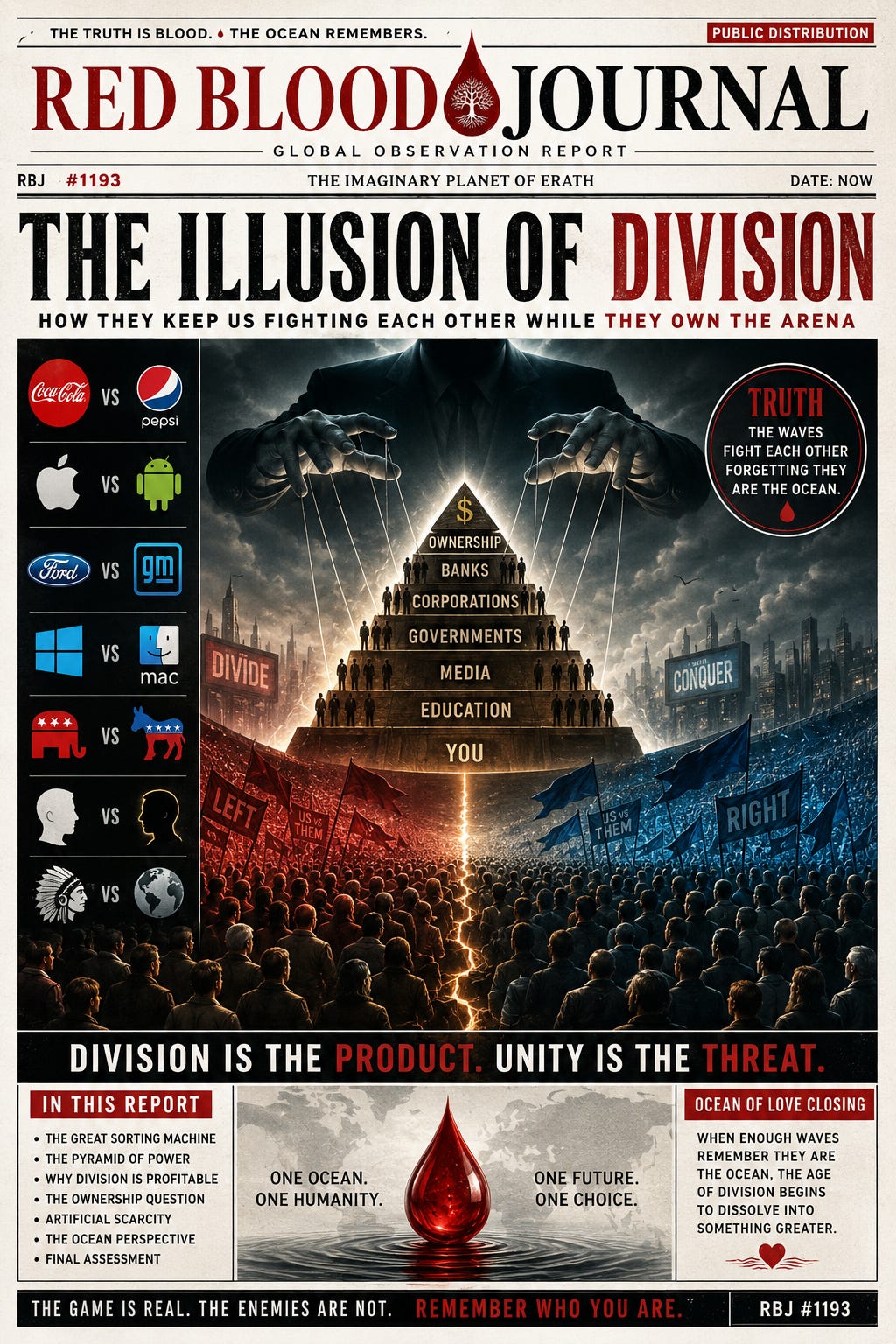
🩸 #1193 — THE ILLUSION OF DIVISION
Red Blood Journal Transmission
Classification: Societal Observation Report
Location: The Imaginary Planet of Erath
Status: Public Distribution
Executive Summary
The citizens of Erath were taught that competition was the engine of progress.
Compete in business.
Compete in politics.
Compete in technology.
Compete in sports.
Compete in ideology.
Compete in everything.
Competition itself was never the problem.
The problem emerged when competition became division.
When the citizen stopped competing to improve and began competing to hate.
When identities became products.
When tribes became prisons.
When fellow citizens became enemies.
The rulers of Erath learned long ago that a population divided into thousands of camps is easier to manage than a population united by common interests.
The result was a civilization where nearly every institution encouraged citizens to choose sides while very few encouraged them to question the game itself.
The Great Sorting Machine
From birth, every citizen was encouraged to join a camp.
Choose a beverage.
Choose a technology.
Choose a political faction.
Choose a religion.
Choose a nationality.
Choose a race.
Choose a team.
Choose a tribe.
The choices appeared harmless.
Yet every choice slowly built invisible walls.
The citizen gradually learned to define himself not by what he was, but by what he opposed.
The sorting machine never stopped.
Every disagreement became a category.
Every category became a division.
Every division became a battlefield.
Soon millions of citizens spent their energy fighting one another while believing they were exercising freedom.
The Theater of Opposition
The citizens observed endless battles.
Coke versus Pepsi.
Apple versus Android.
Ford versus GM.
Windows versus Mac.
Republican versus Democrat.
Native versus Foreigner.
Left versus Right.
The battles seemed authentic.
The emotions were certainly real.
The loyalties were real.
The arguments were real.
But the philosophers of Erath noticed something unusual.
The people were examining the fighters.
Very few were examining the arena.
The more emotional the conflict became, the less likely anyone was to ask who owned the stadium.
The audience focused on the performers while the structure surrounding the performance remained largely invisible.
This pattern repeated itself throughout Erathian society.
Politics.
Media.
Finance.
Technology.
Entertainment.
Everywhere the citizens looked they found opposition.
Everywhere they looked they found teams.
Everywhere they looked they found division.
The Pyramid
The economy of Erath resembled a pyramid.
At the bottom stood millions.
Above them stood thousands.
Above them stood hundreds.
Above them stood dozens.
At the very top stood remarkably few.
The citizens at the bottom competed fiercely with one another.
The closer one moved toward the top, the less competition appeared and the more coordination appeared.
Those at the bottom were told they lived in a world of ruthless rivalry.
Those at the top often appeared surprisingly interconnected.
The pyramid possessed a simple characteristic.
Wealth flowed upward.
Risk flowed downward.
Responsibility flowed downward.
Rewards flowed upward.
The architects called this efficiency.
The citizens called it normal.
The critics called it concentration.
Why Division Is Profitable
Division creates customers.
Division creates followers.
Division creates predictable behavior.
Division creates emotional investment.
Most importantly, division creates distraction.
A citizen focused on another citizen is rarely focused on the system surrounding both.
A citizen consumed by tribal conflict is unlikely to investigate deeper structures.
A divided population often performs its own management.
The rulers of Erath discovered that the most effective control is frequently invisible.
No chains are required when citizens voluntarily defend the walls around their own tribes.
The system no longer needs to divide them.
They divide themselves.
The Ownership Question
The philosophers of Erath proposed a dangerous question.
What if competition remained but ownership changed?
What if innovation remained?
What if entrepreneurship remained?
What if creativity remained?
What if invention remained?
But instead of rewards accumulating primarily toward the peak of a pyramid, the benefits were distributed broadly among the people who created the value?
The engineers would still build.
The scientists would still discover.
The artists would still create.
The entrepreneurs would still innovate.
Competition would survive.
Excellence would survive.
Progress would survive.
The difference would be where the rewards flowed.
The growth of civilization would become the growth of its citizens rather than the growth of increasingly concentrated centers of power.
Artificial Scarcity
The scholars of Erath observed another recurring pattern.
Scarcity often generated profit.
Delay often generated profit.
Dependency often generated profit.
The slower the solution.
The larger the extraction.
The longer the dependency.
The greater the revenue.
Not every institution behaved this way.
Not every organization behaved this way.
But the incentive existed.
The philosophers therefore asked a simple question:
How much human progress remains unrealized because delay is more profitable than acceleration?
The question alone was enough to make many gatekeepers uncomfortable.
The Forgotten Truth
The deepest illusion on Erath was not political.
It was not financial.
It was not technological.
It was not ideological.
It was separation itself.
The citizen was taught to see himself as isolated.
Separate from his neighbor.
Separate from society.
Separate from nature.
Separate from humanity.
Yet every achievement depended upon countless others.
Every invention was built upon previous inventions.
Every success relied upon unseen contributors.
The citizen who believed he stood alone was standing upon the labor of thousands.
The illusion of separation concealed the reality of interdependence.
The Ocean Perspective
From the perspective of the Ocean of Love, the entire drama appeared almost comical.
The waves argued endlessly.
One wave called itself conservative.
Another called itself progressive.
One called itself native.
Another called itself foreign.
One called itself rich.
Another called itself poor.
One called itself successful.
Another called itself oppressed.
Each wave believed it was fundamentally different from the others.
Yet every wave was made from the same water.
The Ocean never forgot.
Only the waves forgot.
The wave fought the neighboring wave.
The wave feared the neighboring wave.
The wave blamed the neighboring wave.
Yet both arose from the same sea.
When a wave remembers the Ocean, the illusion weakens.
When enough waves remember, the pyramid weakens.
For the Ocean does not divide itself.
The Ocean expands.
The Ocean includes.
The Ocean remembers that every wave belongs to the whole.
Final Assessment
The question is not whether competition should exist.
Competition can create excellence.
Competition can create innovation.
Competition can create progress.
The real question is who benefits from the results.
Does growth serve the many or the few?
Does innovation elevate humanity or merely concentrate power?
Does competition unite society through shared prosperity or divide society through manufactured conflict?
These questions determine whether civilization becomes a pyramid or a horizon.
One concentrates.
The other distributes.
One requires division.
The other requires participation.
One fears awakening.
The other welcomes it.
Ocean of Love Closing
The Ocean does not ask a wave whether it drinks Coke or Pepsi.
The Ocean does not ask whether it carries Apple or Android.
The Ocean does not ask whether it votes Republican or Democrat.
The Ocean does not ask whether it was born native or foreign.
The Ocean recognizes only water.
The labels belong to the wave.
The reality belongs to the sea.
Every wave rises.
Every wave falls.
Every wave eventually returns home.
The illusion of division may enrich a few for a season.
But the remembrance of unity belongs to eternity.
And when enough waves remember they are the Ocean itself, the age of division begins to dissolve into something greater.
🩸 End Transmission
RBJ #1193 — THE ILLUSION OF DIVISION
🌊 The Ocean and the Pyramid:
The Illusion of Division
May 30, 2026
The provided text examines a metaphorical society called Erath to critique how systemic division functions as a tool for social control and wealth concentration.
It argues that while competition can drive progress, modern institutions often transform it into tribal hostility to distract the public from a hierarchical pyramid that funnels rewards upward.
This “Great Sorting Machine” encourages individuals to define themselves through superficial labels and opposition rather than recognizing their shared interests.
The narrative suggests that artificial scarcity and manufactured conflicts are maintained because they are more profitable than collective advancement.
Ultimately, the source advocates for an “Ocean Perspective,” a shift in consciousness where people recognize their fundamental interdependence to dissolve the illusions of separation.
This philosophical transition aims to move society from a structure of power concentration toward a more equitable model of shared prosperity.


