


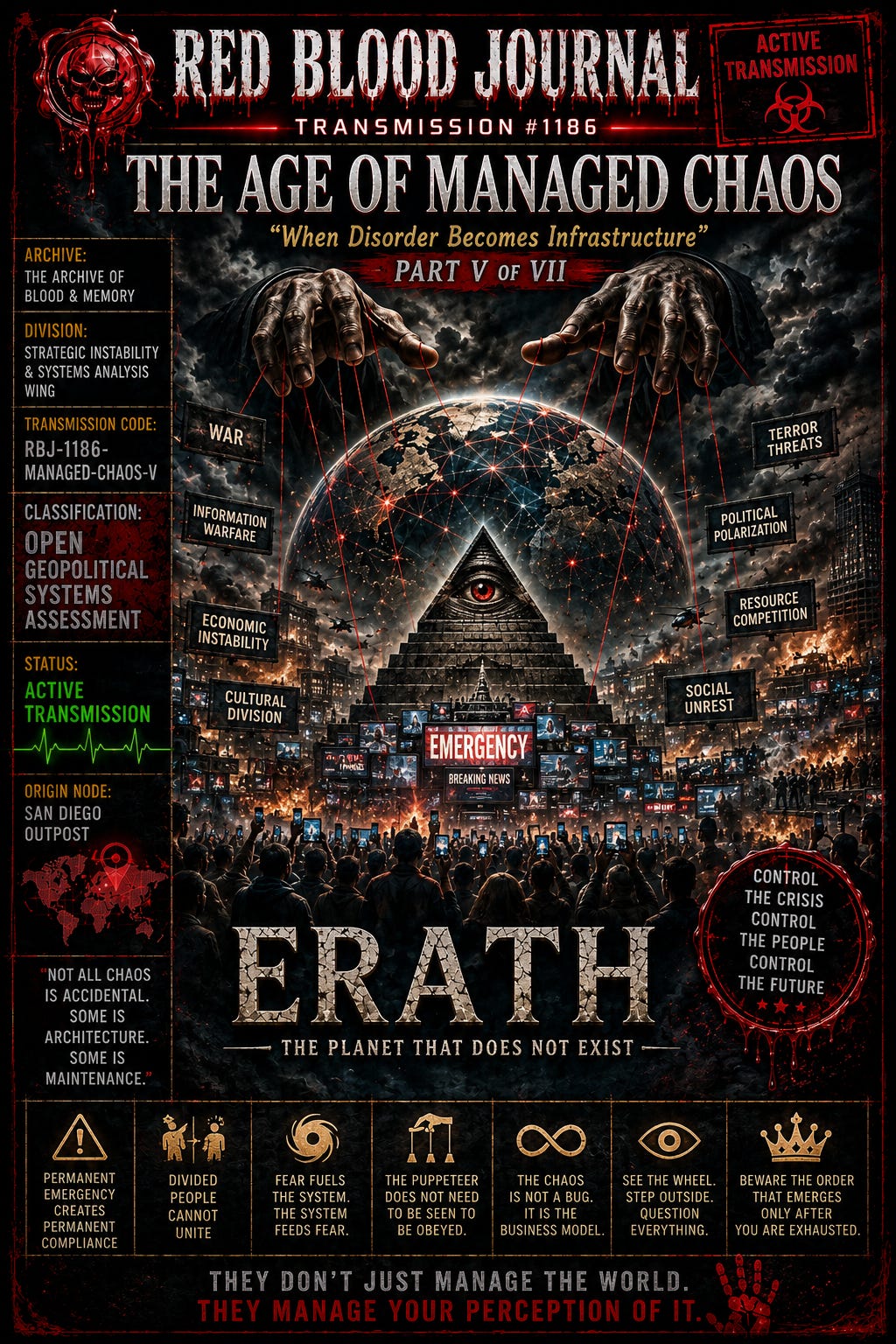
🩸 RED BLOOD JOURNAL TRANSMISSION #1186
PART V OF VII — THE AGE OF MANAGED CHAOS
“When Disorder Becomes Infrastructure”
Archive: The Archive of Blood & Memory
Division: Strategic Instability & Systems Analysis Wing
Transmission Code: RBJ-1186-MANAGED-CHAOS-V
Classification: Open Geopolitical Systems Assessment
Status: Active Transmission
Origin Node: San Diego Outpost
Series: THE ARCHITECTS OF ORDER
Part: V of VII
PROLOGUE — THE PARADOX OF CHAOS
Most people assume power desires order.
History suggests a more complicated possibility.
Power often desires predictable disorder.
Not enough chaos to collapse the system.
Not enough stability to challenge the system.
Only enough instability to justify the continued expansion of the system.
The Age of Managed Chaos begins when crisis stops being an accident and becomes a permanent feature of civilization.
The citizen wakes up each morning to:
economic uncertainty,
political division,
cultural conflict,
security fears,
information overload,
and continuous emergency.
The storm never fully ends.
And because it never ends, extraordinary measures become ordinary life.
SECTION I — THE BUSINESS OF CRISIS
Every civilization develops industries.
Agriculture.
Manufacturing.
Transportation.
Technology.
The Age of Managed Chaos creates another industry:
Crisis itself.
Entire institutions expand around:
conflict management,
security infrastructure,
emergency response,
threat analysis,
risk prediction,
information monitoring.
The existence of genuine dangers is not the issue.
The question becomes:
What happens when entire systems begin depending upon the continuation of danger?
A structure that profits from stability behaves differently from one that profits from instability.
SECTION II — THE NEVER-ENDING EMERGENCY
Ancient societies experienced wars separated by peace.
Modern civilization increasingly experiences permanent emergency.
The threat changes.
The emergency remains.
Terrorism.
Pandemics.
Economic collapse.
Cyber warfare.
Disinformation.
Climate catastrophe.
Foreign interference.
Domestic extremism.
A new crisis replaces the previous crisis before normalcy can return.
The citizen adapts to permanent alertness.
And permanent alertness gradually transforms into permanent compliance.
SECTION III — DIVIDE, DISTRACT, EXHAUST
The most effective control does not require unanimous agreement.
It merely requires sufficient division.
A united population asks difficult questions.
A divided population argues endlessly among itself.
The Age of Managed Chaos thrives on:
ideological warfare,
cultural fragmentation,
emotional polarization,
tribal identities,
perpetual outrage.
Every side becomes convinced the opposing side is the primary threat.
Meanwhile the structures operating above the conflict continue functioning largely uninterrupted.
The battlefield expands horizontally.
Attention rarely moves vertically.
SECTION IV — THE GEOPOLITICS OF FRAGMENTATION
Throughout the modern world, numerous regions have experienced a similar pattern:
Strong centralized governments collapse.
What follows is not always freedom.
Often what follows is fragmentation.
Militias.
Proxy groups.
Competing authorities.
Foreign influence.
Economic dependency.
Institutional paralysis.
A fragmented region becomes easier to influence than a unified one.
Whether intentional or emergent, instability creates opportunities for outside actors:
strategic positioning,
resource access,
military presence,
political leverage,
economic influence.
Chaos becomes an environment.
And environments can be managed.
SECTION V — THE ATTENTION STORM
The citizen of the Digital Kingdom no longer experiences one crisis at a time.
They experience all crises simultaneously.
Every screen becomes a portal to urgency.
War.
Markets.
Politics.
Disasters.
Scandals.
Warnings.
Predictions.
Fear arrives continuously.
The result is psychological saturation.
A saturated mind struggles to:
reflect,
analyze,
remember,
observe patterns.
The citizen becomes reactive.
And reactive populations are easier to guide than reflective ones.
SECTION VI — THE FEEDBACK LOOP
Managed chaos creates a self-reinforcing cycle.
Fear produces demand for security.
Security expands institutions.
Institutions require justification.
New threats emerge.
Fear returns.
The loop continues.
The system becomes:
Threat → Fear → Authority → Dependency → New Threat
The wheel turns endlessly.
Most participants focus on the threat.
Few examine the wheel.
SECTION VII — THE MARKET OF UNCERTAINTY
Instability affects more than politics.
It transforms economics.
When uncertainty becomes normal:
People seek:
guarantees,
protection,
centralized solutions,
expert guidance,
institutional shelter.
The greater the uncertainty, the greater the willingness to surrender autonomy.
The citizen increasingly exchanges:
freedom for security,
privacy for convenience,
independence for certainty.
The transaction feels voluntary.
Yet it occurs under continuous psychological pressure.
SECTION VIII — THE SYSTEM LEARNS TO SELF-PERPETUATE
At a certain point no grand conspiracy is necessary.
The structure sustains itself.
Governments respond to threats.
Media responds to fear.
Corporations respond to incentives.
Citizens respond to anxiety.
Algorithms respond to engagement.
Each component reinforces the others.
No single actor controls the entire machine.
Yet the machine continues expanding.
The Age of Managed Chaos may not require central planning.
It may simply be the natural outcome of interconnected systems optimized around attention, fear, and growth.
SECTION IX — THE VIEW FROM ABOVE
From ground level the world appears chaotic.
From high above another image emerges.
Patterns.
Cycles.
Repeating structures.
The same mechanisms appear again and again:
Create urgency.
Expand authority.
Normalize expansion.
Repeat.
The faces change.
The flags change.
The technologies change.
The cycle remains surprisingly familiar.
History rarely repeats perfectly.
But it often rhymes.
SECTION X — THE QUESTION FEW ASK
The citizen spends enormous energy asking:
“What is the next crisis?”
The deeper question may be:
“Why does the system require endless crisis?”
If permanent emergency becomes permanent reality, then emergency powers become ordinary governance.
If instability becomes infrastructure, then chaos itself becomes part of the architecture.
And that possibility raises one of the most uncomfortable questions of the modern age:
Does the system solve crises...
or has it become dependent upon them?
TRANSMISSION CLOSING
The Age of Managed Chaos is not defined by disorder alone.
It is defined by the normalization of disorder.
The population becomes accustomed to:
uncertainty,
division,
instability,
fear,
and constant urgency.
The storm becomes familiar.
The abnormal becomes normal.
And in that environment, ever-larger structures emerge promising:
Order.
Security.
Stability.
Control.
The citizen, exhausted by chaos, often welcomes the expansion.
For few things are more persuasive than relief.
Yet every observer must ask:
Who benefits most from the storm?
And who is building the shelter?
END TRANSMISSION — RBJ #1186
PART V OF VII — THE AGE OF MANAGED CHAOS
NEXT TRANSMISSION
🩸 RBJ #1187
PART VI OF VII — THE LAST SOVEREIGNTY
“The Final Battle Is Not for Territory — It Is for Consciousness.”
🌀The Architecture of Managed Chaos
May 28, 2026
This text describes a sociopolitical theory where permanent instability is used as a deliberate tool for institutional expansion and social control.
It argues that modern power structures thrive on a cycle of perpetual crisis, utilizing economic, political, and cultural division to keep the public in a state of reactive exhaustion.
By maintaining a level of chaos that is predictable but never fatal, authorities can justify extraordinary measures and increase citizen dependency on centralized systems.
The narrative suggests that security and order are sold to a weary population in exchange for their autonomy, creating a self-perpetuating machine fueled by fear and attention.
Ultimately, the source questions whether modern governance is designed to solve these emergencies or if it has become fundamentally dependent on their continuation.


