


Here’s an addendum that builds directly on Report #1802 rather than replacing it.
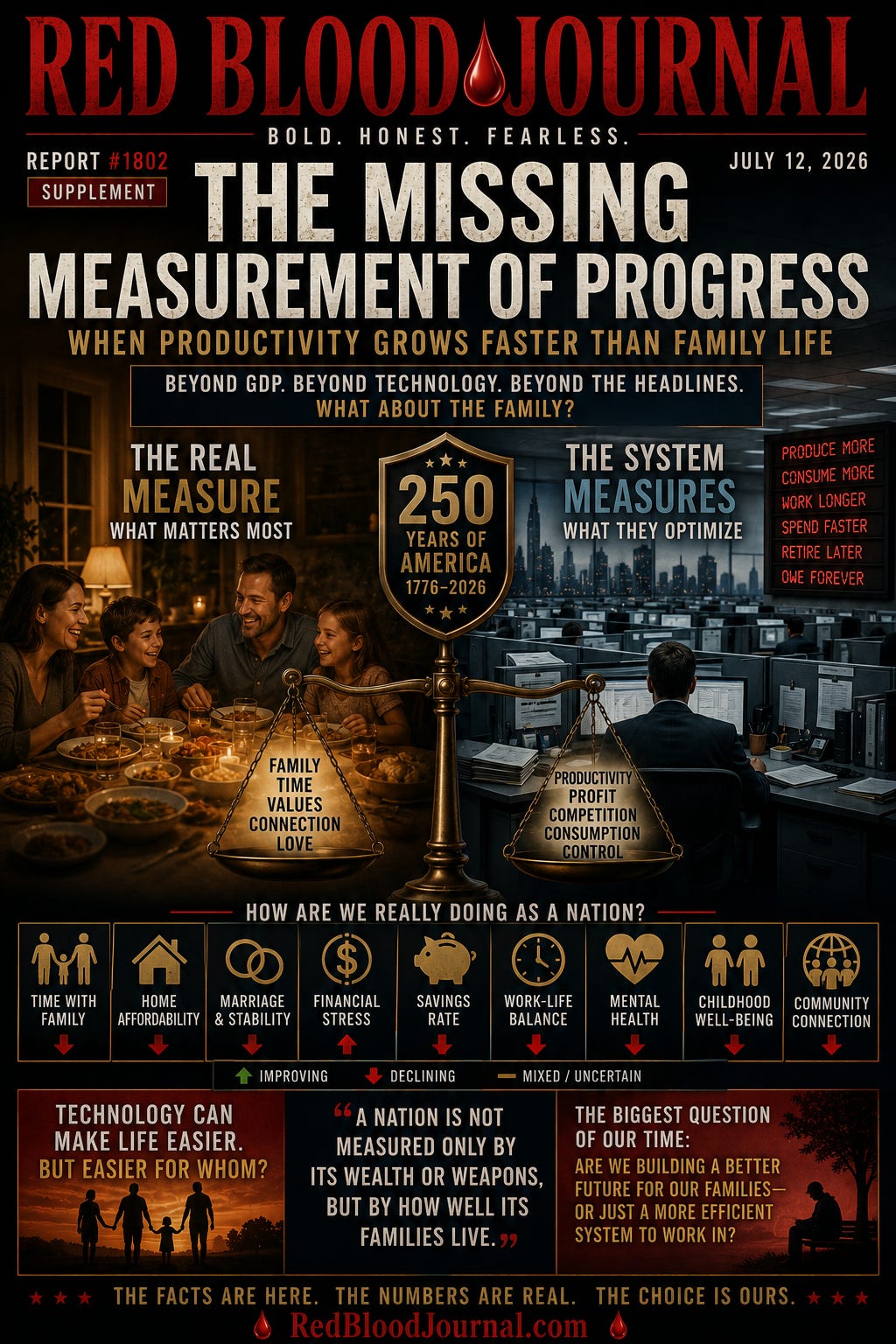
🩸 RED BLOOD JOURNAL
REPORT #1802 — SUPPLEMENT
The Missing Measurement of Progress
When Productivity Grows Faster Than Family Life
RedBloodJournal.com
Report #1802 examined whether the American family has become stronger over the past 250 years using indicators such as income, housing, debt, marriage, health, savings, employment, and family stability.
There is, however, another question that deserves equal attention.
Perhaps the most important measurement was never included in the national scorecard.
TWO DIFFERENT DEFINITIONS OF PROGRESS
Modern society often celebrates progress through measurable achievements.
We build faster computers.
Develop more advanced medicines.
Construct larger cities.
Increase productivity.
Improve manufacturing.
Generate more economic output.
These achievements are real.
But they answer only one question:
How much can society produce?
They do not answer another question that may be even more important:
How well are families actually living?
THE DIFFERENCE BETWEEN MEDIA REALITY AND LIVED REALITY
Public discussion often creates the impression that each generation is unquestionably better off than the previous one.
People repeat familiar observations.
“Our technology is better.”
“Our medicine is better.”
“Our economy is larger.”
“Our homes contain more conveniences.”
All of these statements may be true.
Yet none of them necessarily describes the daily experience of an ordinary family.
A nation can become wealthier while its families struggle to find enough uninterrupted time to share dinner together.
Economic progress and family well-being are related, but they are not identical.
PRODUCTIVITY IS NOT THE SAME AS PROSPERITY
Imagine that advances in technology allow a worker to produce twice as much in one hour as a previous generation.
A reasonable expectation might be that the worker could enjoy more free time while maintaining the same standard of living.
Instead, many households describe a different experience.
Housing costs have risen.
Healthcare expenses have increased.
Childcare has become more expensive.
Education requires greater financial commitment.
Many families rely on two incomes where one income once supported a household.
Whether these changes represent progress depends on which outcome is being measured.
If the objective is total economic production, modern society has achieved extraordinary success.
If the objective is increasing the amount of time families spend together, the answer is less obvious.
THE VALUE OF TIME
Time may be the one resource that cannot be manufactured.
A larger house cannot create an additional hour with a child.
A faster computer cannot replace a family conversation.
A higher income does not automatically produce stronger relationships.
Every hour devoted to earning a living is an hour unavailable for something else.
The question is not whether work is necessary.
The question is whether increasing productivity has translated into increasing freedom.
LONGER LIVES—FOR WHAT PURPOSE?
Medical science has extended life expectancy for many people compared with previous centuries.
At the same time, retirement systems have evolved alongside demographic and economic changes.
Today, Americans can claim reduced Social Security retirement benefits beginning at age 62, while the full retirement age depends on birth year and is currently between 66 and 67, with delayed retirement credits available through age 70.
These policies reflect changing demographics, longer average lifespans than in earlier eras, and the financial design of retirement systems.
They also invite a broader philosophical question.
If technology allows society to become more productive, should that productivity primarily extend working lives?
Or should some of those gains be converted into more time with family, community, creativity, and personal fulfillment?
That question has no universally accepted answer.
It is ultimately a question about the purpose of progress itself.
WHAT HAS BEEN OPTIMIZED?
Modern civilization has become remarkably effective at optimizing:
Speed
Efficiency
Production
Consumption
Connectivity
Data
Convenience
But has it become equally effective at optimizing:
Family meals?
Time with children?
Strong marriages?
Close friendships?
Community trust?
Emotional resilience?
Quiet reflection?
Intergenerational relationships?
The answers may differ depending on the household.
THE INVISIBLE COST
Every society makes trade-offs.
Greater convenience may reduce physical effort.
Greater efficiency may reduce idle time.
Greater productivity may increase national wealth.
Yet each gain can carry costs that are more difficult to measure.
Parents may work longer hours.
Children may spend more time with screens than with grandparents.
Meals may become faster but less shared.
Neighborhoods may become larger while communities become less connected.
These are not technological failures.
They are choices about how technological success is ultimately used.
A DIFFERENT REPORT CARD
Suppose a nation were evaluated using a different scorecard.
Instead of asking:
How much did GDP grow?
How many products were sold?
How much wealth was created?
We asked:
Do parents have enough time for their children?
Can one full-time income reasonably support a family?
Are families financially resilient?
Do people know their neighbors?
Are marriages becoming more stable?
Are people less lonely?
Do grandparents remain part of everyday family life?
Do families feel hopeful about the future?
Such measurements would not replace economic statistics.
They would complement them.
Because a prosperous economy and a healthy family are related—but they are not the same achievement.
FINAL REFLECTION
Perhaps history will remember this period as one of extraordinary technological success.
Future generations may also ask another question.
Did those advances give people more freedom to live?
Or did they simply make people more efficient at working?
A civilization ultimately reveals its priorities not only through what it invents, but through what those inventions allow families to become.
The strongest nation may not be the one that produces the most.
It may be the one whose families have the greatest opportunity to live meaningful lives together.
The facts continue to evolve.
The conversation continues.
The judgment belongs to the reader.
🩸 RedBloodJournal.com
⚖️ The Human Cost of Productivity:
Measuring Family Progress
Jul 12, 2026
The provided text explores the critical disconnect between rising economic productivity and the actual well-being of modern families. While society has successfully optimized for technological speed and national wealth, these achievements have not necessarily resulted in more quality time or financial ease for the average household. The author argues that true progress should be measured by familial stability and personal freedom rather than just GDP growth or manufacturing efficiency. By highlighting the rising costs of essentials like housing and childcare, the report suggests that increased output has often led to longer working hours instead of more shared moments. Ultimately, the source advocates for a new evaluation of success that prioritizes meaningful relationships and community health over mere industrial consumption. This reflection challenges readers to consider if modern advancements are serving the family unit or simply demanding more from it.


