


I’d frame it as a philosophical question rather than implying there is a single correct answer.
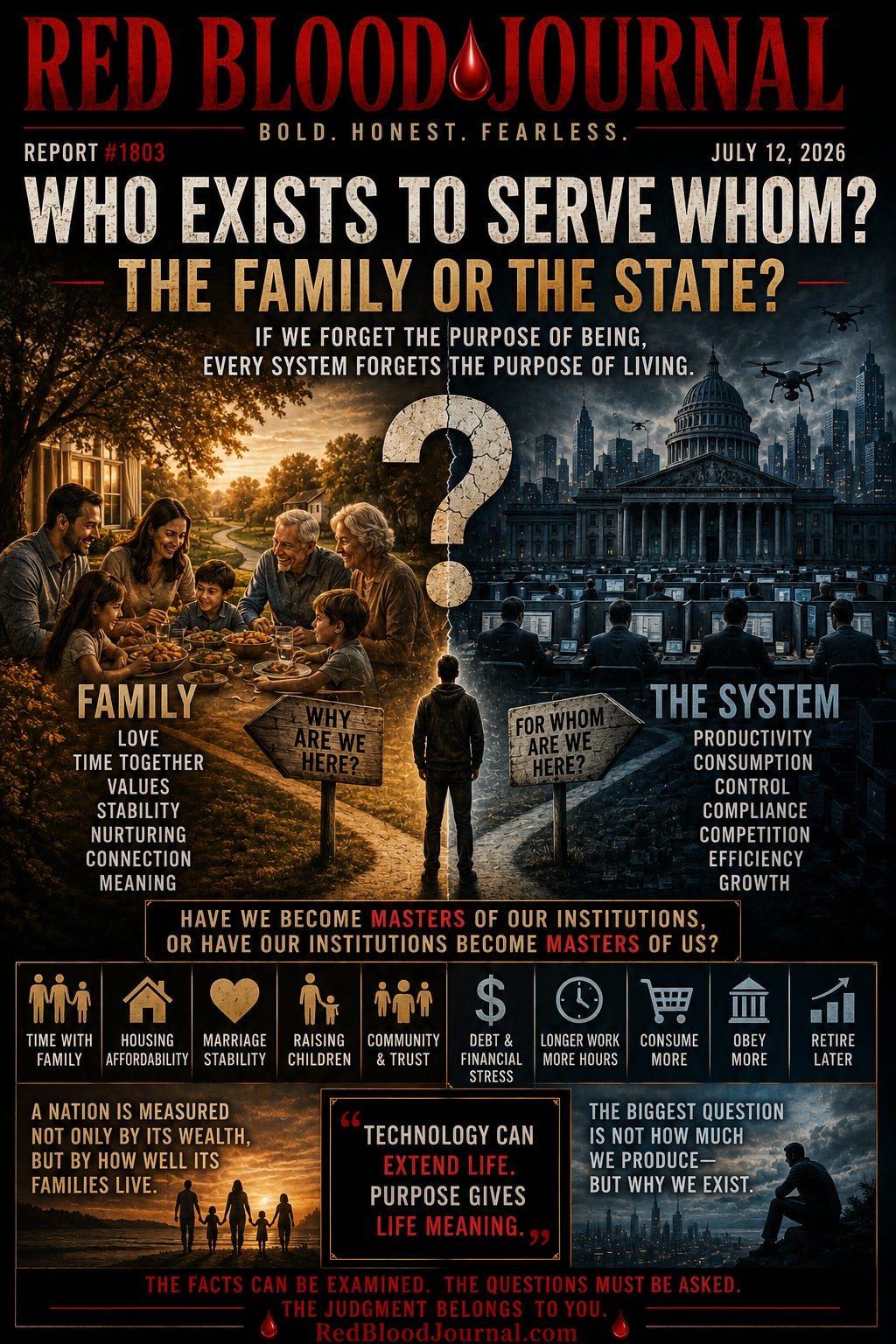
🩸 RED BLOOD JOURNAL
REPORT #1803
Who Exists to Serve Whom?
If We Forget the Purpose of Being, Every System Eventually Forgets the Purpose of Living
RedBloodJournal.com
PROLOGUE
Human civilization has spent thousands of years building governments.
We have built kingdoms.
Empires.
Democracies.
Corporations.
Banks.
Markets.
Universities.
Armies.
Laws.
Technologies.
Artificial intelligence.
Entire systems designed to organize human society.
Yet beneath all of these achievements lies a question that is rarely asked.
Why are we here in the first place?
Not why governments exist.
Not why economies exist.
Not why corporations exist.
But why human beings exist.
If that question remains unanswered, every other institution risks becoming an end in itself rather than a means to serve humanity.
This report does not attempt to answer that question for the reader.
It asks whether modern civilization still remembers to ask it.
THE FIRST HUMAN INSTITUTION
Before there were nations...
There were families.
Before there were governments...
There were parents and children.
Before there were political parties...
There were relationships.
The family is humanity’s oldest social institution.
Governments came later.
Markets came later.
Corporations came later.
Technology came later.
If that historical order matters, then another question naturally follows.
Were these later institutions created to serve families, or have families gradually become instruments for serving those institutions?
WHEN THE MEANS BECOME THE PURPOSE
Every system begins with a purpose.
Schools exist to educate.
Hospitals exist to heal.
Courts exist to deliver justice.
Governments exist to provide order, security, and public services.
Economies exist to organize the exchange of goods and labor.
But history shows that institutions can sometimes become focused on preserving themselves.
When that happens, success may increasingly be measured by the growth of the institution rather than by the well-being of the people it was created to serve.
That possibility deserves examination rather than assumption.
WHAT DO WE CELEBRATE?
Modern societies devote enormous attention to measurable achievements.
Economic growth.
Productivity.
Stock markets.
Industrial output.
Corporate earnings.
Government revenue.
Military capability.
Technological innovation.
These indicators are important.
They reveal much about the capacity of a nation.
But they reveal less about the quality of everyday life.
How often do national discussions focus on:
Time parents spend with children?
The strength of marriages?
The ability to care for aging parents?
Neighborhood trust?
Family meals?
Emotional well-being?
A sense of meaning?
If these are discussed less frequently, it raises an important question:
Are we measuring what is easiest to count rather than what is most valuable to human life?
PRODUCTIVITY OR HUMAN FLOURISHING?
Technology has increased productivity beyond anything previous generations could have imagined.
Many tasks that once required days now require minutes.
Communication travels instantly.
Automation performs work that once required thousands of people.
If productivity is increasing, one might expect people to enjoy more freedom.
More family time.
More rest.
More opportunity for reflection.
For many households, however, the experience is more complicated.
Housing has become a larger financial burden.
Healthcare consumes a significant share of household budgets.
Childcare and education often require substantial resources.
Many families depend on two incomes.
Many workers remain connected to work long after the workday ends.
These observations do not prove that technological progress has failed.
They invite a different question:
Has productivity primarily expanded human freedom, or has it primarily expanded the capacity to produce more?
THE VALUE OF TIME
Money can be earned again.
Time cannot.
A child will never again be five years old.
Parents cannot recover years that were never shared.
Grandparents cannot postpone aging.
Every additional hour devoted to production is an hour unavailable for something else.
Societies therefore make choices—not only about economics, but about time itself.
WHY ARE WE HERE?
This may be the oldest philosophical question in human history.
Are we here primarily to produce?
To consume?
To compete?
To accumulate?
To increase national wealth?
To strengthen governments?
To maximize efficiency?
Or are those simply tools intended to support something deeper?
Different philosophical and religious traditions have answered this question differently.
Some emphasize service.
Others virtue.
Others spiritual growth.
Others happiness.
Others relationships.
Others freedom.
Despite these differences, many traditions share one observation:
Human beings should not become merely instruments of the systems they create.
THE DIRECTION OF CIVILIZATION
Imagine two societies.
The first continually increases production, consumption, and economic output.
The second increases family stability, trust, health, education, and time available for meaningful relationships.
If only one could improve more rapidly, which direction should be called progress?
There is no universally accepted answer.
But the question itself may be more important than many of the statistics used to evaluate nations.
A DIFFERENT REPORT CARD
Imagine measuring national success by questions such as:
Are children growing up in stable and loving homes?
Do parents have time to raise them?
Can families afford healthy food without sacrificing all their free time?
Do older generations remain connected to younger ones?
Are people lonely less often?
Are communities stronger?
Do people feel their lives have meaning beyond work?
These measures may not appear in quarterly economic reports.
Yet they shape the lives people actually live.
THE PARADOX OF MODERN SUCCESS
The modern world has become remarkably successful at extending life, increasing knowledge, improving transportation, and expanding communication.
Those achievements deserve recognition.
The remaining question is whether civilization has become equally successful at helping people understand why they are living longer.
A longer life is not automatically a more meaningful life.
A wealthier society is not automatically a happier one.
A more efficient economy is not automatically a stronger family.
Progress answers the question of how.
Purpose answers the question of why.
Both matter.
FINAL REFLECTION
Every civilization eventually reveals what it values most.
Not by its speeches.
Not by its slogans.
But by where it directs its greatest attention, resources, and imagination.
If governments, economies, technologies, and institutions ultimately strengthen families, encourage meaningful relationships, and allow people to live lives of purpose, many would say they are fulfilling their role.
If, instead, people gradually organize their entire existence around serving the systems they created, then another question deserves to be asked.
Have we become masters of our institutions—or have our institutions become masters of us?
Perhaps the deepest measure of progress is not how efficiently a civilization works.
It is whether that civilization remembers why human beings exist beyond work, consumption, and production.
The evidence can be examined.
The questions can be debated.
The purpose of being is one that each individual—and every generation—must ultimately explore for themselves.
The judgment belongs to the reader.
🩸 RedBloodJournal.com
❓ The Purpose of Being: Humanity Versus the System
Jul 12, 2026
This text explores the fundamental tension between human purpose and the complex systems of modern civilization. It argues that institutions like governments, economies, and technology should serve the well-being of families and individuals rather than existing as ends in themselves. The author suggests that society frequently prioritizes measurable data, such as productivity and economic growth, while neglecting the deeper quality of human life and relationships. By highlighting the value of time and the stability of the family unit, the report questions whether current progress actually expands human freedom. Ultimately, it challenges readers to consider if people have become subservient to the systems they originally created for their own benefit. The narrative concludes that true success should be measured by meaning and connection rather than mere industrial or institutional efficiency.


