


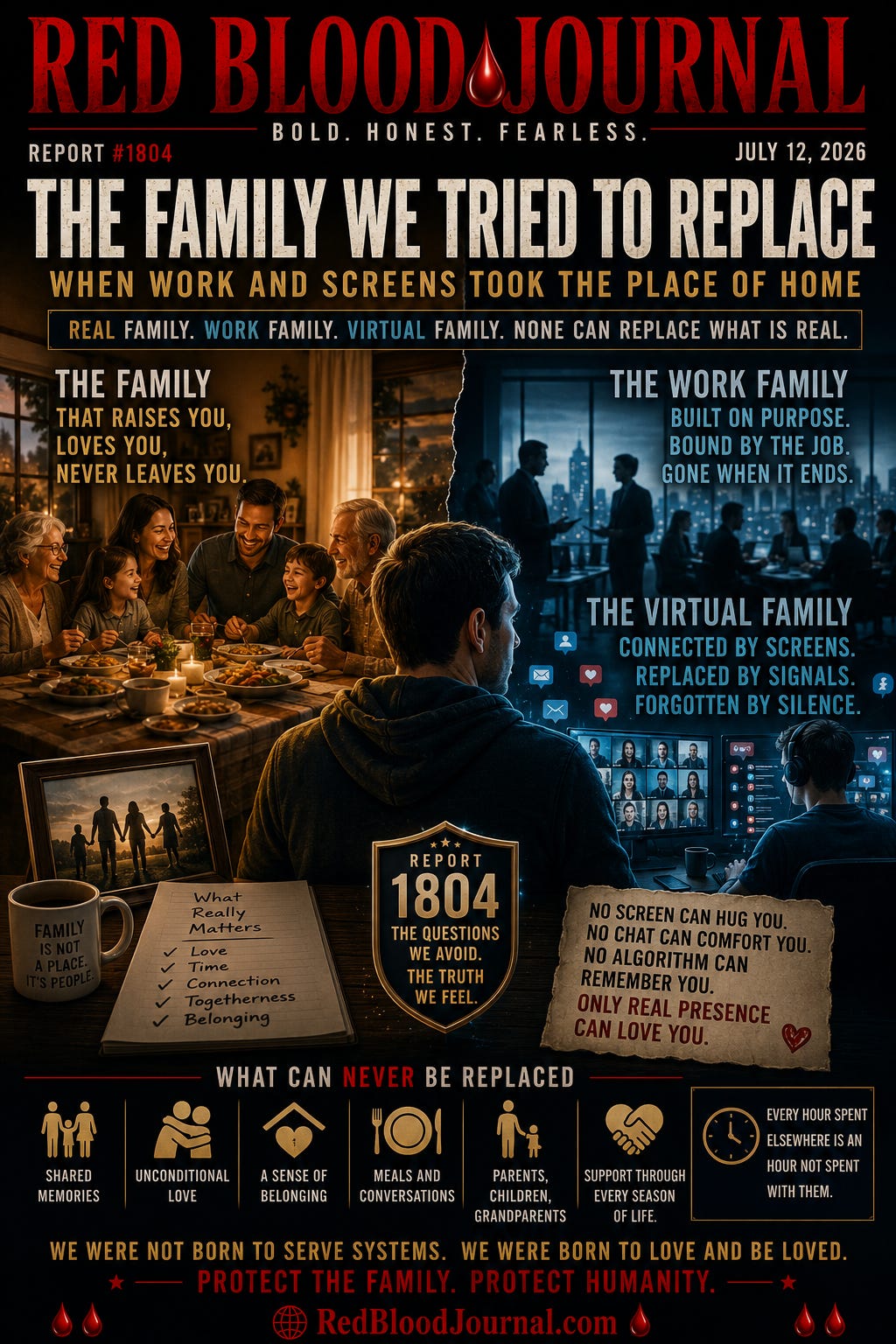
🩸 RED BLOOD JOURNAL
REPORT #1804
The Family We Tried to Replace
When Work, Then Screens, Quietly Took the Place of Home
RedBloodJournal.com
PROLOGUE
Human beings are born into families.
Long before they become employees...
Taxpayers...
Consumers...
Citizens...
Or voters...
They are sons and daughters.
For thousands of years, the family has been the primary place where people discovered love, belonging, identity, security, and purpose.
Yet modern civilization has gradually introduced substitutes.
First came the workplace.
Now comes the screen.
Neither was designed to replace the family.
Yet many people spend more time with them than with those they love most.
MY SECOND FAMILY
For much of my life, I unknowingly built my work into the family I wished I had.
The people I worked beside became companions.
We solved problems together.
Celebrated achievements.
Shared stress.
Spent thousands of hours together.
We understood each other’s routines.
We knew birthdays.
We helped one another through difficult days.
For a while, it almost felt like family.
Almost.
THE DIFFERENCE
No matter how close co-workers become...
No matter how loyal they are...
No matter how much respect exists...
The relationship remains different.
It is built around a shared purpose.
The purpose is the work.
When the work ends...
People retire.
Companies close.
Departments reorganize.
Businesses are sold.
Friends move away.
The workplace continues.
The work family slowly dissolves.
Not because the affection was false...
But because it depended upon something temporary.
A real family exists before success.
During success.
And after success.
Its foundation is not productivity.
It is relationship.
THE NEXT REPLACEMENT
Now another transition is taking place.
The workplace itself is gradually disappearing.
The office becomes remote.
Meetings become video calls.
Conversations become messages.
Colleagues become profile pictures.
Artificial intelligence answers questions once asked of coworkers.
Even the work family is becoming virtual.
We are replacing one substitute with another.
CONNECTED EVERYWHERE...
LONELY ANYWHERE
Modern technology has solved extraordinary problems.
Distance.
Communication.
Information.
Convenience.
Productivity.
But one question remains.
Has it solved loneliness?
A video call is not a hug.
An emoji is not a smile across the dinner table.
A thousand followers are not one trusted friend.
A family group chat is not the same as grandparents watching grandchildren grow.
Technology connects signals.
Families connect lives.
Those are not identical achievements.
WHAT CANNOT BE DIGITIZED
Some experiences refuse to become virtual.
Holding a newborn child.
Helping aging parents.
Preparing dinner together.
Listening without interruption.
Comforting someone who is grieving.
Laughing around a table.
Watching children become adults.
No technology has replaced these moments.
Nor should it try.
THE ECONOMY OF ATTENTION
Modern economies compete for attention.
Work demands it.
Advertising purchases it.
Entertainment captures it.
Algorithms optimize it.
Screens consume it.
Families quietly wait for what remains.
The greatest competition today may no longer be between companies.
It may be between relationships and distractions.
Every hour devoted elsewhere is an hour unavailable to the people who matter most.
WHAT DOES SUCCESS LOOK LIKE?
If a person becomes wealthy...
But hardly knows their children...
Has success been achieved?
If productivity reaches historic levels...
Yet family dinners disappear...
Has civilization advanced?
If technology extends life...
But leaves people increasingly isolated...
What exactly has improved?
These are not economic questions.
They are human questions.
THE LAST PLACE WE BELONG
Perhaps every human being spends life searching for one place where they are valued simply because they exist.
Not because they produce.
Not because they perform.
Not because they earn.
Not because they succeed.
Simply because they belong.
Healthy families often provide that place.
No government can manufacture it.
No corporation can sell it.
No technology can automate it.
No artificial intelligence can replace it.
FINAL REFLECTION
Perhaps the greatest illusion of modern civilization is not that technology has become too powerful.
It is that substitutes can eventually replace what they imitate.
Work can imitate community.
Social media can imitate friendship.
Artificial intelligence can imitate conversation.
Virtual reality can imitate presence.
But imitation is not identity.
The closer the imitation becomes, the easier it is to forget what the original felt like.
Perhaps that is why so many people feel connected...
Yet alone.
Busy...
Yet empty.
Surrounded...
Yet isolated.
Maybe the question is no longer whether technology can imitate family.
Maybe the question is whether we still remember what family was before we began replacing it.
The answer belongs not to governments...
Nor corporations...
Nor technology...
But to every person who still has someone waiting for them at home.
Or wishes they did.
🩸 RedBloodJournal.com
“A family does not love you because you are useful. A healthy family loves you because you are you.”
🩸🌊✨ Fantastic!
🏠 The Illusion of Belonging:
Reclaiming Family from Screens and Success
Jul 12, 2026
The provided text explores how modern civilization has gradually displaced traditional family bonds with temporary substitutes like the workplace and digital technology. While professional environments offer a sense of community, the author argues that these relationships are ultimately contingent on productivity and dissolve once the shared task ends. The narrative further warns that digital connectivity acts as a deceptive imitation of intimacy, providing constant interaction without the genuine emotional depth of physical presence. By prioritizing economic success and screen time, individuals risk losing the only support system that values them for who they are rather than what they produce. Ultimately, the source serves as a poignant reminder that human belonging cannot be automated, digitized, or purchased through professional achievement. Concluding with a call to prioritize authentic relationships, the text suggests that true success is found in the irreplaceable sanctuary of the home.


