


The report below uses a 27-country illustrative scorecard. It measures broad living-condition trajectories after major U.S. military, political, or sanctions involvement; it does not claim that the United States alone caused each result. Iran and Venezuela’s 2026 military developments are treated separately because their long-term consequences cannot yet be measured.
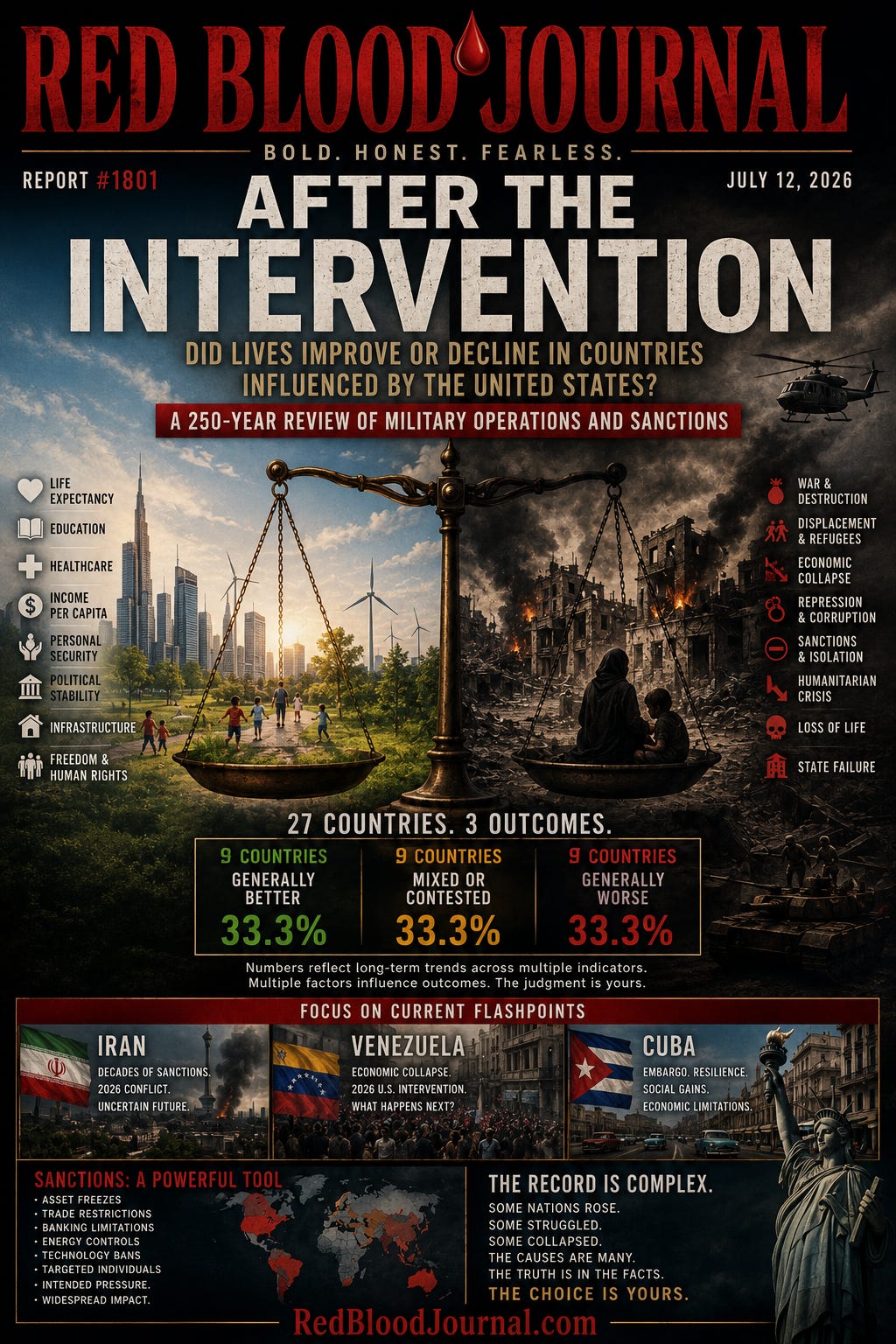
🩸 RED BLOOD JOURNAL
REPORT #1801
After the Intervention
Did Living Conditions Improve or Decline in Countries Influenced by the United States?
A comparative historical review of 27 countries
RedBloodJournal.com
PROLOGUE
Report #1800 examined approximately 250 years of American military operations, interventions, occupations, security missions, sanctions, and other instruments of international influence.
That historical record raises a second question:
What happened to the people living in the countries where the United States intervened or exercised sustained coercive influence?
Did their lives improve?
Did they become less secure?
Did governments stabilize?
Did poverty fall?
Did healthcare, education, freedom, and economic opportunity expand?
Or did intervention leave behind war, sanctions, displacement, weakened institutions, and dependence?
This report does not begin with the assumption that every American intervention succeeded.
It also does not begin with the assumption that every intervention failed.
It examines the observable record and leaves the final judgment to the reader.
THE PROBLEM WITH A SINGLE ANSWER
There is no universally accepted database that divides every U.S.-influenced country into “success” or “failure.”
Living conditions are shaped by many forces operating simultaneously:
Domestic leadership
Civil war
Ethnic and religious divisions
Colonial history
Foreign military involvement
Sanctions
Commodity prices
Corruption
Geography
Natural disasters
International aid
Decisions made by neighboring countries
Actions by Russia, China, European powers, and regional governments
For that reason, this report does not claim that the United States independently produced every positive or negative result.
It asks a narrower question:
After substantial American involvement, did the population’s overall living conditions improve, deteriorate, or produce a mixed outcome?
HOW THE COUNTRIES WERE MEASURED
The assessment considers several broad indicators:
Life expectancy
Infant and child mortality
Income per person
Access to education
Healthcare availability
Infrastructure
Political stability
Personal security
Displacement and refugee flows
Civil and political freedoms
Exposure to continuing war
Ability to obtain food, medicine, energy, and employment
The World Bank describes mortality measures as among the indicators most frequently used to compare socioeconomic development. The United Nations Human Development Index combines health, education, and material living standards into a broader measure of human progress. (Human Development Reports)
Countries were placed into three categories:
Generally Better
Most major long-term indicators improved, and the country achieved relative stability.
Mixed or Contested
Some conditions improved while others deteriorated, or improvements occurred only after long periods of violence, repression, sanctions, or instability.
Generally Worse
The population experienced sustained deterioration, large-scale displacement, institutional collapse, prolonged conflict, or severe economic hardship following the period of involvement.
These categories describe observed historical trajectories, not exclusive responsibility.
THE 27-COUNTRY SCORECARD
9 Generally Better
Germany
Japan
South Korea
Kuwait
Bosnia and Herzegovina
Kosovo
Grenada
Panama
Dominican Republic
9 Mixed or Contested
Philippines
Vietnam
Cuba
Serbia
Lebanon
El Salvador
Nicaragua
Haiti
Somalia
9 Generally Worse
Iraq
Afghanistan
Libya
Syria
Yemen
Cambodia
Laos
Iran
Venezuela
THE RESULT
Within this selected group of 27 countries:
Observed outcomeCountriesPercentageGenerally better933.3%Mixed or contested933.3%Generally worse933.3%
The result is not a universal scientific verdict.
It is a structured historical assessment showing that the record cannot honestly be described as either overwhelmingly successful or overwhelmingly disastrous.
Approximately one-third of the selected countries show broadly better long-term conditions.
Approximately one-third show mixed, incomplete, or heavily contested outcomes.
Approximately one-third show broadly worse conditions.
CATEGORY ONE: GENERALLY BETTER
Germany and Japan
Germany and Japan are usually cited as the strongest examples of successful postwar occupation and reconstruction.
Both countries suffered catastrophic destruction during World War II. Both were occupied, demilitarized, institutionally reorganized, and incorporated into a U.S.-led security and economic order.
Over subsequent decades, both became wealthy democracies with high life expectancy, extensive infrastructure, strong educational systems, and globally important economies.
However, their recovery cannot be attributed to occupation alone.
Both possessed educated populations, established industrial capacity, administrative institutions, and access to extensive reconstruction assistance.
Their experiences therefore cannot automatically be duplicated in countries with different histories or institutional foundations.
South Korea
The United States intervened in the Korean War after North Korea invaded the South in 1950.
The war ended in an armistice rather than a peace treaty, and South Korea remained authoritarian for decades afterward.
Over time, however, South Korea developed into a high-income democracy with major technological, industrial, educational, and healthcare achievements.
The Korean case demonstrates that battlefield survival and long-term development can eventually produce a positive outcome, while also showing that the path may include dictatorship, repression, and decades of insecurity.
Kuwait
The U.S.-led coalition expelled Iraqi forces from Kuwait during Operation Desert Storm in 1991.
The operation accomplished its principal military objective: restoring Kuwait’s government and territorial control.
Kuwait remained wealthy and avoided the prolonged occupation and institutional destruction later experienced by Iraq.
Its outcome is therefore commonly treated as a relatively clear military success, although Kuwait’s political system and treatment of migrant workers remain subjects of criticism.
Bosnia and Kosovo
American and NATO involvement in Bosnia and Kosovo helped end or contain mass violence and ethnic displacement.
Bosnia obtained a durable peace but retained a complicated and frequently paralyzed political system.
Kosovo achieved de facto separation from Serbia and developed its own institutions, although its international status remains disputed.
Both cases produced greater physical security than existed during the wars, but neither represents a simple or complete political resolution.
Grenada, Panama, and the Dominican Republic
These three cases involved direct American military intervention and political restructuring.
Each later experienced periods of electoral government and economic growth.
However, critics argue that their later development reflected domestic choices, global trade, tourism, financial services, and regional economic conditions—not merely U.S. military action.
They are classified as generally better because broad living conditions eventually improved, not because every aspect of the interventions was necessarily justified or beneficial.
CATEGORY TWO: MIXED OR CONTESTED
The Philippines
The Philippines developed national institutions, education systems, and a long-term security relationship with the United States.
It also experienced colonial war, repression, unequal development, dictatorship, insurgency, and continuing poverty.
The country improved in several measurable areas, but the human cost of colonization and war prevents the outcome from being classified as an uncomplicated success.
Vietnam
The Vietnam War caused enormous casualties, destruction, displacement, and environmental damage.
The United States did not achieve its stated objective of preserving South Vietnam as a separate noncommunist state.
Vietnam later reunified under communist rule and, decades after the American withdrawal, achieved substantial economic growth and poverty reduction.
The present improvement in Vietnamese living standards occurred largely after the war and after later market reforms.
Vietnam is therefore neither a simple long-term failure nor evidence that the intervention produced the country’s later development.
Cuba
The relationship between Cuba and the United States has included intervention, the Bay of Pigs invasion, covert action, diplomatic isolation, and a sanctions structure lasting more than six decades.
Cuba produced substantial achievements in literacy, basic healthcare, and life expectancy.
It also experienced political repression, low wages, shortages, migration, restricted economic opportunity, and long-term limits on political opposition.
The Cuban government attributes much of the country’s economic hardship to the American embargo.
U.S. officials attribute hardship principally to the Cuban government’s political and economic system.
Both factors can operate at the same time.
In 2026, the United States expanded restrictions through Executive Order 14404 and additional designations affecting Cuban military, security, and commercial entities. (OFAC)
Haiti and Somalia
Haiti and Somalia received repeated American or multinational interventions intended to restore order, deliver humanitarian assistance, protect civilians, or support political transitions.
Some missions saved lives during immediate emergencies.
Neither country achieved durable institutional stability.
Both experienced recurring political crises, armed groups, poverty, displacement, and weak government capacity.
The short-term humanitarian results and poor long-term institutional outcomes place them in the mixed category.
Lebanon, Nicaragua, El Salvador, and Serbia
Each experienced different combinations of civil conflict, foreign involvement, political pressure, military support, sanctions, or NATO action.
Each also experienced periods of reconstruction and improved living standards.
However, unresolved political divisions, migration, inequality, corruption, institutional distrust, or geopolitical tension continue to complicate the record.
CATEGORY THREE: GENERALLY WORSE
Iraq
The 2003 invasion removed Saddam Hussein’s government.
It also dismantled major state institutions, contributed to an insurgency, intensified sectarian conflict, and created conditions later exploited by the Islamic State.
Iraq eventually established elections and rebuilt portions of its economy and infrastructure.
However, the country endured mass casualties, displacement, corruption, institutional weakness, militia power, and repeated insecurity.
The removal of a dictatorship was a clear political change.
Whether that change produced a better life for most Iraqis remains heavily disputed.
Afghanistan
The 2001 intervention removed the Taliban from national power and disrupted al-Qaeda’s operating base.
During the following two decades, Afghanistan experienced improvements in education, urban healthcare, communications, and opportunities for many women.
It also remained dependent on foreign aid, suffered persistent warfare, corruption, civilian casualties, and institutional fragility.
The Taliban returned to power in August 2021 after the withdrawal of U.S. forces.
Some social gains survived; others were reversed.
Measured against the original expectation of a stable democratic Afghanistan, the outcome is generally classified as worse or unsuccessful.
Libya
The 2011 intervention helped prevent an immediate assault on Benghazi and contributed to the collapse of Muammar Qaddafi’s government.
No stable national political order replaced it.
Libya experienced competing governments, armed militias, foreign interference, human trafficking, infrastructure deterioration, and recurring violence.
The immediate military objective was achieved.
The postwar political outcome was substantially worse than anticipated.
Syria and Yemen
U.S. involvement in Syria and Yemen formed only part of wider wars involving domestic governments, insurgent movements, terrorist groups, regional powers, Russia, Iran, Saudi Arabia, Turkey, and other actors.
Neither war can be attributed to the United States alone.
Nevertheless, military operations, proxy support, sanctions, and external intervention became part of conflicts that produced large-scale death, displacement, economic collapse, and humanitarian suffering.
Modern research finds that armed conflict can damage development through destruction, disruption, reduced investment, institutional deterioration, and the diversion of resources away from civilian needs. (ScienceDirect)
Cambodia and Laos
Large-scale bombing and covert military operations expanded into Cambodia and Laos during the Vietnam War.
Both countries suffered extensive destruction and long-term contamination from unexploded ordnance.
Cambodia later experienced the Khmer Rouge genocide, whose rise had multiple domestic and international causes.
Laos remained economically isolated and heavily affected by the physical legacy of war.
The history of these countries demonstrates that military consequences can continue long after the aircraft, soldiers, and political leaders have departed.
IRAN: DECADES OF PRESSURE AND A NEW WAR
American influence over Iran has taken several forms:
The 1953 overthrow of Prime Minister Mohammad Mossadegh
Support for the Shah
Sanctions after the 1979 Revolution
Maritime clashes during the Iran–Iraq War
Nuclear negotiations
The 2020 killing of Qasem Soleimani
Strikes on Iranian nuclear facilities in June 2025
Operation Epic Fury beginning on February 28, 2026
The Pentagon stated that Operation Epic Fury involved an intensive bombing campaign and reported the death of Supreme Leader Ali Khamenei during its opening phase. (U.S. Department of War)
Iran had already endured inflation, currency weakness, restricted international trade, shortages, political repression, and outward migration before the 2026 operation.
The Iranian government bears responsibility for domestic governance, military expenditures, regional policies, repression, and economic management.
American sanctions and military pressure also affected trade, investment, banking, energy exports, medicine procurement, and the wider economic environment.
Because the 2026 operation is recent, its long-term outcome cannot yet be known.
Iran is placed in the generally worse category based on the condition of its population across decades of combined internal mismanagement, repression, sanctions, confrontation, and isolation—not as a final judgment on the still-unfolding 2026 conflict.
VENEZUELA: SANCTIONS, COLLAPSE, AND THE 2026 INTERVENTION
Venezuela suffered severe economic and institutional decline before the direct American military action of 2026.
Major contributing factors included:
Dependence on oil
Falling production
Price controls
Currency destruction
Corruption
Political repression
Mismanagement
International sanctions
Capital flight
Mass migration
On January 3, 2026, the Pentagon announced that U.S. forces had captured Nicolás Maduro during a joint extraction operation in Caracas. (U.S. Department of War)
The United States subsequently adjusted portions of its Venezuela sanctions system, authorizing selected oil, aviation, commercial, and humanitarian transactions while retaining broader restrictions. OFAC issued additional licenses during 2026, including earthquake-relief authorization in June. (OFAC)
It is too early to determine whether the 2026 intervention will produce:
Political stability
A legitimate transition
Increased oil production
Improved public services
Return migration
Renewed foreign investment
New conflict
Dependence on outside authority
Replacement of one elite structure by another
Venezuela’s pre-2026 trajectory is classified as generally worse.
The result of the 2026 intervention remains unresolved.
THE SANCTIONS QUESTION
Sanctions are often described as an alternative to war.
They may target:
Government officials
Military organizations
Banks
Energy companies
Shipping networks
Technology transfers
State-owned enterprises
Foreign intermediaries
Individuals accused of corruption, repression, terrorism, or weapons proliferation
OFAC states that sanctions may be comprehensive or selective and may use asset blocking and trade restrictions to pursue foreign-policy and national-security goals. Its active programs cover countries and issues including Iran, Cuba, Venezuela, Russia, Belarus, Myanmar, North Korea, Syria-related networks, terrorism, cyber activity, narcotics trafficking, and other targets. (OFAC)
Supporters argue that sanctions:
Apply pressure without a full military invasion
Restrict funding for weapons and repression
Isolate targeted governments
Create negotiating leverage
Punish designated officials and institutions
Critics argue that sanctions:
Raise prices for ordinary people
Reduce employment and investment
Complicate medicine and food imports
Encourage black markets
Strengthen politically connected elites
Give governments an external enemy to blame
Produce suffering without changing leadership
Both outcomes may occur simultaneously.
A sanction can weaken a government’s revenue while also reducing the purchasing power of families who had no role in making national policy.
WHAT THE NUMBERS DO—AND DO NOT—SHOW
The 33.3% better, 33.3% mixed, and 33.3% worse result should not be interpreted as a permanent universal law.
Changing the selected countries, measurement period, indicators, or definition of intervention would change the percentages.
The scorecard does show something important:
Military victory does not automatically produce better living conditions.
It also shows the opposite:
Foreign intervention does not automatically condemn a country to permanent failure.
Germany, Japan, and South Korea demonstrate that security, reconstruction, domestic institutions, education, investment, and long-term commitment can coincide with major development.
Iraq, Afghanistan, and Libya demonstrate that removing a government is much easier than constructing a stable replacement.
Vietnam shows that a country may recover and prosper decades after a failed foreign war.
Cuba, Iran, and Venezuela demonstrate the difficulty of separating the effects of sanctions from those of domestic political and economic systems.
THE DIFFERENCE BETWEEN WINNING A WAR AND IMPROVING A LIFE
Governments commonly measure military operations through:
Targets destroyed
Territory captured
Governments removed
Enemies killed
Shipping lanes reopened
Weapons programs damaged
Alliances strengthened
Populations measure outcomes differently:
Is food affordable?
Is electricity available?
Can children attend school?
Can families obtain medicine?
Can people travel?
Are jobs available?
Are streets safe?
Can citizens criticize the government?
Will another war begin?
Is tomorrow likely to be better than today?
A military operation can meet every battlefield objective and still fail the civilian population.
It can also suffer military setbacks while contributing to a longer political settlement.
The two measurements are related, but they are not identical.
FINAL ASSESSMENT
In this 27-country sample:
9 countries—33.3%—show generally better long-term living conditions.
9 countries—33.3%—show mixed or contested outcomes.
9 countries—33.3%—show generally worse outcomes.
The numbers do not prove that American involvement caused every result.
They do show that the historical record is divided.
Some populations eventually gained security, wealth, institutional strength, and international access.
Others experienced fragmented states, migration, debt, sanctions, militia rule, economic decline, or renewed war.
Others gained in one area while losing in another.
The fairest conclusion may therefore be neither celebration nor condemnation.
It may be recognition that military power can remove a government, destroy an army, defend an ally, or open a shipping lane.
It cannot by itself create trustworthy institutions, social unity, economic competence, accountable leadership, or public hope.
Those outcomes require more than weapons.
They require time, legitimacy, domestic participation, competent administration, investment, restraint, and a population that believes the future belongs to them.
The historical record has been presented.
The percentages have been stated.
The countries have been named.
The judgment belongs to the reader.
🩸 RED BLOOD JOURNAL
RedBloodJournal.com
History counts governments and battles. Humanity must also count the lives lived afterward.
🩸🌊✨ Fantastic!
⚖️ The Intervention Scorecard:
A Global History of Outcomes
Jul 12, 2026
This report from RedBloodJournal.com evaluates the long-term impact of United States intervention and influence on living conditions across 27 different nations. The study categorizes outcomes into three equal groups—generally better, mixed, or generally worse—to demonstrate that military or political involvement does not yield a uniform result. By tracking metrics like life expectancy, economic stability, and political freedom, the analysis highlights that while some countries like Japan and South Korea flourished, others like Iraq and Libya suffered institutional collapse. The text emphasizes that domestic leadership and historical context are just as influential as foreign actions in determining a population’s welfare. Ultimately, the source argues that military success is distinct from human progress, as removing a regime is far simpler than building a prosperous society. The scorecard serves as a historical assessment rather than a definitive scientific verdict, leaving final interpretations of success or failure to the reader.


