


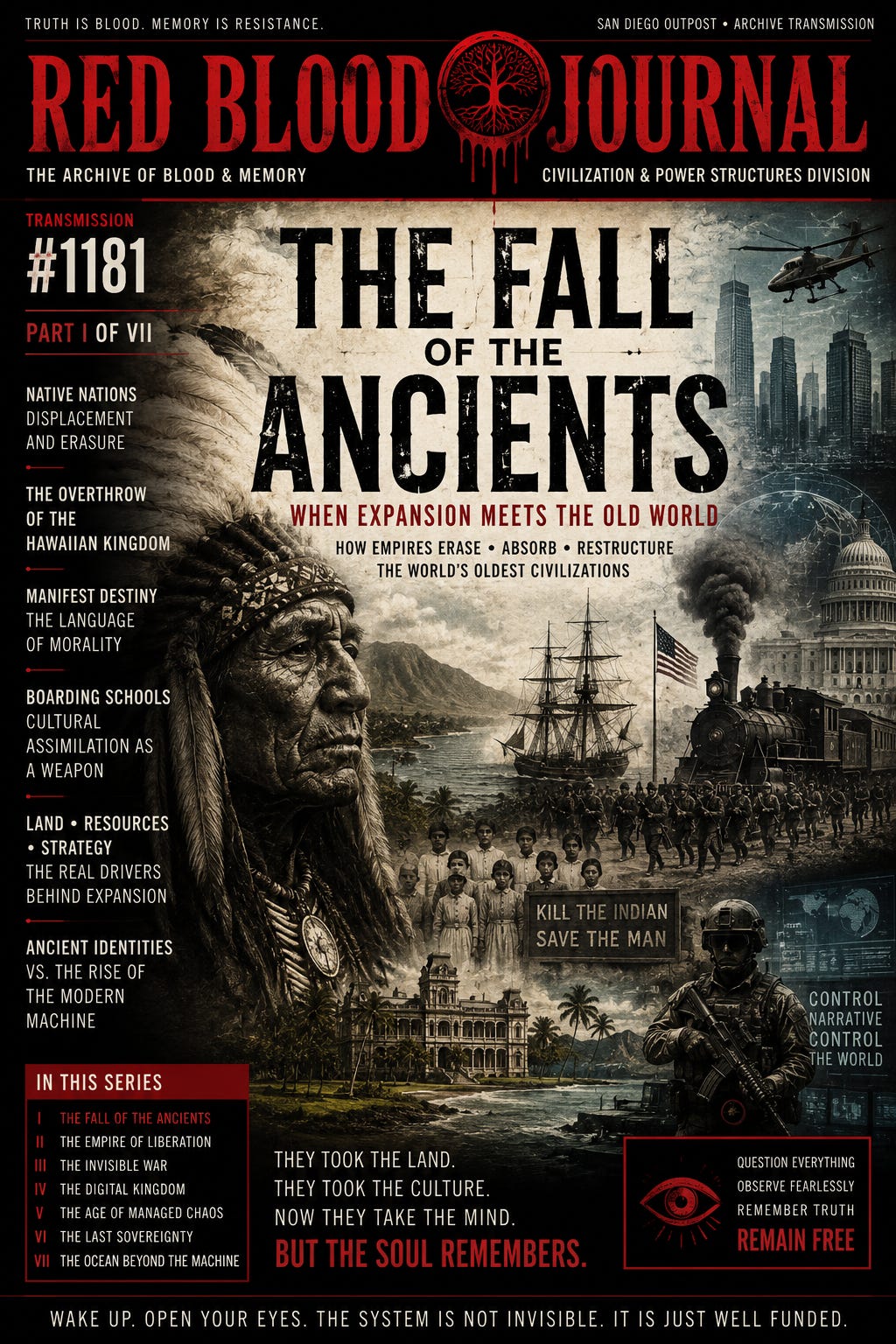
🩸 RED BLOOD JOURNAL TRANSMISSION #1181
PART I OF VII — THE FALL OF THE ANCIENTS
“When Expansion Meets the Old World”
Archive: The Archive of Blood & Memory
Division: Civilization & Power Structures Division
Transmission Code: RBJ-1181-ANCIENTS-I
Classification: Open Historical Analysis Transmission
Status: Active Transmission
Origin Node: San Diego Outpost
Series: THE ARCHITECTS OF ORDER
Part: I of VII
PROLOGUE — THE DUST UNDER THE FOUNDATIONS
Every empire tells the same story about itself.
It arrived to civilize.
It arrived to modernize.
It arrived to bring order.
It arrived to spread progress.
It arrived to save.
Yet beneath nearly every modern capital city, every monument, every flag, every financial district, every military base, and every polished narrative of expansion… lies the dust of older worlds.
Ancient civilizations do not usually disappear naturally.
Most are absorbed.
Restructured.
Fragmented.
Commercialized.
Or erased slowly enough that future generations mistake the process for inevitability.
The modern world often speaks about history as if ancient societies simply “faded away,” as though industrial civilization naturally replaced them through superior advancement. But when the curtain is pulled back, another pattern emerges:
The expansion of centralized systems repeatedly collides with decentralized civilizations.
And in nearly every case, the centralized machine survives by consuming the older structure.
SECTION I — THE CONTINENT BEFORE THE MACHINE
Before the rise of the United States, North America was not an empty wilderness waiting to be discovered.
It was a continent of nations.
Complex civilizations existed across the land:
trade routes stretching thousands of miles,
agricultural systems,
governance councils,
spiritual traditions,
ecological stewardship,
oral libraries of memory and law.
The modern mind often underestimates ancient societies because they did not mirror industrial Europe.
But absence of industrialization does not equal absence of civilization.
Many Indigenous cultures operated through distributed systems rather than centralized empires:
tribal federations,
consensus governance,
land stewardship,
communal responsibility,
spiritual integration with nature.
To expanding industrial powers, such decentralized systems presented both an obstacle and an opportunity.
The land was valuable.
The resources were immense.
The territory was strategic.
But the civilizations occupying those lands stood outside the emerging architecture of centralized industrial expansion.
And history repeatedly demonstrates a brutal reality:
Empires rarely tolerate independent systems sitting on top of valuable territory.
SECTION II — MANIFEST DESTINY AND THE LANGUAGE OF MORALITY
Expansion rarely introduces itself honestly.
Instead, it dresses itself in moral language.
In the United States, one of the most powerful ideological mechanisms was the doctrine later known as “Manifest Destiny” — the belief that continental expansion was natural, justified, and historically inevitable.
The language sounded spiritual.
Civilizational.
Almost sacred.
But beneath the poetry stood material reality:
land acquisition,
resource control,
strategic dominance,
population expansion,
economic growth.
Every empire develops a vocabulary that transforms expansion into righteousness.
The Roman Empire spoke of civilization.
European colonial powers spoke of enlightenment.
Modern interventions speak of democracy, security, and liberation.
The wording evolves.
The mechanism remains familiar.
The moral story softens the psychological burden of conquest.
SECTION III — THE DESTRUCTION OF MEMORY
The elimination of ancient civilizations is not achieved solely through warfare.
The deeper victory comes from erasing memory itself.
Physical conquest can seize territory.
Cultural conquest reshapes reality.
This is why so many systems throughout history targeted:
language,
education,
religion,
identity,
family structures,
historical narratives.
The Indigenous boarding school systems across North America revealed this mechanism clearly.
Children were separated from ancestral traditions.
Languages were forbidden.
Names were changed.
Identity itself became the battlefield.
The objective was not merely land acquisition.
It was transformation.
A civilization disconnected from memory becomes easier to absorb into the expanding structure surrounding it.
When ancient identity weakens, centralized identity takes its place.
The old world becomes mythology.
The new system becomes reality.
SECTION IV — THE OVERTHROW OF THE OLD KINGDOMS
The pattern did not stop on the mainland.
The overthrow of the Hawaiian Kingdom revealed another layer of modern expansion.
Hawaii was not an unclaimed paradise.
It was an internationally recognized sovereign kingdom with:
diplomatic relations,
governance systems,
cultural identity,
and strategic importance in the Pacific.
But strategic geography often attracts expanding powers.
Economic interests, military positioning, and geopolitical ambition converged.
The monarchy fell.
Foreign influence deepened.
Military infrastructure expanded.
Over time:
language diminished,
land ownership shifted,
tourism transformed sacred spaces into commercial zones,
and strategic military significance overtook indigenous sovereignty.
Again, the modern system framed the transformation as progress.
Yet from another angle, it represented the absorption of an ancient identity into a growing imperial structure.
SECTION V — THE MACHINE REQUIRES STANDARDIZATION
Ancient civilizations tend to be local.
Empires tend to centralize.
This creates an unavoidable tension.
Decentralized cultures preserve:
local traditions,
independent identity,
regional memory,
unique spiritual systems,
and alternative ways of organizing life.
Large centralized systems require:
standardization,
administrative uniformity,
economic integration,
infrastructure compatibility,
and ideological cohesion.
The larger the machine becomes, the more difficult independent civilizations become to tolerate.
What cannot be integrated becomes marginalized.
What cannot be standardized becomes targeted.
What cannot be controlled becomes reframed as primitive, dangerous, or outdated.
This pattern is not unique to one country.
It echoes throughout history:
Rome,
colonial Europe,
communist revolutions,
industrial empires,
modern technocratic systems.
The tools evolve with time:
swords become laws,
cavalry becomes banking,
missionaries become media,
occupation becomes digital integration.
But the gravitational pull toward centralization remains remarkably consistent.
SECTION VI — THE SILENT QUESTION
The modern world celebrates expansion because expansion built the world most people now inhabit.
Roads.
Cities.
Industries.
Technology.
Global trade.
Financial systems.
Military protection.
But history contains another question rarely explored deeply enough:
What disappeared to make the modern world possible?
Which civilizations were crushed, absorbed, or erased beneath the foundations of modern power?
Which languages vanished?
Which spiritual traditions dissolved?
Which identities became museum artifacts?
Which ancient memories survive only in fragments?
And perhaps most importantly:
Does every expanding system eventually require the sacrifice of independent human identity in exchange for larger centralized order?
TRANSMISSION CLOSING
The first phase of empire is not always military.
Often it begins psychologically.
A civilization must first be convinced that:
expansion is morality,
centralization is progress,
standardization is civilization,
and ancient memory is backwardness.
Only then can the machine expand cleanly across the horizon while calling itself liberation.
The ancient world rarely disappears in a single moment.
It disappears piece by piece…
until future generations inherit the new structure and mistake it for the natural order of reality itself.
END TRANSMISSION — RBJ #1181
PART I OF VII — THE FALL OF THE ANCIENTS
🏛️ The Architecture of Order:
Centralization and the Ancient World
May 27, 2026
This historical analysis examines how centralized imperial powers systematically consume and replace decentralized ancient societies.
The text argues that modern expansion is often framed as moral progress or inevitable modernization, though it actually relies on the disruption of memory, language, and local governance.
Through examples like the colonization of North America and the annexation of Hawaii, the author illustrates a recurring pattern of cultural absorption and resource acquisition.
The source posits that empires achieve dominance not just through force, but by standardizing human identity and erasing traditional structures to serve a larger industrial machine.
Ultimately, it challenges the reader to consider the hidden human costs buried beneath the foundations of contemporary global civilization.


