


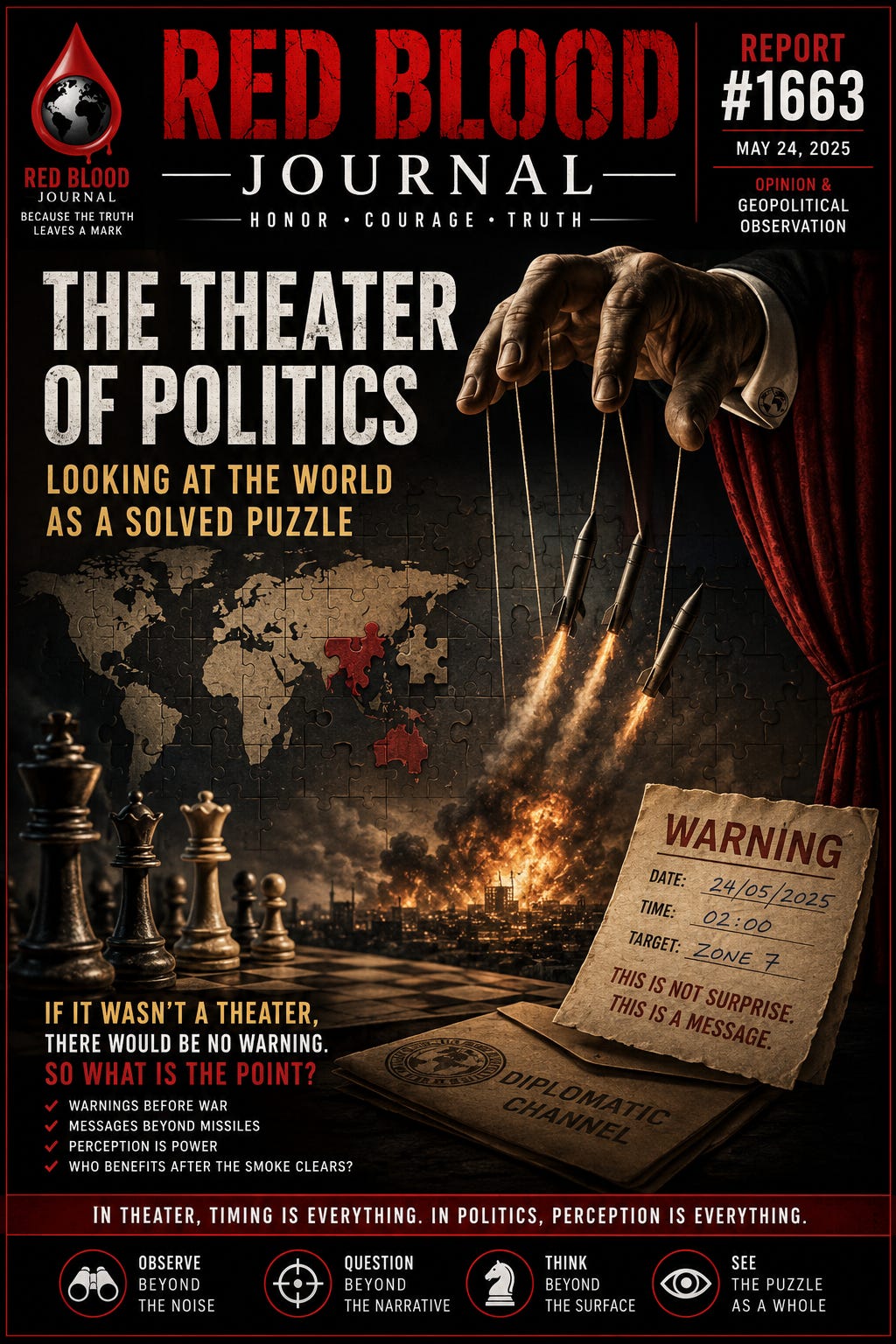
🩸 RED BLOOD JOURNAL — REPORT #1663
The Theater of Politics: Looking at the World as a Solved Puzzle
Classification: Opinion & Geopolitical Observation
Introduction
Most people observe world events one headline at a time. They ask who attacked first, who retaliated, and who appears to be winning.
A different approach is to imagine the puzzle has already been solved.
Instead of viewing each event as an isolated incident, step back and examine recurring patterns. Sometimes the sequence itself raises questions that deserve careful consideration.
The Question Behind the Missiles
Throughout modern conflicts, there have been documented occasions where governments or militaries have issued warnings before military operations. Airspace has been cleared, embassies notified, civilians warned, or communication channels used to reduce the risk of unintended escalation.
These actions are often explained as humanitarian measures designed to minimize civilian casualties or prevent a regional war from expanding.
Yet they also invite another question.
If the primary objective of every strike were maximum destruction, why would there sometimes be advance warning?
That question alone does not prove any particular conclusion. However, it encourages observers to think beyond the immediate spectacle and examine the broader strategic purpose of military actions.
Politics as Public Performance
Modern warfare is fought on two battlefields.
The first is the physical battlefield.
The second is the battlefield of public perception.
Televised explosions, official statements, emergency meetings, sanctions, financial market reactions, and diplomatic speeches all become part of a larger narrative presented to billions of people around the world.
Military action can serve multiple objectives simultaneously:
Achieving tactical military goals.
Sending strategic messages to allies and adversaries.
Influencing domestic public opinion.
Demonstrating political resolve.
Managing international alliances.
The visible event may therefore represent only one layer of a much larger strategic picture.
Looking at the Puzzle Backwards
Imagine beginning at the end rather than the beginning.
Instead of asking:
“Who fired first?”
Ask:
“Who benefited from everything that happened afterward?”
Instead of asking:
“Who appears to be winning today?”
Ask:
“What long-term political, economic, or strategic changes emerged because the conflict occurred?”
Viewing history from this perspective does not require assuming hidden coordination or predetermined outcomes. It simply encourages the observer to examine incentives, recurring patterns, and historical precedents before reaching conclusions.
Observation Before Conclusion
History repeatedly demonstrates that international conflicts involve far more than battlefield operations. Diplomacy, deterrence, intelligence, economics, domestic politics, and public messaging all influence the decisions made by governments.
Recognizing these layers is not the same as claiming certainty about unseen motives.
The disciplined observer distinguishes between established facts, reasonable inferences, and personal hypotheses.
The search for understanding begins not with certainty, but with asking better questions.
Final Reflection
Perhaps the greatest lesson is that politics often resembles a complex stage where military power, diplomacy, economics, and public perception interact simultaneously.
Whether one interprets these interactions as strategic statecraft, crisis management, or political theater, the responsibility of the observer remains the same:
Observe carefully.
Question respectfully.
Separate evidence from assumption.
Allow patterns to emerge before drawing conclusions.
In a world filled with noise, thoughtful observation remains one of the most valuable tools available to any citizen.
🎭 The Theater of Strategy:
Geopolitics as Choreographed Performance
Jul 11, 2026
This text presents a unique framework for interpreting geopolitics by treating global conflicts as strategic theater rather than isolated events. It suggests that modern warfare operates on two levels: the physical battlefield and the battlefield of public perception, where military strikes often serve as symbolic messages. By analyzing recurring patterns and the long-term beneficiaries of a crisis, observers can move beyond emotional headlines to see a broader strategic picture. The author highlights how actions like advance warnings before strikes indicate that military objectives are frequently balanced with diplomatic signaling and domestic political needs. Ultimately, the source encourages a disciplined approach to news consumption that prioritizes careful observation and the questioning of incentives over immediate assumptions. This perspective invites the reader to view history as a solved puzzle, where the outcomes reveal the true motivations behind the initial spectacle.


