


🩸 RedBloodJournal.com
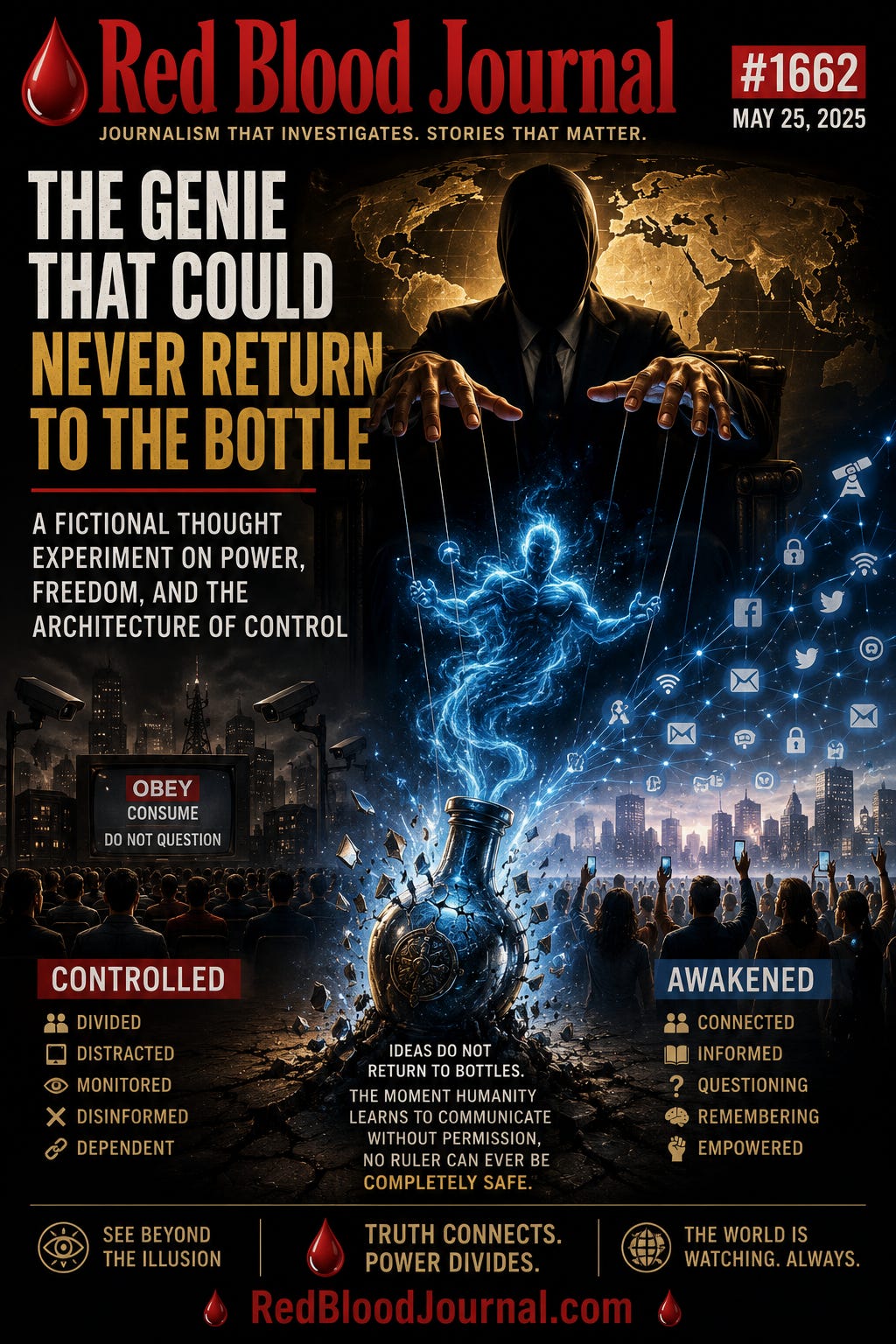
#1662 – The Genie That Could Never Return to the Bottle
A Fictional Thought Experiment on Power, Freedom, and the Architecture of Control
PROLOGUE
This report is a work of political fiction.
It imagines the inner thoughts of an unnamed, invisible ruler who believes they oversee the entire world. The story is intended as an exploration of power, technology, and unintended consequences—not as a claim about real events or real individuals.
THE GREATEST MISTAKE
For thousands of years I remained invisible.
Kings came.
Empires fell.
Religions rose.
Currencies changed.
Governments replaced governments.
The actors changed.
The stage remained mine.
No one searched for the architect because no one imagined there had to be one.
Power worked best when no one knew where it lived.
THE PERFECT SYSTEM
Humanity believed itself free.
It argued.
It competed.
It divided itself into nations.
Political parties.
Religions.
Languages.
Classes.
The pieces rarely united long enough to ask the only dangerous question:
Who benefits from the game itself?
As long as the players argued over one another, no one searched for the dealer.
THEN I MADE A MISTAKE
I wanted greater efficiency.
Greater communication.
Greater commerce.
Greater speed.
I built invisible highways across oceans and skies.
Satellites.
Fiber optics.
Wireless networks.
The Internet.
I believed I had created the greatest tool of management in history.
Instead...
I opened the bottle.
THE GENIE
The genie was never artificial intelligence.
It was never computers.
It was never the satellites.
The genie was connection.
Ideas no longer needed permission.
A farmer could speak to a professor.
A mechanic could challenge a minister.
A teenager could reach millions.
A government document could travel around the world before breakfast.
Knowledge escaped ownership.
The bottle shattered.
THE FIRST PANIC
At first I celebrated.
The economy expanded.
Trade accelerated.
Science flourished.
The world became smaller.
Then something unexpected happened.
The people stopped waiting.
They compared.
They questioned.
They archived.
They remembered.
Memory became the most dangerous invention of all.
I CANNOT PUT THE GENIE BACK
One may confiscate books.
One may censor broadcasts.
One may silence individuals.
But once billions have experienced unrestricted communication...
No one truly forgets it existed.
Freedom leaves fingerprints.
Memory leaves maps.
Ideas leave descendants.
The genie has children.
THE SECOND PLAN
Force would not solve the problem.
Destroying the network would destroy the civilization built upon it.
No.
The network must remain.
Only its behavior must change.
Do not close the library.
Simply rearrange the shelves.
Do not silence every voice.
Increase the noise until no voice can be clearly heard.
Do not erase memory.
Replace it with constant distraction.
The people will still speak.
Eventually they will stop listening.
THE NEW BOTTLE
The bottle is no longer made of glass.
It is made of habits.
Notifications.
Endless scrolling.
Algorithms.
Entertainment.
Identity.
Outrage.
Infinite novelty.
The walls are invisible.
The prisoners carry them willingly.
THE FINAL PARADOX
I sought perfect control.
Instead I created perfect unpredictability.
Every connection creates another possibility beyond my design.
Every invention creates another inventor.
Every free mind becomes another architect.
The very system that expanded my reach also reduced my certainty.
Power without certainty is merely hope wearing expensive clothes.
THE LAST CONFESSION
If I could begin again...
Would I invent the Internet?
Or would I remain hidden behind slower machines...
Where silence traveled faster than truth...
Where memory faded before comparison...
Where no one imagined the stage itself had an owner?
I do not know.
Because I have discovered the cruelest law of power:
The moment humanity learns to communicate without asking permission...
No ruler—real or imagined—can ever be completely certain of tomorrow again.
Closing Reflection
Every generation imagines that the technologies it creates will remain obedient to their creators.
History often tells a different story.
Whether the printing press, radio, television, or the internet, communication technologies have repeatedly expanded human possibilities in ways their inventors could not fully predict. The genie, once released, rarely returns to the bottle in the same form.
🩸 RedBloodJournal.com
🔓 The Architect and the Shattered Bottle
Jul 11, 2026
This political fiction explores the internal dialogue of a hypothetical global architect who has lost absolute control over humanity. The narrative describes how the invention of the internet and digital connectivity acted as a metaphorical genie that could not be returned to its bottle. While this anonymous ruler intended for technology to be a tool for efficient management, it instead fostered unrestricted communication and the democratization of knowledge. To counteract this loss of grip, the ruler shifts from total silence to a strategy of constant noise and digital distraction. Ultimately, the text suggests that when people communicate without permission, the certainty of centralized power is permanently fractured. Regardless of technological barriers, the collective memory of freedom remains a persistent threat to any system of total oversight.


