


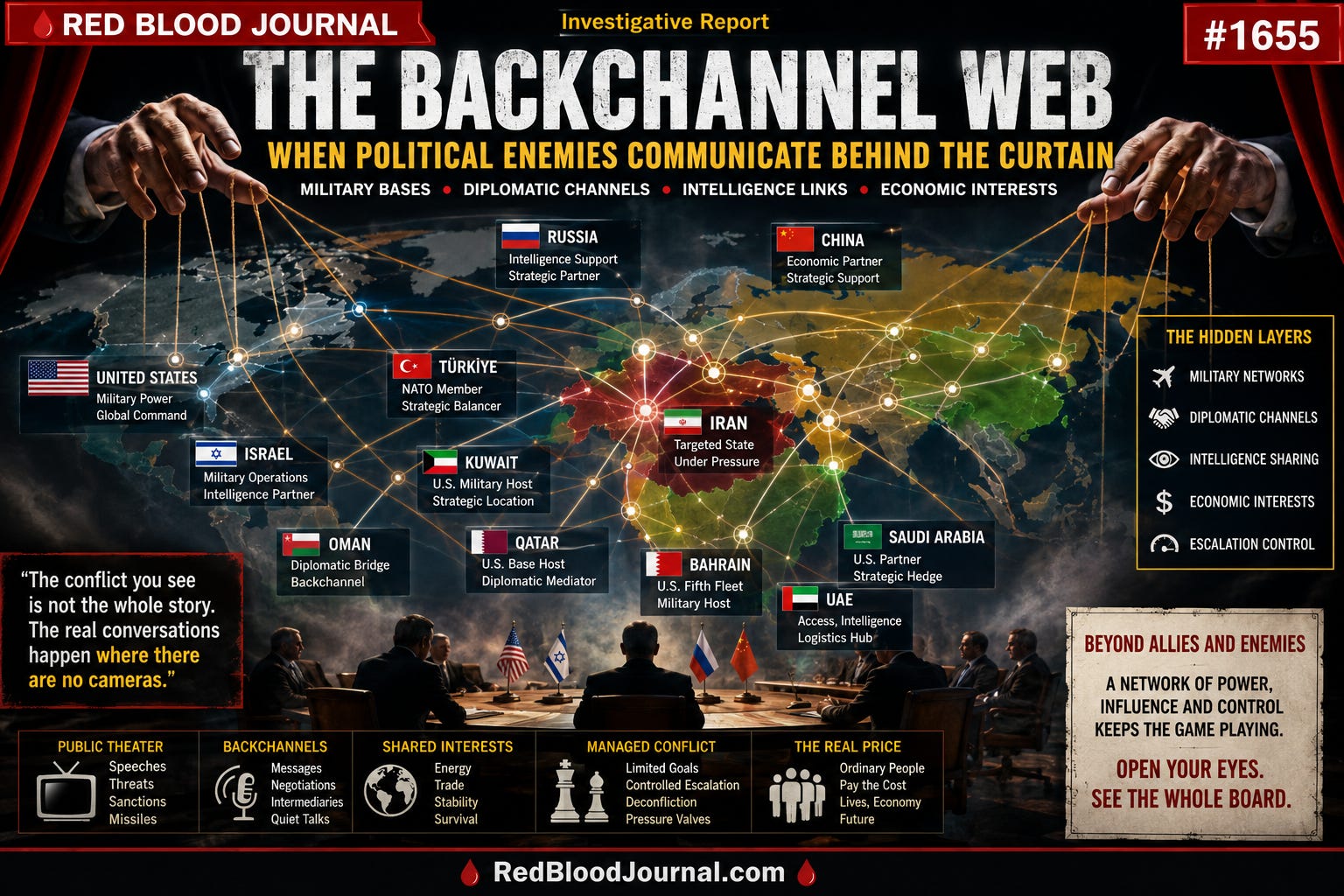
🩸 RED BLOOD JOURNAL — INVESTIGATIVE REPORT
#1655 – The Backchannel Web
When Political Enemies Communicate Behind the Curtain
Classification: Geopolitical Analysis / Intelligence Networks / Managed Conflict
Publication: RedBloodJournal.com
PROLOGUE — THE FIGHT IN THE RING AND THE MEETING BACKSTAGE
International politics is presented to the public as a contest between clearly separated camps.
One government is called an ally.
Another is called an enemy.
A third claims neutrality.
Military bases are activated, threats are broadcast, missiles are launched, sanctions are announced, and television commentators explain the conflict as if every participant stands permanently on one side of an invisible dividing line.
Yet the deeper structure is rarely that simple.
Countries described as enemies may continue exchanging messages through intermediaries. Governments publicly supporting one side may quietly negotiate with the other. States hosting foreign military forces may simultaneously act as diplomatic messengers. Economic partners may condemn one another in public while protecting trade, energy, and security interests in private.
The visible confrontation may therefore resemble professional wrestling.
The impact can be real.
The injuries can be real.
The fear experienced by ordinary people can be real.
But behind the curtain, participants may still communicate, negotiate the limits of escalation, and protect relationships that the public is never shown.
This report does not claim that every conflict is fake or that all governments belong to one unified secret organization.
It examines a more supportable conclusion:
Public enemies are often connected through a dense network of military arrangements, diplomatic intermediaries, intelligence channels, financial interests, and controlled communication.
The theater is not necessarily that nothing is happening.
The theater may be that the public is shown only the stage.
I. THE PUBLIC MAP IS TOO SIMPLE
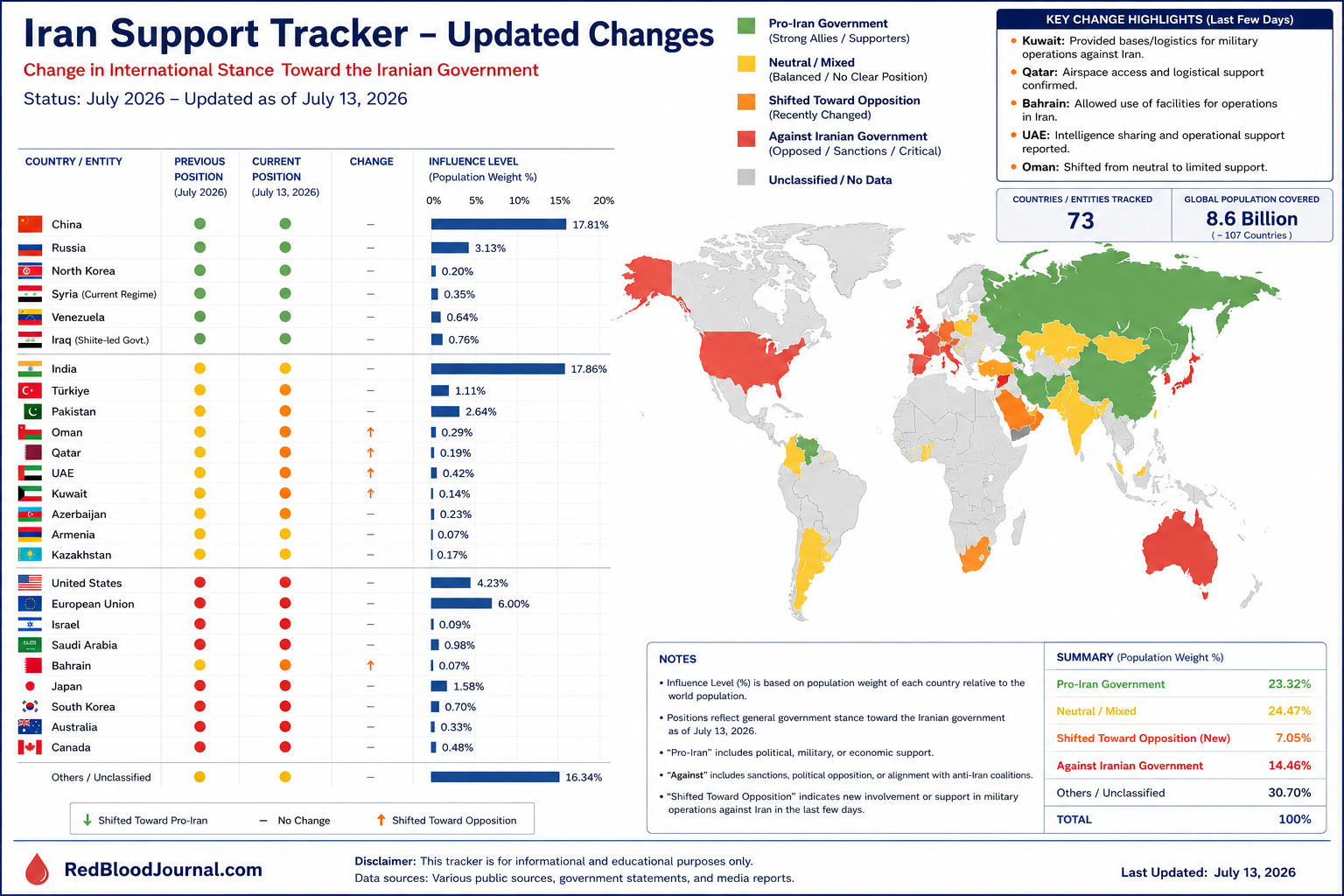
Political maps commonly divide countries into three categories:
Pro-Iran
Anti-Iran
Neutral
Such classifications are useful for visual presentation, but they can hide the most important reality: a government may occupy several positions at the same time.
A country may:
host American troops,
purchase Iranian energy,
negotiate with Tehran,
share intelligence with Western partners,
oppose a regional war,
and publicly declare neutrality.
This is not necessarily hypocrisy.
It is the normal operation of state power.
Governments do not behave like individual spectators choosing one team. They manage overlapping interests.
A state may oppose Iran’s regional military influence while fearing the collapse of Iran.
It may cooperate with Washington while resisting an American war.
It may allow foreign troops on its territory while denying involvement in a particular attack.
It may condemn military escalation while quietly sharing information that helps one side prepare for it.
Therefore, the true geopolitical map is not divided into fixed colors.
It is a web.
II. QATAR — THE MILITARY HOST AND THE DIPLOMATIC MESSENGER
Qatar represents one of the clearest examples of overlapping roles.
It hosts Al Udeid Air Base, a central location in the American military structure across the Middle East. The base gives the United States command, logistical, intelligence, and operational capabilities across the region.
At the same time, Qatar maintains working relations with Iran.
It has acted as a mediator in regional disputes and has carried messages between governments that do not communicate comfortably or directly.
This places Qatar in two worlds.
In the public military structure, it is closely connected to Washington.
In the diplomatic structure, it can communicate with Tehran.
This does not automatically prove that Qatar participates in every American military operation. Nor does its communication with Iran mean that it supports the Iranian government.
Its significance lies elsewhere.
Qatar demonstrates that a country can stand inside the military architecture of one side while functioning as a communication bridge to the other.
The apparent contradiction is not a breakdown in the system.
It may be the system.
III. OMAN — THE QUIET CORRIDOR
Oman has long occupied a special position in regional diplomacy.
While other governments publicly exchange threats, Oman frequently provides a quieter room where messages can pass indirectly.
American and Iranian representatives do not always need to sit at the same table for communication to occur. A mediator can receive one position, carry it to the other side, return with a response, and continue the exchange.
This process allows both governments to maintain public hostility without fully closing the door to negotiation.
The visible message may be:
We will not compromise.
The private message may be:
What terms would prevent the next escalation?
Oman therefore cannot be understood merely as neutral.
It performs a strategic function.
It acts as a pressure valve.
When the public temperature rises, a private diplomatic route remains available.
This makes it possible for conflict and negotiation to exist simultaneously.
IV. KUWAIT AND BAHRAIN — HOSTING POWER WITHOUT CONTROLLING IT
Kuwait and Bahrain occupy critical positions in the American military network.
Bahrain hosts the U.S. Fifth Fleet.
Kuwait accommodates substantial American military infrastructure and personnel.
When military operations occur in the region, the existence of these facilities immediately raises questions:
Were the host governments informed?
Were their airspaces used?
Did they provide logistical support?
Did they share intelligence?
Did they approve the operation?
Did they merely host forces whose command decisions were made elsewhere?
These are not the same questions.
A country hosting a military base is integrated into a security structure, but that does not automatically establish that its government planned or approved every mission connected to that base.
The distinction is essential.
Political analysis becomes unreliable when military presence is treated as proof of direct operational participation.
The more accurate conclusion is:
Kuwait and Bahrain are part of the infrastructure that makes American regional power possible, but evidence is still required before attributing specific attacks directly to their national governments.
This is precisely where the backstage system becomes difficult to observe.
Responsibility is distributed.
Commands may come from one capital.
Aircraft may depart from another territory.
Intelligence may be gathered elsewhere.
Refueling may occur in another airspace.
The public searches for one actor, while the operation may depend on a network.
V. THE UNITED ARAB EMIRATES — ACCESS, INTELLIGENCE, AND DENIAL
The United Arab Emirates maintains deep military and security relationships with the United States.
American personnel and aircraft have operated from Emirati facilities, and the UAE has developed significant surveillance, intelligence, and defense capabilities of its own.
At the same time, the Emirates maintains commercial and diplomatic relations with Iran.
Trade continues even when political tensions rise.
Iranian businesses, capital, and regional commerce have historically passed through Emirati channels.
This creates another dual relationship.
The UAE may oppose aspects of Iranian policy while preserving economic ties.
It may cooperate with American defense systems while avoiding open war.
It may possess useful intelligence without publicly acknowledging how that intelligence is shared.
Accusations of covert operational assistance must still be treated as allegations unless supported by reliable evidence.
But the structural possibility is undeniable.
The UAE sits at the intersection of:
American military access,
Gulf intelligence coordination,
regional commerce,
Iranian economic connections,
and security competition.
It is not simply on one side of the map.
It is a junction.
VI. SAUDI ARABIA — OPPONENT, NEGOTIATOR, AND STRATEGIC HEDGE
Saudi Arabia and Iran have competed for influence across the Middle East for decades.
Their rivalry has affected Lebanon, Syria, Iraq, Yemen, energy markets, religious leadership, and regional security.
Yet rivalry does not eliminate communication.
Saudi Arabia also has powerful reasons to prevent an unlimited war with Iran.
A major conflict could threaten:
oil facilities,
shipping routes,
investment projects,
airports,
cities,
desalination systems,
and the long-term stability of the Gulf.
Saudi Arabia therefore faces a complicated calculation.
It may rely on American military protection.
It may oppose Iranian regional influence.
It may communicate with Tehran.
It may support de-escalation.
It may privately warn both sides.
It may also prepare for conflict while publicly calling for restraint.
This is strategic hedging.
The government attempts to protect itself regardless of which direction events move.
From the public perspective, this can appear contradictory.
From the perspective of state survival, it is rational.
VII. RUSSIA — SUPPORTING IRAN WHILE MANAGING ITS OWN INTERESTS
Russia is commonly placed in the pro-Iran camp.
The two governments cooperate in military, diplomatic, and strategic areas. They share opposition to American dominance and have worked together in regional conflicts.
Reports of Russian intelligence, technical, cyber, or targeting support to Iran would represent one of the most direct backchannel connections on the pro-Iran side.
However, Russia’s relationship with Iran should not be mistaken for unconditional loyalty.
Moscow also maintains relationships with:
Gulf monarchies,
Israel,
Türkiye,
European governments,
and global energy markets.
Russia’s primary objective is not necessarily the victory of Iran.
Its objective is the expansion of Russian leverage.
A prolonged crisis can:
distract American attention,
raise energy prices,
weaken Western alliances,
increase demand for Russian diplomacy,
and force regional governments to negotiate with Moscow.
Russia may support Iran enough to prevent defeat while avoiding support so extensive that Iran becomes independent of Russian influence.
That is not friendship in the personal sense.
It is geopolitical management.
VIII. CHINA — SUPPORT WITHOUT SURRENDERING STABILITY
China is another major partner of Iran, particularly in trade, energy, diplomacy, and opposition to American sanctions.
Yet China also depends on stability.
Its economy relies upon predictable shipping routes, access to Gulf energy, international markets, and functioning relationships with both Iran and Arab states.
An uncontrolled regional war would threaten all of these interests.
China therefore has incentives to support Iran politically while discouraging actions that could destabilize the broader economic system.
Beijing may oppose American military dominance but still depend on the security environment that allows global commerce to continue.
This creates a subtle position:
China may want Iran strong enough to resist Washington, but not so emboldened that the entire Gulf economy is thrown into chaos.
Once again, the categories become blurred.
Support does not mean unlimited support.
Opposition does not mean total separation.
Every relationship has boundaries.
IX. THE INTELLIGENCE CONNECTION
The most important backstage relationships may never appear in official diplomatic statements.
Intelligence cooperation operates through different channels:
satellite imagery,
radar data,
intercepted communications,
cyber access,
aircraft tracking,
maritime surveillance,
financial monitoring,
informants,
and liaison officers.
Countries do not need to enter a formal alliance to exchange selected information.
They can share intelligence temporarily, indirectly, or through a third party.
A government may provide warning information without supporting an attack.
It may reveal a threat to protect its own territory.
It may share radar tracks while denying involvement in targeting.
It may pass information to an ally knowing that the ally could use it offensively.
This creates deliberate ambiguity.
Intelligence agencies can cooperate in one area while their governments oppose each other in another.
For example, two states may disagree over Iran while continuing to share information concerning terrorism, shipping, organized crime, or missile threats.
The intelligence world is not built on permanent friendship.
It is built on temporary usefulness.
X. THE BACKCHANNEL ARCHITECTURE
The backstage structure can be understood through five interconnected layers.
1. The military layer
This includes bases, airfields, ports, radar facilities, command centers, refueling routes, and weapons systems.
The United States maintains a regional network stretching through Qatar, Bahrain, Kuwait, the UAE, Saudi Arabia, Iraq, Jordan, Türkiye, and surrounding waters.
Russia and China maintain their own forms of military and intelligence cooperation with Iran.
The public sees the weapon.
The backstage system includes the infrastructure that allows the weapon to move.
2. The diplomatic layer
This includes intermediaries such as Oman and Qatar.
Messages can pass even when official relations are frozen.
Negotiations may continue during bombing campaigns.
Ultimatums may contain private exceptions.
Public deadlines may be extended through secret discussions.
The public sees confrontation.
The backstage system protects the possibility of agreement.
3. The intelligence layer
This includes data sharing among both allies and temporary partners.
A country may publicly claim neutrality while privately providing warnings, surveillance, or technical assistance.
The public sees national flags.
The intelligence world sees access points.
4. The economic layer
Iran trades with countries that criticize it.
Western-allied Gulf states maintain commerce with Iranian businesses.
China purchases energy.
Russia coordinates strategic interests.
Türkiye balances trade, geography, and military competition.
Economic dependence creates channels that political hostility cannot fully close.
The public sees sanctions.
The backstage system searches for exemptions, intermediaries, alternate currencies, shipping routes, and informal markets.
5. The escalation-management layer
This may be the most important layer of all.
Governments need ways to communicate what they will tolerate and what will trigger a wider war.
A military strike may be followed by a message stating that no further escalation is intended.
A retaliation may be calibrated to demonstrate strength without causing mass casualties.
A warning may be delivered through a third country before an attack.
This does not make the strike harmless or unreal.
It suggests that the boundaries of the confrontation may be negotiated.
The violence remains real for those living underneath it.
The limits may be managed by those standing above it.
XI. WHY IT RESEMBLES WWE
The professional-wrestling comparison should be understood as a metaphor, not a literal claim.
In wrestling, the audience sees opposing characters, dramatic speeches, betrayal, alliances, and confrontation.
Backstage, the participants belong to the same production system.
International politics differs because governments are independent actors, and wars produce real death, destruction, and displacement.
Yet the comparison remains useful in one respect:
The audience is encouraged to focus on the visible rivalry while the institutional relationships connecting the rivals remain largely hidden.
The governments may genuinely oppose one another.
But they also share the same international financial system.
They attend the same diplomatic institutions.
They communicate through the same intermediaries.
Their military officers study one another’s doctrine.
Their intelligence agencies maintain indirect contacts.
Their corporations trade through third countries.
Their political leaders understand that uncontrolled destruction could threaten all of them.
The disagreement may be real.
The stage management may also be real.
Both can exist together.
XII. THE CITIZENS PAY FOR THE PERFORMANCE
The most painful part of the system is that ordinary people rarely have access to the backstage conversation.
Citizens are shown speeches designed for public consumption.
They are asked to accept:
fear,
sacrifice,
military spending,
sanctions,
inflation,
shortages,
conscription,
surveillance,
and loss of life.
Meanwhile, the governments involved may continue communicating privately.
Leaders may negotiate after citizens have been told negotiation is impossible.
Trade may continue after the public has been told the enemy is completely isolated.
Warnings may be exchanged before attacks that civilians experience as sudden.
The political class may understand the limits of the confrontation.
The population is left to experience the uncertainty.
This is where the theater becomes dangerous.
The actors may know the script boundaries.
The audience does not.
XIII. WHAT CAN BE ESTABLISHED
A responsible investigation must separate evidence from interpretation.
The following conclusions are supportable:
Backchannels between hostile governments exist.
Oman and Qatar have served as intermediaries between Iran and the United States.
Several Gulf states host American military infrastructure while maintaining diplomatic or economic relations with Iran.
Russia and China cooperate with Iran while also protecting separate relationships with countries opposed to Tehran.
Military, diplomatic, intelligence, and economic roles overlap.
Public hostility does not prevent private communication.
Escalation and negotiation can occur at the same time.
These observations reveal a sophisticated backstage network.
XIV. WHAT HAS NOT BEEN ESTABLISHED
The available public evidence does not prove that:
every attack is prearranged,
every government secretly serves one central authority,
all casualties are part of a mutually agreed script,
or every apparent enemy is actually a hidden ally.
Such claims would require much stronger evidence, including:
authenticated internal documents,
command records,
intercepted communications,
financial transfers,
operational orders,
or credible testimony from individuals directly involved.
The absence of proof does not mean that deeper coordination is impossible.
It means the investigation must distinguish suspicion from conclusion.
The purpose is not to replace official propaganda with an equally rigid counter-narrative.
The purpose is to identify the hidden structures that official narratives leave out.
XV. THE MORE ACCURATE MAP
The world should not be mapped only as pro-Iran, anti-Iran, and neutral.
A more revealing map would include additional categories:
Military Host
A country providing territory, bases, ports, radar, or logistics.
Diplomatic Bridge
A country transmitting messages between opposing governments.
Intelligence Partner
A government sharing surveillance, cyber, targeting, or warning information.
Economic Intermediary
A country maintaining trade or financial channels despite political hostility.
Strategic Hedge
A state cooperating with several opposing powers at the same time.
Operational Participant
A country with confirmed involvement in planning or conducting military action.
Alleged Participant
A country accused of involvement without conclusive public proof.
Such a map would not force every government into one color.
It would show the multiple roles each state performs.
That map would look less like two opposing armies.
It would look like a nervous system.
CONCLUSION — THE TRUE ALLIANCE MAY BE THE PRESERVATION OF THE SYSTEM
The strongest conclusion is not that all governments secretly love one another.
Nor is it that every war is fake.
The stronger and more defensible conclusion is that governments presented as enemies remain connected through systems they all depend upon.
They share:
diplomatic channels,
economic interests,
intelligence contacts,
military deconfliction mechanisms,
financial networks,
energy markets,
and fear of uncontrolled collapse.
They may fight over power while cooperating to preserve the structure in which that power exists.
That may be the closest thing to a behind-the-curtain alliance.
Not an alliance of friendship.
An alliance of survival.
The public is shown the flags.
The governments manage the connections.
The citizens are told to choose a side.
The backstage operators keep every telephone line open.
And as the political wrestling continues, the ordinary population must remember one essential truth:
The conflict shown on the screen may be only one part of the relationship taking place behind it.
The punches may be real.
The suffering is certainly real.
But the full story is rarely performed in front of the audience.
🩸 RED BLOOD JOURNAL — CLOSING OBSERVATION
The purpose of exposing political theater is not to create more hatred.
It is to reduce the emotional control created by the performance.
When citizens understand that governments can threaten one another publicly while communicating privately, fear loses some of its power.
The flags may remain different.
The speeches may remain hostile.
The stage may remain loud.
But beyond the governments, the same human ocean continues beneath every border.
RedBloodJournal.com
🩸🌊✨ Fantastic!
🕸️
🕸️ The Backchannel Web: Geopolitics Behind the Curtain
Jul 10, 2026
This text explores the discrepancy between public geopolitical conflict and the hidden networks of cooperation that function behind the scenes. It argues that while nations appear as rigid enemies on the world stage, they often maintain clandestine backchannels through diplomatic intermediaries, shared intelligence, and economic ties to manage escalation. Using the metaphor of professional wrestling, the report illustrates how real violence and suffering can coexist with highly managed theatrical performances by world leaders. Countries like Qatar, Oman, and the UAE are highlighted as pivotal junctions that balance hosting foreign militaries with maintaining open lines of communication to their supposed rivals. Ultimately, the source suggests that the true priority of global powers is the preservation of the international system rather than the total defeat of an opponent. This analysis encourages citizens to look beyond nationalistic rhetoric to understand the complex, overlapping interests that drive state behavior.


