


🩸 RedBloodJournal.com
REPORT #1665
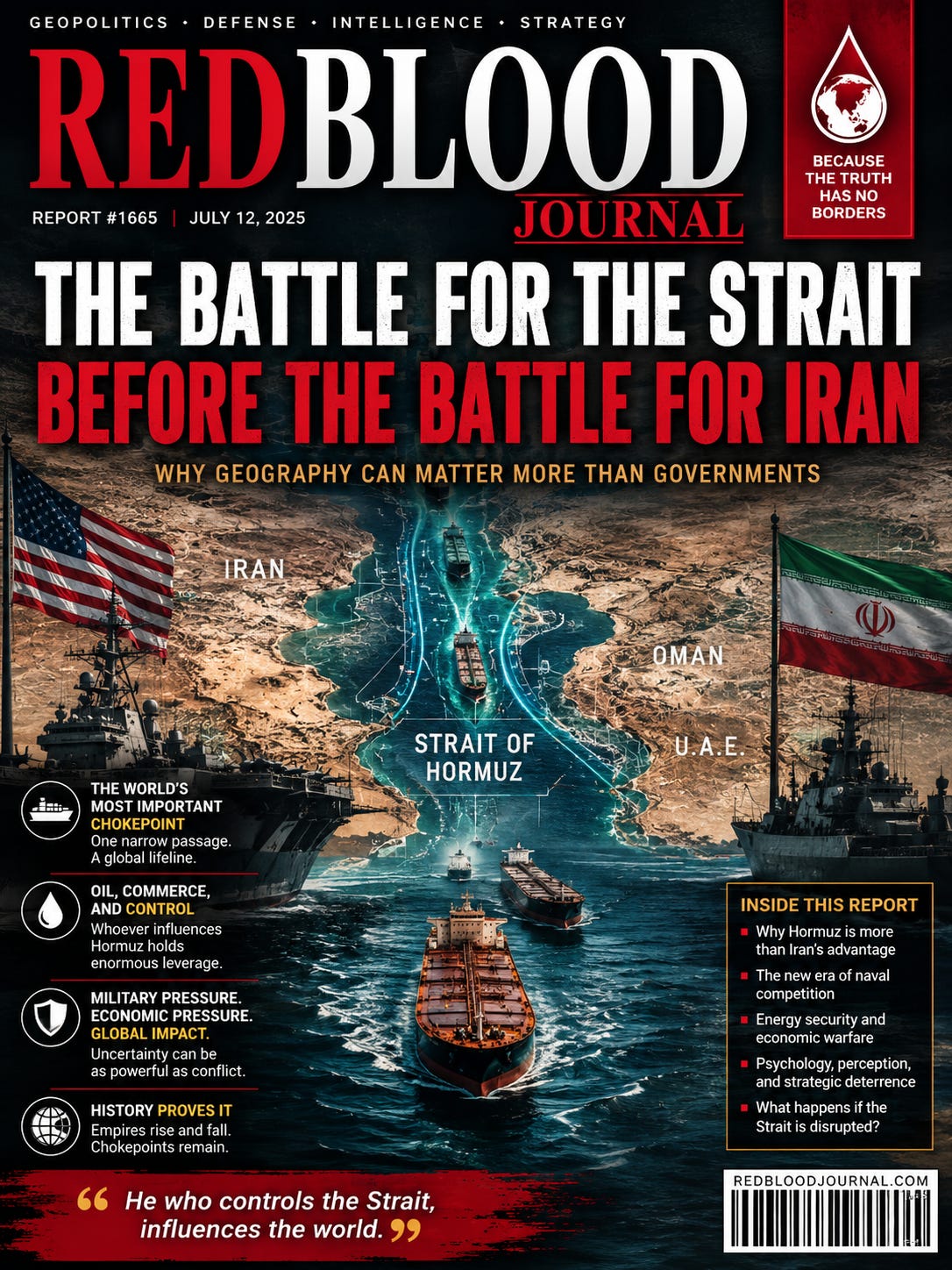
The Battle for the Strait Before the Battle for Iran
Why Every Great Power Understands That Geography Can Matter More Than Governments
Executive Summary
Wars are often presented as battles over ideology, terrorism, democracy, religion, or national security.
History frequently reveals another layer.
Sometimes geography itself becomes the true prize.
Throughout history, whoever controlled the world’s most important maritime chokepoints possessed influence far beyond the size of their nation. Oil, commerce, military logistics, insurance markets, shipping costs, inflation, and even diplomatic leverage can all be affected by control—or the perceived control—of a narrow waterway.
Recent developments surrounding the Strait of Hormuz have once again drawn global attention to this principle. Reports of increased naval deployments, commercial shipping concerns, negotiations, and competing political narratives suggest that the strategic value of the Strait remains central to regional calculations.
Geography Never Votes
Governments change.
Leaders rise and fall.
Political parties disappear.
Geography remains.
The Strait of Hormuz is one of only a handful of locations on Earth where an extremely narrow passage carries a substantial portion of global energy exports.
From a strategic perspective, whoever can influence traffic through this corridor possesses leverage that extends well beyond the Persian Gulf.
The issue is therefore larger than Iran.
It concerns global commerce.
The Strait Is More Valuable Than the Oil
Oil can be discovered elsewhere.
Pipelines can eventually be constructed.
Alternative energy may continue to expand.
A strategic maritime chokepoint, however, cannot simply be relocated.
The world’s shipping routes are constrained by geography rather than politics.
This makes narrow passages like Hormuz enduring strategic assets regardless of which government controls the surrounding territory.
Military Pressure and Economic Pressure
Modern conflicts are increasingly fought on two battlefields.
The visible battlefield involves ships, aircraft, missiles, and military deployments.
The invisible battlefield involves insurance premiums, commodity markets, shipping delays, investor confidence, and energy prices.
Even without sustained combat, uncertainty surrounding a major shipping route can have global economic consequences.
The possibility of disruption can become almost as influential as disruption itself.
Every Side Understands the Stakes
Recent public statements, military movements, and diplomatic messaging suggest that multiple actors view the Strait as strategically significant.
Different governments may pursue different objectives:
preserving freedom of navigation,
maintaining regional influence,
protecting commercial shipping,
increasing negotiating leverage,
or demonstrating deterrence.
Public rhetoric may differ, but the underlying strategic importance of the waterway remains constant.
Reading Between the Lines
Political headlines often focus on personalities.
Military planners usually focus on logistics.
Observers sometimes become absorbed in speeches while strategic planners evaluate shipping lanes, supply chains, ports, naval positioning, and economic resilience.
Viewed from this perspective, the contest surrounding Hormuz is not solely about today’s political disputes.
It is also about preserving or altering long-term strategic advantages.
The Psychological Dimension
Control does not always require physical closure.
Sometimes uncertainty alone changes behavior.
Shipping companies may reroute vessels.
Insurance costs may rise.
Commodity markets may react.
Governments may accelerate diplomatic efforts.
Investors may alter long-term decisions.
In this sense, perception itself becomes a strategic instrument.
A Lesson Repeated Throughout History
History repeatedly demonstrates that major powers invest enormous resources in protecting maritime trade routes.
From ancient empires guarding narrow sea passages to modern naval coalitions securing international commerce, geography consistently shapes political decisions.
Technologies evolve.
Governments change.
Strategic geography remains remarkably constant.
Final Observation
Whether present tensions ultimately produce negotiation, prolonged competition, or renewed confrontation remains uncertain.
What appears far less uncertain is that the Strait of Hormuz will continue to occupy a central place in global strategic thinking for years to come.
Those seeking to understand future developments may benefit from looking beyond daily headlines and considering the enduring influence of geography, commerce, and maritime strategy.
The battle for influence may begin long before the battle for territory.
And sometimes the narrowest passage on a map becomes the widest point of global consequence.
Source Context: This analysis was inspired by themes and developments discussed in recent tensions around the Strait of Hormuz, military deployments, negotiations, and competing political narratives.
📍 The Chokepoint Catalyst: Geography as Global Leverage
Jul 11, 2026
The provided report argues that geographic chokepoints like the Strait of Hormuz possess a permanent strategic value that transcends temporary political regimes or ideologies. Because these narrow waterways facilitate a massive portion of global energy and commerce, control over them provides immense diplomatic and economic leverage. The text emphasizes that modern conflict occurs on both a physical and psychological level, where the mere threat of a maritime disruption can destabilize commodity markets and insurance rates. While public discourse often focuses on specific government leaders, strategic planners prioritize the logistics of shipping lanes and supply chains. Ultimately, the source suggests that while technologies and administrations evolve, the enduring influence of geography remains the most critical factor in global power dynamics. This analysis concludes that the struggle for influence over such passages is a constant historical reality that dictates the behavior of every great nation.


