


🩸 RedBloodJournal.com
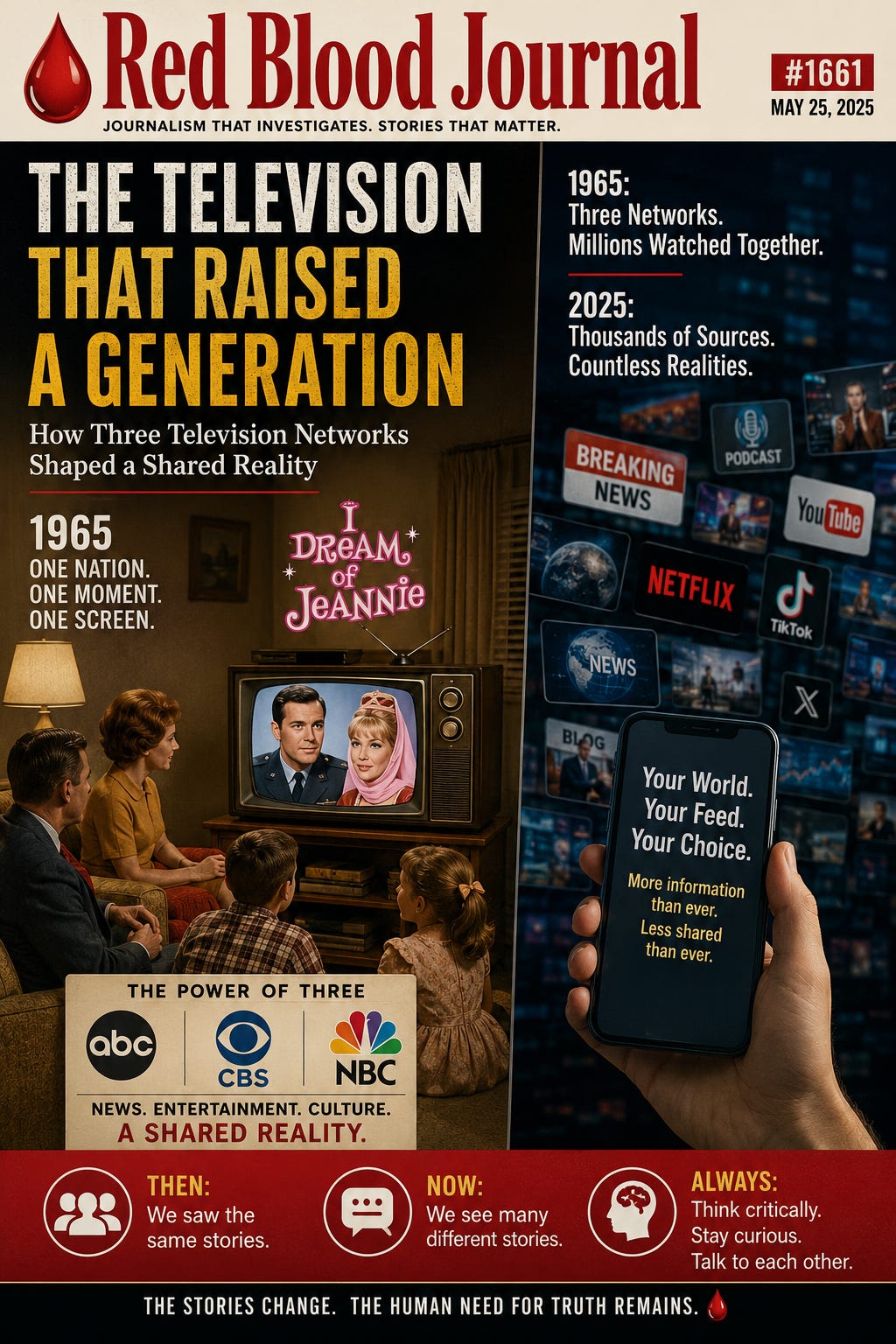
#1661 – The Television That Raised a Generation
How Three Television Networks Shaped a Shared Reality
Introduction
Every generation is shaped by the stories it consumes.
Before smartphones, before social media, before search engines and streaming platforms, there was a period when much of the Western world gathered around the television at the same time each evening. Millions of households watched the same programs, laughed at the same jokes, heard the same advertisements, and received much of their understanding of current events from a relatively small number of broadcasters.
One such program was I Dream of Jeannie. On the surface, it was a lighthearted comedy about an astronaut who discovers a magical genie. Yet beyond its entertainment value, the series offers a glimpse into an era when television possessed a unique cultural influence. A single successful program could become a common language shared across an entire generation.
This report is not an argument that television was better or worse than today’s digital landscape. Rather, it examines how a concentrated media environment created a shared cultural experience—and how that contrasts with the fragmented information ecosystem of the twenty-first century.
The Living Room Was the Town Square
During the mid-1960s, television had become the centerpiece of family life.
Evenings often followed a familiar routine:
Dinner.
The evening news.
Prime-time entertainment.
Late-night programming.
Families frequently watched together rather than individually.
Unlike today, viewers could not pause, rewind, or choose from thousands of competing programs. If a popular show aired on Tuesday night, millions watched it at the same moment.
Television was not simply entertainment—it was a national meeting place.
Three Networks, One Shared Conversation
In the United States, three major television networks dominated national broadcasting.
Together they carried:
National news.
Sitcoms.
Dramas.
Variety shows.
Special events.
Presidential speeches.
Historic moments.
The result was remarkable.
People from different regions, professions, and backgrounds often had the same cultural reference points because they had watched many of the same programs.
A joke made at work the following morning usually required no explanation.
Everyone had seen it.
I Dream of Jeannie: A Product of Its Time
The pilot episode begins with astronaut Captain Tony Nelson surviving an emergency landing after a failed space mission. Alone on a remote island, he discovers an ancient bottle containing a genie who has been imprisoned for centuries.
The story combined two powerful cultural themes of the 1960s:
America’s fascination with the Space Race.
Timeless fantasy drawn from Middle Eastern folklore.
Science represented the future.
Magic represented limitless imagination.
The combination proved irresistible.
The result was a television series that became recognized across much of the world.
Shared Entertainment Created Shared Identity
Because audiences consumed many of the same programs, television helped establish common cultural experiences.
Popular characters became household names.
Catchphrases spread naturally.
Families discussed episodes together.
Children reenacted scenes in schoolyards.
The entertainment itself became part of society’s collective memory.
Whether someone loved or disliked a particular program mattered less than the fact that nearly everyone knew what others were talking about.
News Followed the Same Pattern
Entertainment was not the only shared experience.
Evening news broadcasts also reached enormous audiences.
For many households, the television news served as the primary source of national and international information.
This created a more unified public conversation, though it also meant people had fewer immediately accessible alternatives than they do today.
Then Came the Information Explosion
Over the following decades, technological advances transformed how information is produced and consumed.
Today’s audiences can choose from:
Streaming platforms.
Independent publishers.
Podcasts.
Social media.
Video platforms.
Online newspapers.
Blogs.
AI-assisted research tools.
Instead of one broad conversation, there are now countless overlapping conversations occurring simultaneously.
The amount of available information has grown dramatically.
So has the diversity of viewpoints.
From Shared Reality to Personalized Reality
Modern technology allows individuals to select content that matches their interests.
This creates remarkable opportunities for learning and creativity.
It also means two people living in the same neighborhood may consume entirely different information every day.
One person’s daily media diet may consist primarily of financial news.
Another’s may focus on science.
Another’s on entertainment.
Another’s on international affairs.
The common cultural experience that once characterized broadcast television has become less universal.
Looking Back Without Romanticizing
The era of three dominant television networks should neither be idealized nor dismissed.
A concentrated media landscape encouraged shared cultural experiences but offered fewer channels for alternative voices.
Today’s decentralized media environment enables more people to publish and discover information, while also presenting challenges such as information overload and competing claims.
Each era brings its own strengths and tradeoffs.
Conclusion
The first episode of I Dream of Jeannie reminds us of more than a beloved television series.
It reminds us of a time when millions of people paused together to experience the same stories.
That shared rhythm helped shape a generation’s cultural memory.
Today, technology has expanded access to information beyond anything imaginable in 1965.
The question is no longer whether we have enough information.
It is whether we still have enough shared experiences to understand one another across an increasingly diverse media landscape.
Red Blood Journal Observation
Perhaps the greatest transformation over the past sixty years has not been television itself, but the journey from a handful of shared narratives to billions of individually curated ones. Every generation is influenced by the stories it hears. As those stories become more personalized, the responsibility to think critically, compare perspectives, and engage with others grows ever more important.
🩸 RedBloodJournal.com
📺 The Shared Screen:
From Three Networks to Fragmented Realities
Jul 11, 2026
During the mid-twentieth century, a concentrated media landscape dominated by three major networks fostered a unified cultural identity by providing a singular source for news and entertainment. Families gathered around the television to consume the same programs, such as I Dream of Jeannie, which created a shared language and universal reference points across the population. This historical period contrasts sharply with the modern era of digital fragmentation, where streaming and social media allow for highly personalized content consumption. While today’s technology offers a vast diversity of perspectives and unprecedented access to information, it lacks the collective experience that once synchronized the public’s reality. Ultimately, the transition from a few dominant narratives to billions of individual ones highlights the growing importance of critical thinking in a decentralized information ecosystem.


