


🩸 RedBloodJournal.com
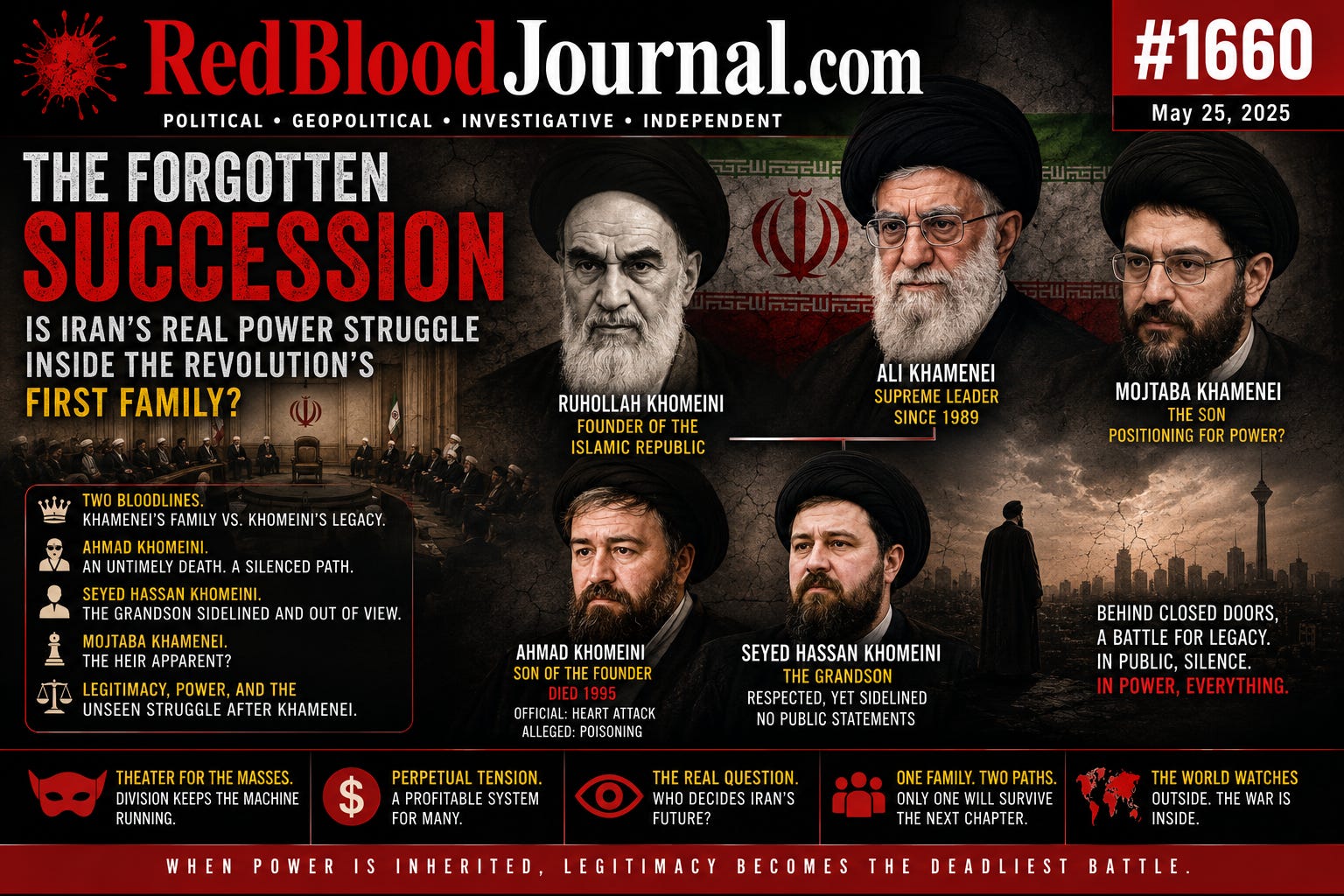
#1660 – The Forgotten Succession: Is Iran’s Real Power Struggle Inside the Revolution’s First Family?
OPINION ANALYSIS
Executive Summary
International attention remains focused on Iran’s nuclear program, regional conflicts, sanctions, and negotiations with the United States. Yet one of the least discussed questions may ultimately prove to be the most consequential:
Who will inherit the ideological and political leadership of the Islamic Republic after Ayatollah Ali Khamenei?
Public discussion generally centers on institutional politics, military influence, and the Assembly of Experts. Much less attention is devoted to the possibility that competing revolutionary bloodlines could represent an underlying source of tension within the Islamic Republic itself.
This report examines that possibility as an opinion analysis based on publicly known history and observed political developments.
The Two Revolutionary Families
The Islamic Republic was founded by Ayatollah Ruhollah Khomeini, whose leadership transformed Iran in 1979.
After his death in 1989, Ayatollah Ali Khamenei became Supreme Leader, establishing what has become the second era of the Islamic Republic.
Today, discussions about succession largely revolve around figures associated with the current leadership, particularly Mojtaba Khamenei, who has frequently been mentioned by analysts as a possible successor.
Yet another family remains largely absent from contemporary political discussions—the direct descendants of the founder himself.
The Forgotten Lineage
Ruhollah Khomeini’s son, Ahmad Khomeini, was one of the closest advisers to the founder throughout the revolutionary period.
Following Ruhollah Khomeini’s death, Ahmad remained an influential figure until his own death in 1995.
Iranian authorities reported that he died following heart complications and a coma.
However, for decades various opposition figures and independent commentators have alleged that his death may not have been natural. Those allegations have never been substantiated publicly, and no conclusive evidence has been produced.
Regardless of the cause, Ahmad’s death effectively removed the founder’s immediate heir from Iran’s political landscape.
Seyed Hassan Khomeini
Ahmad Khomeini’s son, Seyed Hassan Khomeini, inherited perhaps the strongest symbolic family connection to the founder of the Islamic Republic.
Despite his religious credentials and his lineage, he has generally remained outside the center of Iran’s political power structure.
On several occasions he has appeared to be politically marginalized while remaining respected within sections of the religious establishment.
Unlike many political figures, he has avoided becoming a dominant public voice in contemporary succession debates.
His relative absence has generated continuing speculation among outside observers regarding his long-term political role.
The Mojtaba Question
At the same time, considerable public attention has focused on Mojtaba Khamenei, one of Ayatollah Ali Khamenei’s sons.
Although no official succession decision has been announced, analysts have repeatedly discussed his name as a possible future Supreme Leader because of his influence within parts of Iran’s religious and security establishment.
If such a transition were ever to occur, it would represent the continuation of the current governing structure established after 1989.
An Overlooked Question
From an observer’s perspective, one question receives remarkably little public discussion:
If the Islamic Republic derives its revolutionary legitimacy from Ayatollah Ruhollah Khomeini, why is so much attention devoted to the descendants of Ayatollah Ali Khamenei while comparatively little attention is given to the founder’s own family?
That question does not imply that either family possesses a legal or automatic right to leadership.
Rather, it highlights an apparent imbalance in public discussion surrounding Iran’s future.
A Possible Internal Rivalry
One possible interpretation is that Iran’s most significant political contest may not be between reformists and conservatives, nor solely between Iran and foreign governments.
Instead, it could involve competing visions of revolutionary legitimacy within the establishment itself.
One vision emphasizes continuity through the institutions developed during Ayatollah Ali Khamenei’s leadership.
Another could emphasize the symbolic legacy carried by the descendants of Ayatollah Ruhollah Khomeini.
Whether such a rivalry exists behind closed doors remains unknown.
There is insufficient public evidence to establish the existence of an organized struggle between these families.
Nevertheless, the opacity surrounding succession naturally invites analysis and speculation.
Why It Matters
Leadership transitions in revolutionary systems rarely concern only one individual.
They often determine:
The balance between ideological purity and political pragmatism.
Relations with Western governments.
The future role of the Revolutionary Guard.
Economic reform versus continued isolation.
The long-term direction of the Islamic Republic itself.
For that reason, succession politics may ultimately prove more significant than many of today’s headline events.
Looking Beyond Public Narratives
International media generally presents Iran through the lens of external conflict—nuclear negotiations, sanctions, military confrontations, and regional alliances.
Those issues are undeniably important.
Yet history often shows that the decisive struggles within political systems occur quietly, behind closed doors, long before they become visible to the public.
Whether Iran’s future is shaped primarily by institutions, by ideology, or by competing claims to revolutionary legitimacy remains to be seen.
For observers, the succession process may deserve as much attention as the geopolitical events that dominate daily headlines.
Final Reflection
The future of Iran may not ultimately be determined on the battlefield or at the negotiating table.
It may instead be decided through questions of legitimacy, succession, and internal consensus that remain largely hidden from public view.
Understanding those quieter dynamics may offer a broader perspective on the next chapter of the Islamic Republic.
Editorial Note
This report is an opinion analysis. It combines established historical facts with interpretation regarding possible succession dynamics. Where internal rivalries or political motivations are discussed, they are presented as analytical hypotheses rather than established facts.
📜 The Khomeini-Khamenei Rivalry:
A Dynasty of Two Bloodlines
Jul 10, 2026
The provided text examines a potential internal power struggle regarding the ideological succession within the Islamic Republic of Iran. It suggests that while global attention focuses on international conflicts, a deeper rivalry may exist between the descendants of the nation’s founder, Ruhollah Khomeini, and the lineage of the current Supreme Leader, Ali Khamenei. The analysis highlights Seyed Hassan Khomeini as a figure of symbolic legitimacy who remains largely sidelined by the current hard-line establishment. In contrast, the article notes the rising influence of Mojtaba Khamenei, raising questions about which family truly holds the right to lead. Ultimately, the source argues that this competition for revolutionary legacy could be the most significant factor shaping Iran’s future governance. This perspective remains speculative, as the true nature of these high-level political dynamics is shielded by the opacity of the state’s institutions.


