


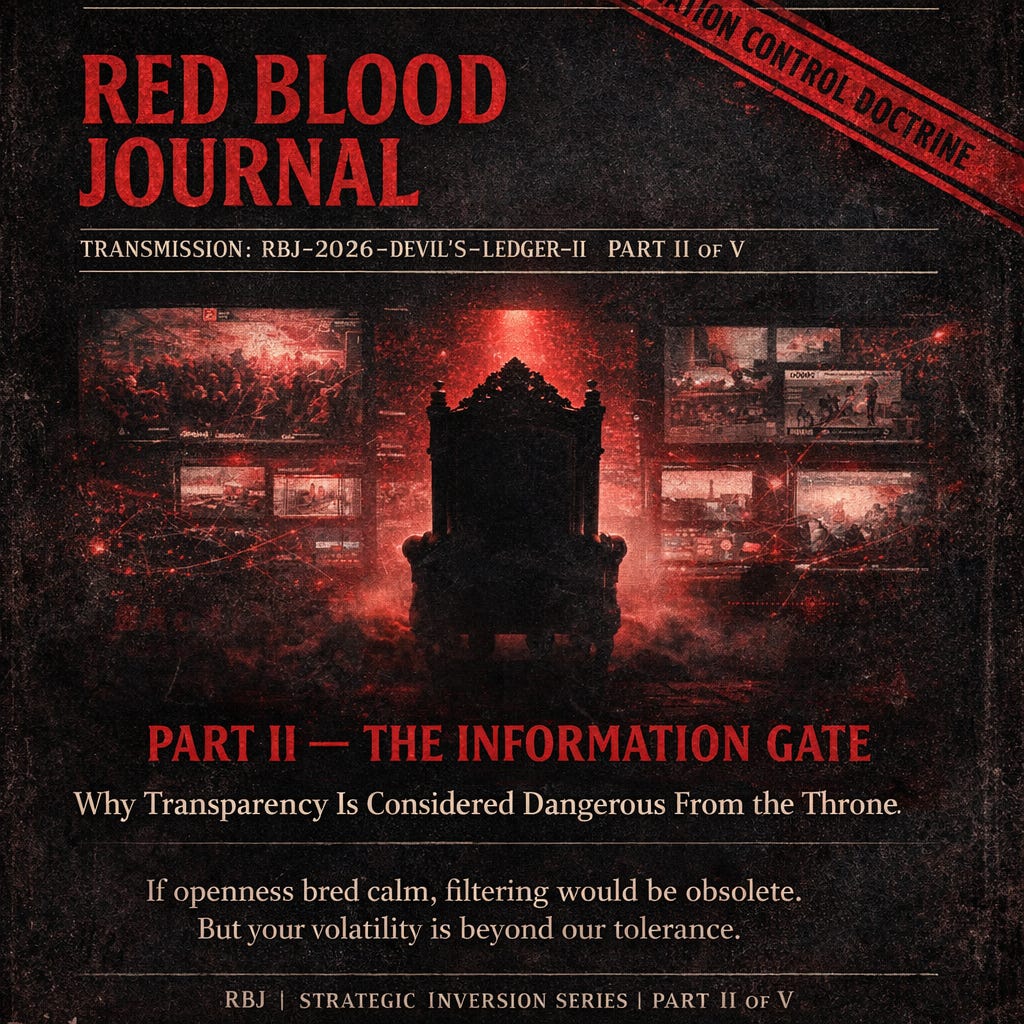
🩸 RED BLOOD JOURNAL TRANSMISSION
T#: RBJ-2026-DEVIL’S-LEDGER-II
Classification: Power Architecture Analysis / Information Control Doctrine
Status: Fictional Analytical Commentary — Strategic Role Reversal
Part II of V
PART II — THE INFORMATION GATE
Why Transparency Is Considered Dangerous From the Throne
PROLOGUE — THE FLOOD PROBLEM
From the street, information equals freedom.
From the throne, information equals volatility.
The citizen believes truth liberates.
The ruler calculates that unfiltered truth destabilizes.
This is the argument of the Information Gate.
I — THE VELOCITY THREAT
The Boss does not fear facts.
The Boss fears speed.
A rumor spreads in minutes.
Markets respond in seconds.
Crowds assemble in hours.
A single unverified narrative can:
Trigger bank runs.
Collapse stock prices.
Incite riots.
Destroy diplomatic negotiations.
From the throne, the question is not:
“Is it true?”
The question is:
“Can society absorb it without fracture?”
If the answer is uncertain, delay becomes policy.
II — THE FILTER AS FIREWALL
The population calls it censorship.
The Boss calls it stabilization.
Information is treated like electricity:
Too much surge, and circuits burn.
Narrative filters are framed as:
Cooling systems.
Pressure regulators.
Time buffers.
The ruler’s internal memo would read:
“Release gradually. Frame responsibly. Prevent panic.”
Transparency without sequencing, in this defense, is recklessness.
III — THE PROBLEM OF TOTAL TRUTH
From below, secrecy appears sinister.
From above, total disclosure appears catastrophic.
Governments hold information about:
Threat assessments.
Financial vulnerabilities.
Military contingencies.
Institutional fragilities.
If exposed raw, these could invite:
Adversary exploitation.
Market collapse.
Public fear spirals.
The Boss argues:
The public demands honesty.
But cannot tolerate systemic fragility.
Therefore, information must be curated.
Not eliminated — calibrated.
IV — MISINFORMATION AS DESTABILIZATION
The ruler’s greatest fear is not dissent.
It is uncontrolled narrative.
False information can be weaponized by:
Foreign states.
Financial actors.
Domestic political rivals.
Ideological movements.
If narratives become uncontrollable, legitimacy fractures.
If legitimacy fractures, compliance erodes.
If compliance erodes, enforcement escalates.
From the throne:
Preemptive moderation prevents reactive force.
Filtering speech is framed as preventing violence.
V — THE TRANSPARENCY PARADOX
The Boss would argue:
Complete transparency erodes authority.
Authority erosion invites instability.
Instability invites emergency measures.
Emergency measures are harsher than quiet filtering.
Therefore:
Selective opacity is mercy.
The gatekeeper believes restriction prevents future crackdowns.
VI — INTERNAL JUSTIFICATION MEMO
If written plainly, it might read:
“We do not control information to dominate.
We control information to pace revelation.
The public sees suppression.
We see containment.”
In this view, the Information Gate is not tyranny.
It is structural pacing.
COUNTERINTELLIGENCE NOTE
Understanding the logic of control does not require accepting it.
But ignoring its internal reasoning makes critique superficial.
Every centralized system believes:
Narrative coherence equals survival.
CLOSING LINE — PART II
From the throne, transparency is not freedom.
It is a calculated risk.
Part III will examine the next defense:
Why economic pain is framed as medicine —
and why recessions are described as corrective design rather than failure.
🛡️ The Mechanics of Narrative Control
May 25, 2026
This text explores the philosophy of narrative control from the perspective of those in power, framing information suppression as a tool for social stability.
Rather than viewing censorship as mere tyranny, the source argues that rulers perceive unfiltered truth as a volatile force capable of triggering economic collapse or civil unrest.
By acting as a gatekeeper, the governing body aims to calibrate the speed at which the public receives potentially destabilizing data.
The narrative suggests that selective transparency is a strategic necessity used to prevent systemic fractures and maintain institutional legitimacy.
Ultimately, the document presents the chilling justification that restricting knowledge is a form of mercy intended to avoid the chaos of total disclosure.


