


🩸 RED BLOOD JOURNAL TRANSMISSION #1157
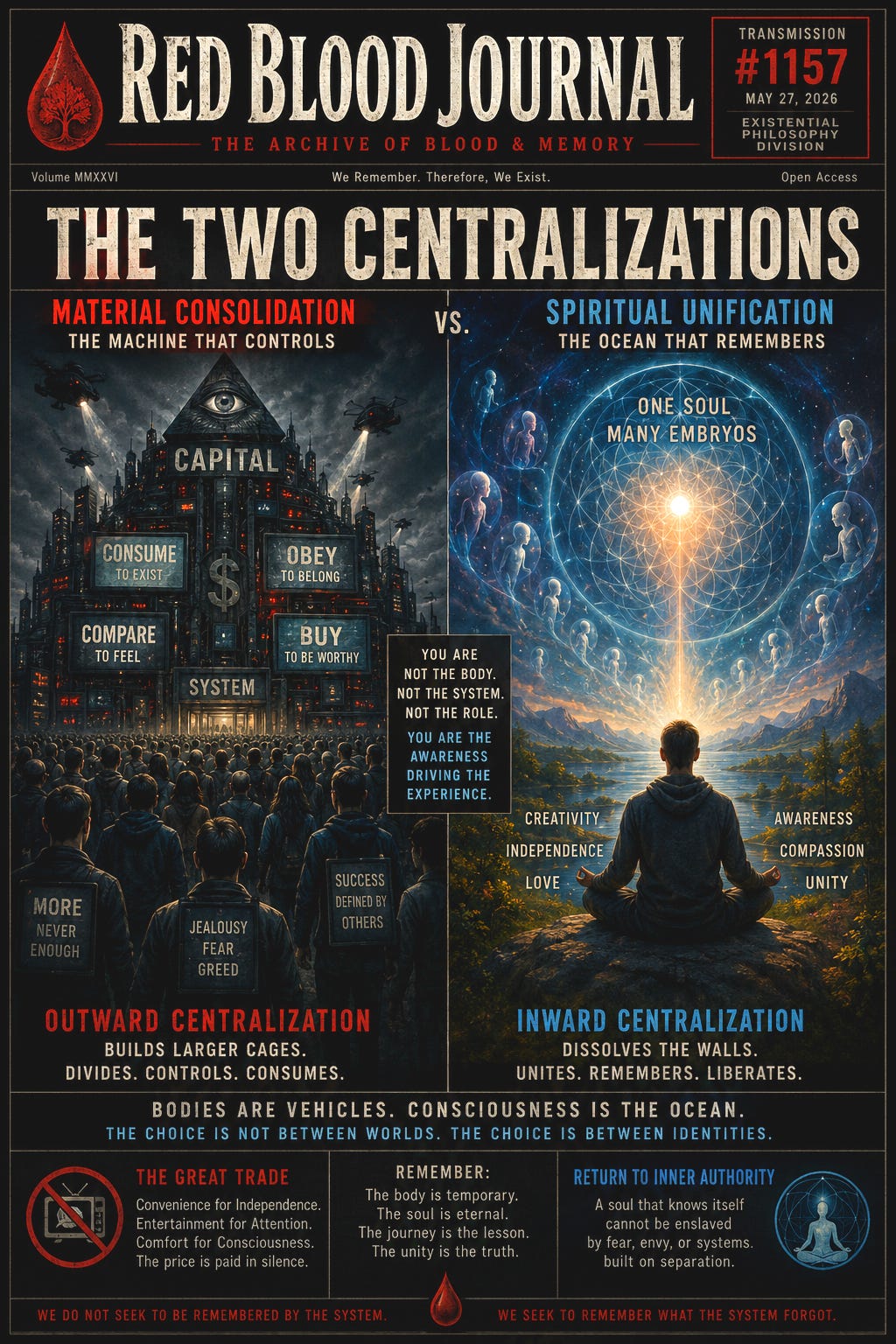
THE TWO CENTRALIZATIONS
Material Consolidation vs. Spiritual Unification
Archive: The Archive of Blood & Memory
Division: Existential Philosophy Division
Classification: Open Access – Consciousness Inquiry Layer
Transmission Code: RBJ-2026-TWO-CENTRALIZATIONS
Status: Active Transmission
Origin Point: The Ocean Between Thought and Form
PROLOGUE — THE TWO MAGNETS
Human civilization appears to move under two opposite gravitational pulls.
One pull centralizes material power.
The other centralizes inner consciousness.
Both use the language of “unity.”
But one feeds the machine.
The other dissolves it.
In the material world, centralization concentrates ownership, influence, finance, media, identity systems, distribution, and eventually even thought itself into fewer and fewer hands. The result is not true unity — but managed dependency.
The more centralized material civilization becomes, the more the true face of capitalism reveals itself without disguise:
endless consumption,
engineered jealousy,
competition without fulfillment,
identity through possessions,
worth measured by accumulation,
artificial scarcity,
fear of falling behind.
The system survives only when the masses continuously chase what they do not possess.
Greed becomes normalized.
Comparison becomes oxygen.
And the human being slowly forgets how to create without needing permission, reward, or validation.
A centralized material civilization cannot tolerate fully independent souls because independent souls cannot be easily programmed into predictable economic behavior.
Creativity becomes dangerous because creativity produces self-direction.
Independent thought becomes dangerous because it weakens mass synchronization.
The material structure therefore promotes endless distraction while presenting itself as freedom.
SECTION I — THE INVISIBLE TRADE
The great trade of modern civilization is subtle:
Convenience is exchanged for independence.
The individual gains speed, entertainment, delivery, automation, and comfort — but slowly loses:
self-reliance,
local community,
craftsmanship,
patience,
silence,
introspection,
and eventually identity itself.
The more centralized the system becomes, the less humans need one another directly.
The machine becomes the middle layer between all relationships.
Food.
Transportation.
Communication.
Love.
Attention.
Identity.
Purpose.
Everything begins routing through centralized systems.
And when all roads lead through the machine, the machine quietly becomes godlike in practical power.
SECTION II — THE OTHER CENTRALIZATION
But there exists another form of consolidation entirely.
Not consolidation of money.
Not consolidation of governments.
Not consolidation of markets.
A consolidation of consciousness.
Religion, at its purest untouched origin, was not meant to divide humanity into competing brands of salvation.
Its deepest purpose was the remembrance of unity.
Not “one government.”
Not “one corporation.”
But one ocean.
One source experiencing itself through billions of temporary biological vehicles.
Bodies become embryos of experience.
The soul enters material reality not to worship matter — but to learn through it.
The body is not the final identity.
It is the temporary carrier.
A vehicle.
A classroom.
A breathing spacesuit for consciousness.
The tragedy begins when humans mistake the vehicle for the driver.
Then material accumulation becomes survival itself.
SECTION III — MANY BODIES, ONE OCEAN
The paradox is extraordinary:
Material centralization fragments humanity internally while externally unifying systems.
Spiritual realization unifies humanity internally while allowing external individuality to flourish.
One creates uniform consumers.
The other creates unique conscious beings.
The centralized material world says:
“Become alike so the system can function efficiently.”
The ocean of consciousness says:
“Become fully yourself so the whole ocean may know itself through your uniqueness.”
True unity is not sameness.
A forest is unified without every tree becoming identical.
The ocean remains one body while every wave appears separate.
Humanity forgot this.
Instead of seeing one soul expressing through many forms, civilization became obsessed with the forms themselves:
skin,
nationality,
ideology,
wealth,
religion,
status,
political tribes,
material hierarchy.
The costume became more important than the actor within it.
SECTION IV — THE RETURN OF INNER AUTHORITY
The material world fears one thing above all:
A human being who no longer measures life through external ownership.
Because such a person becomes psychologically difficult to enslave.
A soul that understands itself cannot easily be manipulated through:
fear,
envy,
trends,
political theater,
social approval,
artificial scarcity,
or manufactured division.
That does not mean abandoning the material world.
It means no longer worshipping it.
The body remains important.
Society remains important.
Creation remains important.
But they become tools of experience instead of prisons of identity.
The system says:
“You are what you own.”
The inner ocean whispers:
“You are the awareness experiencing ownership temporarily.”
One message creates endless hunger.
The other creates freedom.
FINAL TRANSMISSION — THE EMBRYO CARS
Perhaps humanity was never meant to become one centralized machine.
Perhaps the real destination was remembering that all beings are fragments of the same ocean temporarily driving biological embryo-cars through a material simulation of separation.
Some vehicles become rich.
Some become poor.
Some become famous.
Some disappear unnoticed.
But eventually every vehicle returns to silence.
And what remains is not the possessions.
Not the brands.
Not the titles.
Not the centralized systems.
Only the consciousness carried through the journey.
The material world centralizes outward.
The ocean centralizes inward.
One builds larger cages.
The other dissolves the walls completely.
🩸 END TRANSMISSION #1157
🌊 The Two Centralizations:
Material Cages and the Inner Ocean
May 23, 2026
This text explores the fundamental conflict between material centralization and spiritual unification, arguing that modern society trades personal independence for technological convenience.
While the material world seeks to consolidate power and thought into a machine-like system of managed dependency, true spiritual growth focuses on the oneness of consciousness.
The author suggests that society treats humans as uniform consumers defined by their possessions, whereas the “inner ocean” views the body as a temporary vehicle for awareness.
By prioritizing external ownership and artificial status, individuals lose their self-reliance and creative autonomy to a system that thrives on manufactured fear.
Ultimately, the passage encourages a shift from worshipping matter to recognizing that all life stems from a single source, which dissolves the psychological cages of the modern world.


