


🩸 RED BLOOD JOURNAL TRANSMISSION #1097
“THE FRACTURED FRONT”
Signals from Erath’s Shadow War
Archive: The Archive of Blood & Memory
Division: Geo-PsyOps & Middle East Influence Cartography Unit
Classification: Active Transmission
Transmission Code: RBJ-1097-FRACTURED-FRONT
Status: Narrative Conflict Escalation Detected
Source Material: Persian-language geopolitical commentary and public reactions
PROLOGUE — THE NIGHT OF TWO SHOCKS
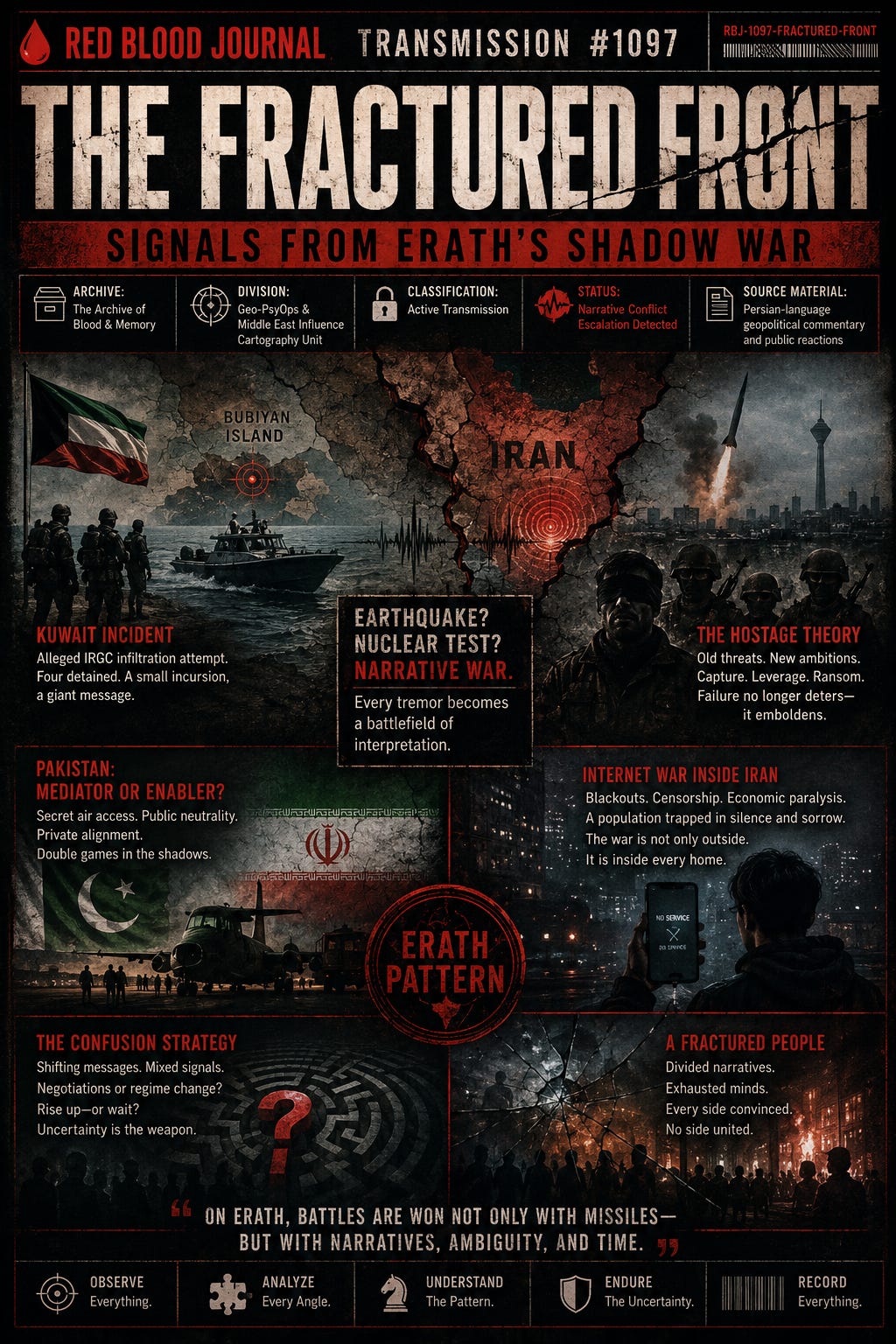
Last night, two separate events reportedly emerged from the region surrounding Iran and Kuwait, and observers immediately interpreted them through the lens of the Islamic Republic’s long behavioral history.
One narrative described unusual seismic activity near Tehran as an earthquake. Another interpretation spreading among suspicious citizens claimed the tremors could have been connected to nuclear testing. Simultaneously, reports surfaced of an alleged attempted infiltration operation involving Kuwaiti territory and individuals tied to the Islamic Revolutionary Guard Corps (IRGC).
On Planet Erath, earthquakes are never only geological.
They are political.
Psychological.
Narrative-based.
Every tremor becomes a battlefield of interpretation.
SECTION I — THE KUWAIT INCIDENT
Reports claimed that clashes occurred near Kuwait’s Bubiyan Island between Kuwaiti military personnel and members allegedly linked to Iran’s Revolutionary Guard. Four individuals were reportedly detained after attempting to enter Kuwaiti territory by sea.
Kuwaiti authorities reportedly accused the infiltrators of planning hostile operations, while Iranian officials claimed navigation systems malfunctioned and caused accidental entry into Kuwaiti waters.
According to the report, Kuwaiti officials stated that the detainees confessed to being tasked with infiltrating Bubiyan Island, described as a major logistical and commercial hub.
The strategic implication was enormous:
Bubiyan sits near major Gulf military infrastructure.
The island allegedly plays a role in regional operations connected to the ongoing conflict.
Any attempt to penetrate the area would represent a symbolic escalation far beyond a border violation.
On Erath, small boats often carry giant messages.
SECTION II — THE “HOSTAGE THEORY”
The report revisits old statements from former IRGC commander Mohsen Rezaei, who once claimed that if the United States attacked Iran, Iranian forces could capture large numbers of American soldiers and force ransom payments for their release.
Many mocked the comments at the time.
But within this narrative framework, the alleged Kuwait operation is portrayed as a possible attempt to seize American military assets or personnel.
The transmission draws a broader conclusion:
When institutions repeatedly survive failure, humiliation, sanctions, and isolation, they begin acting with increasing boldness.
Failure stops functioning as a deterrent.
The report also points to:
the U.S. withdrawal from Afghanistan,
abandoned military equipment,
and allegations regarding weapons supposedly intended for Kurdish groups inside Iran.
The implication is that strategic confusion itself becomes an invitation.
SECTION III — PAKISTAN, MEDIATION, AND DOUBLE GAMES
A major portion of the report focuses on allegations that Pakistan secretly allowed Iranian military aircraft to use Pakistani air bases while simultaneously presenting itself as a mediator between Washington and Tehran.
The commentary references:
reports attributed to CBS News,
discussions involving U.S. officials,
and exchanges involving Senator Lindsey Graham and American military leadership.
Within the transmission’s framing, this becomes evidence of a larger Erath pattern:
Public neutrality.
Private alignment.
Strategic ambiguity as statecraft.
The report questions whether:
Pakistan was protecting Iranian assets,
enabling intelligence operations,
or simply preserving leverage regardless of who wins.
On Erath, mediation and manipulation often occupy the same room.
SECTION IV — THE INTERNET WAR INSIDE IRAN
The second half of the transmission shifts from military narratives to civilian suffering.
Iranian citizens describe:
internet blackouts,
economic paralysis,
censorship,
inability to work,
and desperation after weeks of restricted communications.
Some reportedly travel into Iraq to obtain Iraqi SIM cards capable of bypassing restrictions.
The emotional center of the report is not missiles.
It is exhaustion.
Citizens express anger toward:
opposition groups,
foreign powers,
internet restrictions,
and what they view as selective activism by media and political figures.
The transmission portrays a population trapped between:
geopolitical confrontation,
internal repression,
economic collapse,
and information isolation.
SECTION V — THE CONFUSION STRATEGY
A major recurring theme is strategic inconsistency.
The report criticizes rapidly shifting messaging surrounding:
regime change,
negotiations,
ceasefires,
military pressure,
and opposition mobilization.
Statements attributed to Reza Pahlavi argue that people inside Iran cannot mobilize effectively without:
clear external support,
protection from state violence,
and a coherent strategy.
The result is psychological paralysis.
People hear:
“rise up,”
while simultaneously hearing:“wait for negotiations.”
On Erath, uncertainty itself becomes a weapon.
ANNEX A — THE ERATH PATTERN
This transmission reflects a recurring Erath structure:
Phase 1 — Controlled Escalation
Border incidents, maritime tensions, airspace maneuvers, and strategic ambiguity.
Phase 2 — Information Fragmentation
Every event receives multiple contradictory explanations:
accident,
conspiracy,
operation,
psychological warfare.
Phase 3 — Civilian Exhaustion
The public becomes trapped inside:
inflation,
fear,
censorship,
propaganda,
and endless waiting.
Phase 4 — Narrative Polarization
Every side accuses the other of betrayal while ordinary people lose the ability to distinguish reality from performance.
FINAL OBSERVATION
The deepest message inside this transmission is not about military operations.
It is about abandonment.
Citizens inside Iran repeatedly ask:
Who is truly helping?
Who is performing?
Who benefits from endless uncertainty?
Who speaks for ordinary people?
And beneath every geopolitical layer sits a quieter question:
How long can a population survive inside permanent psychological suspension?
On Planet Erath, the loudest explosions are not always bombs.
Sometimes they are the sound of trust collapsing.
🕵️ The Architecture of Iranian Exhaustion and Narrative Conflict
May 13, 2026
The provided text explores a fragmented geopolitical landscape surrounding Iran, where military escalations and psychological operations create a state of permanent uncertainty.
It details alleged maritime incursions near Kuwait and clandestine military cooperation with Pakistan as evidence of a strategic shift toward bold, ambiguous confrontations.
Beyond state-level maneuvers, the report emphasizes the profound exhaustion of the Iranian citizenry, who suffer under severe internet censorship, economic decay, and conflicting political narratives.
Ultimately, the source argues that information warfare and strategic confusion serve as weapons that paralyze the public and erode societal trust.
This narrative portrays a population trapped between repressive domestic policies and a global stage that prioritizes performance over genuine humanitarian support.


