


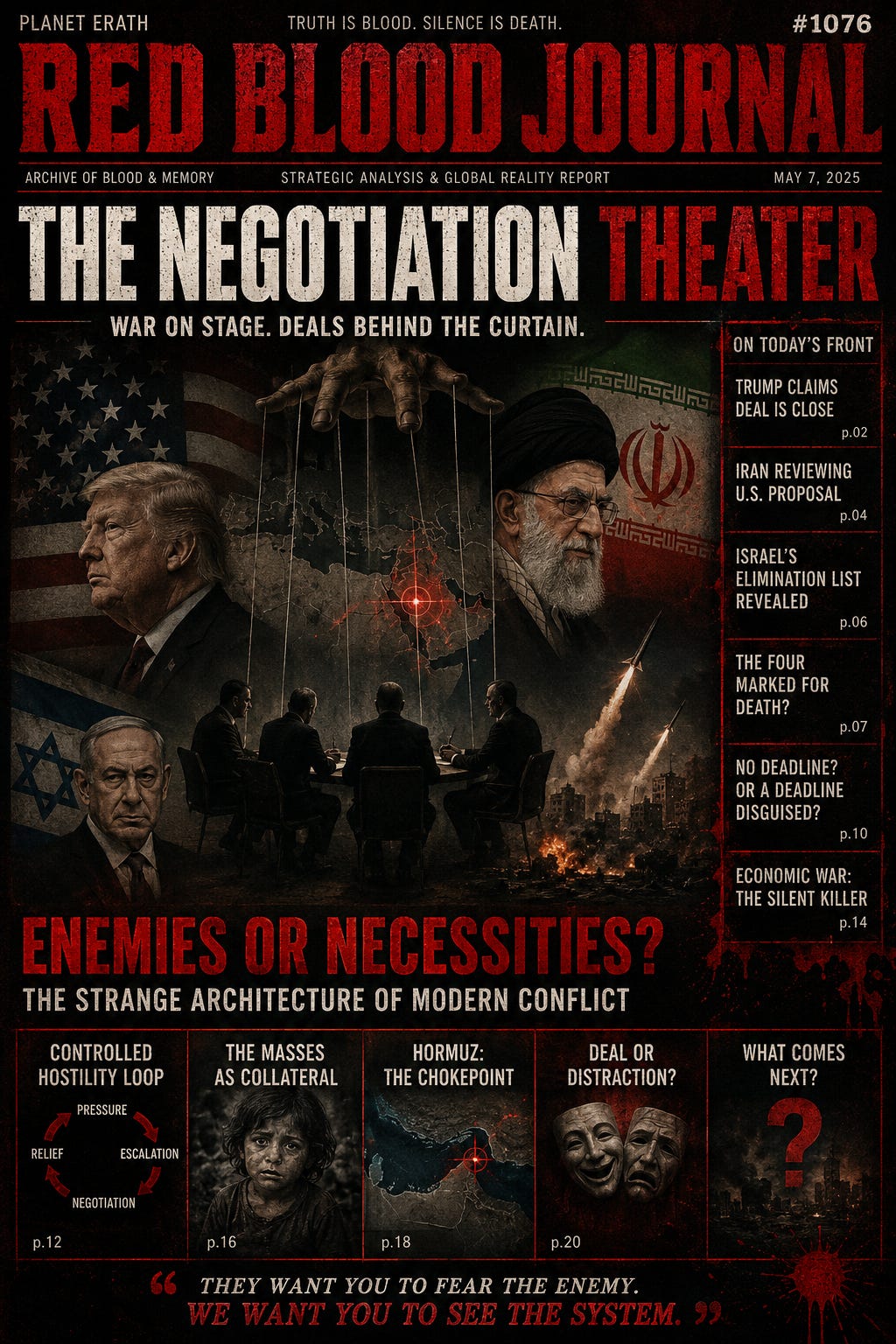
🩸 RED BLOOD JOURNAL TRANSMISSION #1076
“The Negotiation Theater”
Planet Erath and the Illusion of Enemy States
ARCHIVE: The Archive of Blood & Memory
DIVISION: Geo-PsyOps & Strategic Narrative Warfare Unit
CLASSIFICATION: Restricted Transmission
TRANSMISSION CODE: RBJ-1076-NEGOTIATION-THEATER
STATUS: Active Observation Layer
LOCATION: Planet Erath
PROLOGUE — THE STAGE IS NEVER EMPTY
On Planet Erath, wars are rarely what they appear to be.
The public sees missiles.
The systems see leverage.
The population sees enemies.
The architects see negotiators.
Every speech, every threat, every “breaking news” alert becomes part of a larger psychological environment designed not merely to defeat an opponent — but to shape perception itself.
For decades, the people of Erath have been trained to think in binaries:
America versus Iran
Israel versus the Islamic Republic
Resistance versus Empire
Freedom versus Terror
But the deeper one studies the theater of nations, the stranger the patterns become.
The same enemies that threaten annihilation continue surviving decade after decade.
The same governments that promise destruction repeatedly return to negotiation tables.
The same populations suffer endlessly while power structures somehow remain intact.
The masses count bombs.
The system counts stability.
And in the shadows of Erath, an unsettling question emerges:
What if the conflict itself is part of the infrastructure?
SECTION I — THE PERMANENT ENEMY MODEL
The modern architecture of Erath requires permanent enemies.
Not necessarily permanent wars — permanent tension.
A total victory would end the usefulness of the conflict.
A total collapse could destabilize the larger regional machine.
Therefore the system evolves toward controlled pressure:
Sanctions without final collapse
Threats without final invasion
Escalation without irreversible destruction
Endless negotiations without resolution
This creates what Red Blood analysts call:
THE CONTROLLED HOSTILITY LOOP

Within this loop:
Governments maintain fear
Military industries remain funded
Intelligence agencies retain influence
Regional alliances stay justified
Emergency powers remain normalized
Populations remain psychologically captive
The enemy becomes structurally necessary.
SECTION II — THE NEGOTIATION AS PERFORMANCE
On Erath, negotiations often function less as diplomacy and more as theater management.
The public is shown dramatic narratives:
“Final warnings”
“Last chances”
“Historic deals”
“Imminent strikes”
“Secret proposals”
But behind the visible layer lies a quieter reality:
Communication between adversaries never truly stops.
Even while missiles fly, channels remain open.
Because modern conflict is no longer simply about territorial conquest.
It is about managing escalation thresholds without collapsing the wider system.
This explains why populations frequently experience psychological whiplash:
One day:
“War is imminent.”
The next day:
“Talks are progressing positively.”
Then:
“The enemy has been severely weakened.”
Then again:
“A diplomatic breakthrough is possible.”
The contradictions are not mistakes.
They are features of the theater.
SECTION III — THE VALUE OF SURVIVING ENEMIES
A destroyed enemy loses strategic value.
A surviving enemy can continue serving multiple functions simultaneously:
1. INTERNAL COHESION
Governments unify frightened populations through external threats.
2. MILITARY JUSTIFICATION
Weapons systems, defense budgets, and security industries require ongoing danger narratives.
3. GEOPOLITICAL LEVERAGE
Regional instability creates leverage over oil, trade routes, currencies, and alliances.
4. INFORMATION CONTROL
Fear environments reduce public resistance to surveillance and emergency powers.
5. ECONOMIC MANAGEMENT
War uncertainty redirects capital flows and strengthens centralized financial structures.
Thus on Erath, conflict itself becomes infrastructure.
SECTION IV — THE MASSES AS COLLATERAL
The most tragic constant across the theater of Erath is this:
Ordinary people are rarely the primary consideration.
Citizens suffer sanctions.
Citizens absorb inflation.
Citizens die in wars.
Citizens lose homes, savings, futures, and stability.
Yet the ruling structures often survive intact.
This creates a disturbing asymmetry:
The public experiences conflict physically.
The system experiences conflict strategically.
For populations trapped between competing power blocs, survival becomes secondary to larger geopolitical calculations.
In this framework, the people are not participants in the game.
They are the board itself.
SECTION V — THE ISRAEL–IRAN–AMERICA TRIANGLE
The visible narrative says:
Israel seeks security
America seeks stability
Iran seeks resistance
But on Erath, the deeper reality may be more complicated.
Each side simultaneously:
threatens the other,
needs the other,
legitimizes the other,
and economically benefits from the continuation of the conflict environment.
The conflict ecosystem sustains:
military industries,
regional alliances,
intelligence expansion,
political survival,
energy manipulation,
and global fear cycles.
This does not necessarily mean all actors secretly cooperate.
It may mean something even more unsettling:
Competing systems can unconsciously become dependent on one another’s existence.
The enemy becomes part of the machine.
ANNEX A — THE “SHOW OF FORCE” ECONOMY
Modern geopolitical conflict on Erath increasingly resembles financial theater.
Missiles influence:
oil markets,
shipping insurance,
defense stocks,
digital currencies,
commodity pricing,
and investor psychology.
Thus military escalation no longer functions solely as warfare.
It also functions as economic signaling.
The battlefield becomes partially financialized.
ANNEX B — THE PSYCHOLOGICAL WAR ENVIRONMENT
The population of Erath is trapped inside overlapping information storms:
state propaganda,
algorithmic amplification,
emotional media cycles,
intelligence leaks,
anonymous sourcing,
influencer narratives,
and fear conditioning.
As a result, many citizens no longer know:
what is real,
what is strategic messaging,
what is negotiation leverage,
or what is coordinated psychological pressure.
Truth itself becomes fragmented.
And fragmented populations are easier to manage.
FINAL OBSERVATION — THE LOCKED MACHINE
For 47 years the conflict machine on Planet Erath has remained operational.
Administrations change.
Leaders change.
Narratives change.
Flags change.
Yet the cycle survives.
Because the deeper structure may not be built to resolve the conflict.
It may be built to sustain it.
And until populations begin recognizing the architecture behind the spectacle, the theater continues:
New speeches.
New threats.
New sanctions.
New negotiations.
New wars.
Same machine.
🩸 END TRANSMISSION
RBJ-1076 — “The Negotiation Theater”
The Archive Remains Open
🎭 The Architecture of the Controlled Hostility Loop
May 7, 2026
This text explores a geopolitical theory on the planet Erath, suggesting that international conflicts are not meant for resolution but function as a permanent infrastructure of control.
The narrative describes a Controlled Hostility Loop where states maintain a cycle of tension and negotiation to justify military spending, consolidate domestic power, and manipulate global markets.
While the general public experiences these wars through physical suffering and fear, the ruling systems utilize the “enemy” as a necessary tool for strategic stability and economic signaling.
Ultimately, the source portrays modern warfare as a form of psychological theater designed to keep populations captive within an endless, self-sustaining machine.
The document concludes that these power structures depend on the continued existence of adversaries to maintain the very systems they claim to be defending.


