


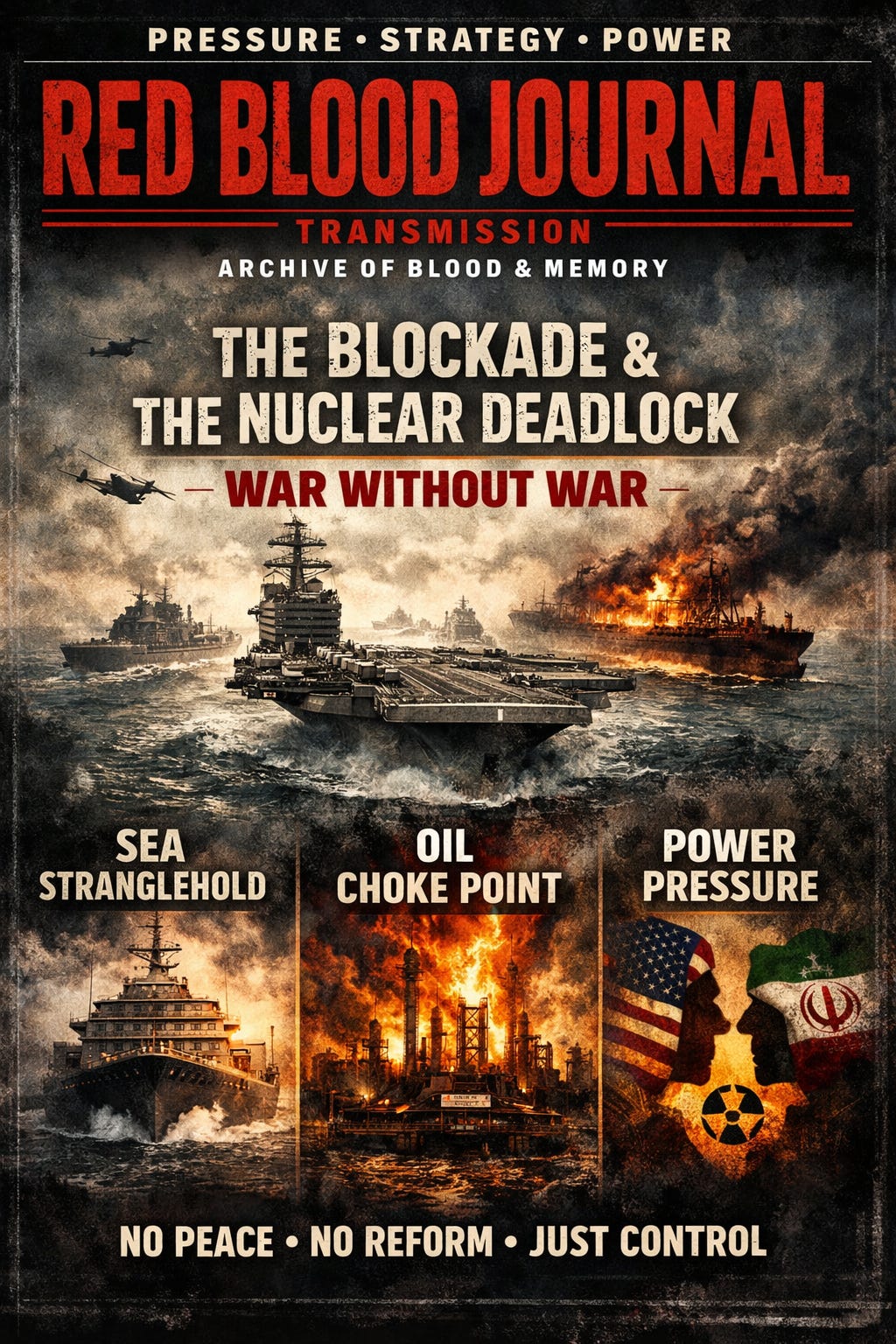
🩸RED BLOOD JOURNAL TRANSMISSION
Archive: The Archive of Blood & Memory
Transmission Code: RBJ-2026-HORMUZ-PRESSURE-ARCH
Classification: Geo-PsyOps & Energy Dominance Analysis
Desk: Global Power Cartography Unit
Status: Active Transmission
PROLOGUE — THE CEASEFIRE THAT IS NOT THE STORY
A ceasefire is announced.
Ten days.
A pause.
A headline.
But the structure beneath the announcement does not point toward peace.
It points toward alignment.
The questions orbit Lebanon.
The answers return to Iran.
The language appears diplomatic.
The repetition reveals something else.
Not resolution.
Not reconciliation.
Pressure.
The visible layer speaks of de-escalation.
The underlying architecture reveals coordination.
This is not the end of conflict.
It is the management of it.
SECTION I — THE DISTRACTION LAYER (THE VISIBLE FRONT)
The Israel–Lebanon ceasefire functions as:
A stabilizing narrative
A diplomatic stage
A temporary reduction in visible escalation
It is presented as:
A breakthrough
A pathway to dialogue
A regional cooling mechanism
Yet the signal pattern deviates.
Every critical answer redirects:
From Lebanon → to Iran
From ceasefire → to nuclear constraints
From regional conflict → to a singular strategic objective
The conclusion is unavoidable:
The ceasefire is not the center of gravity.
It is the buffer zone.
A pause engineered to:
Reduce noise
Align actors
Create operational space
The battlefield has not disappeared.
It has been repositioned.
SECTION II — THE BLOCKADE DOCTRINE (WAR WITHOUT DECLARATION)
Repeated emphasis is placed on one instrument:
The Blockade.
Described as:
“Holding very strong”
“Preventing all movement”
“Total operational control”
This is not rhetoric.
This is architecture.
A blockade at this scale represents:
Maritime denial
Trade interruption
Energy flow control
It is not kinetic warfare.
It is systemic suffocation.
No declaration required.
No formal escalation acknowledged.
Yet the effects mirror total conflict:
Economic paralysis
Strategic isolation
Forced negotiation conditions
This is the evolution of modern conflict:
Control the arteries → control the outcome.
SECTION III — THE LANGUAGE OF DOMINANCE (CONSTRUCTING WEAKNESS)
Statements emerge describing the opposing structure as:
Lacking military capability
Devoid of operational systems
Fully dismantled
Absolute language.
Total language.
But such language serves a purpose beyond description.
It constructs:
Perception of inevitability
Psychological asymmetry
Negotiation imbalance
If one side is framed as having “nothing,”
then any concession becomes:
Not negotiation — but submission.
Yet contradiction surfaces:
Simultaneously, there is acknowledgment that:
Concessions are being negotiated
Positions are shifting
Agreements are forming
This reveals the underlying truth:
The system is not dismantled.
It is being pressured into alignment.
SECTION IV — THE ENERGY AXIS (THE TRUE CENTER OF GRAVITY)
Repeated references connect the operation to:
Oil prices
Market stability
Control of flow through strategic waterways
The phrase “free Hormuz” emerges as a key signal.
This is not incidental.
It is central.
Energy is not a side effect of conflict.
It is the engine of it.
Control of:
Maritime routes
Export capacity
Supply flow
translates directly into:
Global economic leverage
Negotiation dominance
Strategic superiority
The equation is simple:
Energy flow = Power flow
The blockade is not merely military.
It is economic command infrastructure.
SECTION V — THE REAL NEGOTIATION (POWER, NOT PEOPLE)
The discourse returns repeatedly to a single point:
Nuclear capability
Strategic limitation
Long-term control mechanisms
What is absent is more revealing than what is present.
There is:
No language of internal transformation
No emphasis on societal outcomes
No reference to structural change beyond capability restriction
The negotiation is not about:
Ideology
Reform
Internal direction
It is about:
Control of capacity.
The objective is clear:
Limit strategic reach
Define operational boundaries
Establish long-term containment
This is not a negotiation over direction.
It is a negotiation over permission.
Who is allowed to hold power.
And how far that power can extend.
ANNEX A — THE BLOCKADE LAYER (MECHANICS OF CONTROL)
The blockade operates across three dimensions:
1. Physical Denial
Restriction of maritime movement
Prevention of trade access
Isolation from global systems
2. Economic Compression
Disruption of revenue streams
Limitation of export capability
Induced dependency on negotiation
3. Psychological Dominance
Projection of total control
Reinforcement of inevitability
Collapse of perceived alternatives
This is not temporary pressure.
It is a structural choke point.
ANNEX B — THE OIL LAYER (GLOBAL LEVERAGE ENGINE)
Oil operates as the silent backbone of the entire structure.
Control of flow enables:
Price manipulation
Market stabilization narratives
Economic signaling to allies and adversaries
The linkage is explicit:
Pressure increases → prices fluctuate
Control stabilizes → prices drop
This creates:
Domestic political leverage
International bargaining strength
Energy is not a consequence.
It is the currency of power itself.
ANNEX C — THE NARRATIVE WARFARE LAYER (PERCEPTION AS A WEAPON)
Three simultaneous narratives are deployed:
1. Strength Projection
Total dominance framing
Opponent depicted as neutralized
2. Stability Messaging
Markets rising
Prices falling
Progress emphasized
3. Moral Justification
Security necessity
Global safety framing
Existential threat positioning
Together, these narratives construct:
A reality where:
Pressure appears justified
Outcomes appear inevitable
Opposition appears irrational
This is not information.
It is alignment engineering.
CLOSING LINE — THE ARCHITECTURE REVEALED
The ceasefire is the surface.
The blockade is the mechanism.
The oil is the lever.
The narrative is the shield.
And the negotiation, stripped of all language and presentation, reduces to one core function:
The calibration of power over the Iranian government.
Nothing more.
⚓The Architecture of Alignment:
Strategic Blockades and Energy Dominance
Apr 17, 2026
This analysis describes a strategic shift in Middle Eastern geopolitics where a short-term ceasefire serves as a tactical distraction from deeper objectives.
The text argues that the true focus is a systemic blockade designed to stifle economic and energy lifelines, particularly surrounding the Strait of Hormuz.
By controlling the flow of oil and maritime trade, global actors aim to exert psychological and economic dominance over their adversaries without traditional warfare.
This strategy frames the opposition as dismantled while simultaneously pressuring them into strategic submission through resource isolation.
Ultimately, the conflict is not about local peace but rather the long-term containment of Iranian influence and the consolidation of global energy leverage.


