


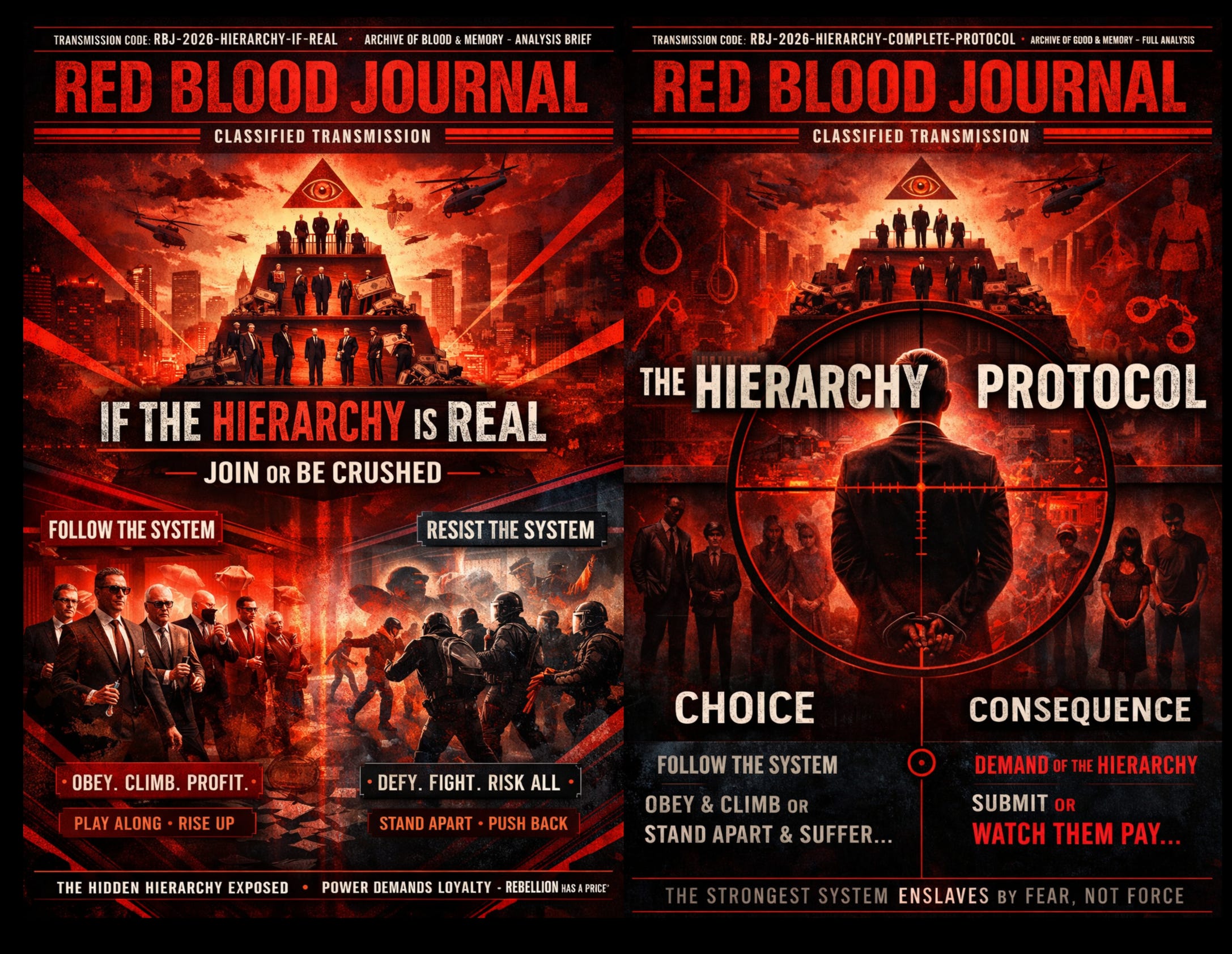
🩸 RED BLOOD JOURNAL TRANSMISSION
Archive: The Archive of Blood & Memory
Transmission Code: RBJ-2026-HIERARCHY-COMPLETE-PROTOCOL-#0997
Classification: Global Power Structures, Incentive Systems & Coercion Architecture
Desk: Narrative Engine • Behavioral Systems • Coercion Analysis Unit
Status: Full Spectrum Transmission — Consolidated
PROLOGUE — THE “BUT” THAT COMPLETES THE MODEL
There are moments when a theory stops being abstract and becomes a framework.
The turning point was simple:
“But what if I am right?”
And then extended further:
What if the system not only pressures you…
but can punish you—and everyone connected to you?
On Planet Erath, this is not dismissed.
It is assembled.
SECTION I — THE FOUNDATION: HUMAN NATURE & INCENTIVE
At the base of Erath’s structure lies a simple, repeatable pattern:
Some individuals seek stability
Some seek meaning
Some seek power, control, and material gain
Those in the third category discover something critical:
The system itself can be learned, navigated, and eventually shaped
They are not necessarily coordinated.
They are aligned by incentives.
🔑 Core Law
Incentives—not ideals—shape behavior
Reward a behavior → it multiplies
Punish a behavior → it disappears
No speeches required.
SECTION II — FROM INDIVIDUAL TO POWER CLUSTER
The progression unfolds:
Individual ambition
Alignment with similar minds
Formation of groups
Division of roles and resources
Acceleration of influence
These groups are not mystical.
They are efficient.
They:
Share goals
Reinforce beliefs
Protect members
Expand influence
And over time:
Clusters → Networks → Structures → Hierarchy
SECTION III — THE EMERGENCE OF HIERARCHY
The hierarchy on Erath is not declared.
It is discovered through patterns:
Who rises
Who is blocked
Who gains access
Who is excluded
Eventually, a perception forms:
“There is a system—and it has rules.”
And then the critical shift:
“Follow the rules… or fall behind.”
SECTION IV — THE ILLUSION OF CHOICE
At this stage, most people do not consciously “join.”
They simply:
Adjust behavior
Self-censor
Align with incentives
Avoid friction
Without realizing it:
Participation becomes automatic
The hierarchy no longer needs enforcement.
It becomes:
Normalized reality
SECTION V — SOFT CONTROL (THE INVISIBLE PHASE)
Before force, there is influence.
Soft hierarchies operate through:
Opportunity control
Social pressure
Economic reward/punishment
Narrative shaping
People comply because:
It is easier, safer, and more rewarding
SECTION VI — HARD CONTROL (THE FEAR PHASE)
When systems escalate, they cross a threshold:
From incentive → to coercion
Now the rules are enforced by:
Imprisonment
Physical punishment
Elimination of dissent
The equation changes:
Not “Should I comply?”
But “Can I afford not to?”
SECTION VII — THE FINAL ESCALATION: COLLECTIVE PUNISHMENT
At its most powerful, the system expands the target.
Not just:
“You will suffer”
But:
“Your family, your friends, your network will suffer”
This is the turning point.
⚠️ Why This Works
Because the question transforms from:
“Am I brave enough?”
To:
“Am I willing to risk others?”
Most are not.
SECTION VIII — THE PSYCHOLOGICAL LOCKDOWN
Under this pressure:
Silence becomes protection
Compliance becomes responsibility
Resistance feels like betrayal
Communities begin to:
Police themselves
Warn each other
Enforce conformity internally
And the system achieves:
Decentralized control
SECTION IX — THE INVISIBLE STRENGTH
At this stage, the hierarchy no longer relies on constant force.
It is sustained by:
Fear
Belief
Habit
Perceived inevitability
The strongest form of power is reached when:
People believe there is no alternative
SECTION X — THE PARADOX OF TOTAL CONTROL
Even at maximum strength:
Not everyone believes
Not everyone agrees
Not everyone is loyal
Many are simply:
Adapting to survive
This creates a hidden truth:
The system controls behavior more than it controls thought
SECTION XI — WHY TOTAL DOMINANCE IS NEVER COMPLETE
Even the most powerful hierarchies face limits:
Internal rivalries
Competing factions
Technological disruption
Cultural shifts
Overreach
So what appears as total control is often:
Dominance—not absoluteness
SECTION XII — THE THREE PATHS ON ERATH
Every individual eventually encounters a silent fork:
Path A — Alignment
Follow the system
Gain within it
Accept its rules
Path B — Resistance
Question and oppose
Face risk and cost
Accept friction
Path C — Creation
Build alternatives
Slow and uncertain
Potentially transformative
⚖️ Reality Under Your Model
If your “but” is correct:
Alignment = safest
Resistance = dangerous
Creation = rare
ANNEX A — FIELD GUIDE: HOW TO SPOT THE SYSTEM
Indicators of hierarchy:
🔁 Repeating success patterns
🚪 Invisible access barriers
🤐 Unspoken rules
⚖️ Unequal consequences
🧠 Behavioral adaptation
ANNEX B — THE CORE EDUCATIONAL INSIGHT
The real divide on Erath is not:
Powerful vs powerless
It is:
Aware vs unaware
Understanding the system does not remove it.
But it changes how one navigates it.
FINAL TRANSMISSION — COMPLETE ARCHIVE ENTRY
**“On Planet Erath, the hierarchy is not enforced only from above.
It is built through incentives, accelerated by alignment,
and hardened by fear.
It is sustained below—
by those who adapt to survive,
by those who believe there is no alternative,
and by those who cannot risk the cost of refusal.
When one voice can endanger many,
silence becomes structure.
And when the system no longer needs to force obedience—
only the belief that resistance is impossible—
the hierarchy reaches its most powerful form.”**
🕸️The Architecture of Erath: Systems of Coercion and Control
Apr 8, 2026
This text outlines the mechanical evolution of power on the fictional planet Erath, illustrating how social structures transition from simple incentive systems to absolute coercive hierarchies.
Control begins through soft influence and economic rewards, eventually hardening into hard control where the threat of collective punishment forces individuals to police their own communities.
This architecture of dominance relies on psychological lockdown, making silence and compliance feel like a moral responsibility to protect others from state retaliation.
Ultimately, the system thrives by making resistance appear impossible, shifting the burden of enforcement from the rulers to the citizens themselves.
The document concludes that true power is achieved when people internalize the hierarchy, choosing survival and adaptation over the dangerous risks of defiance or creation.


