


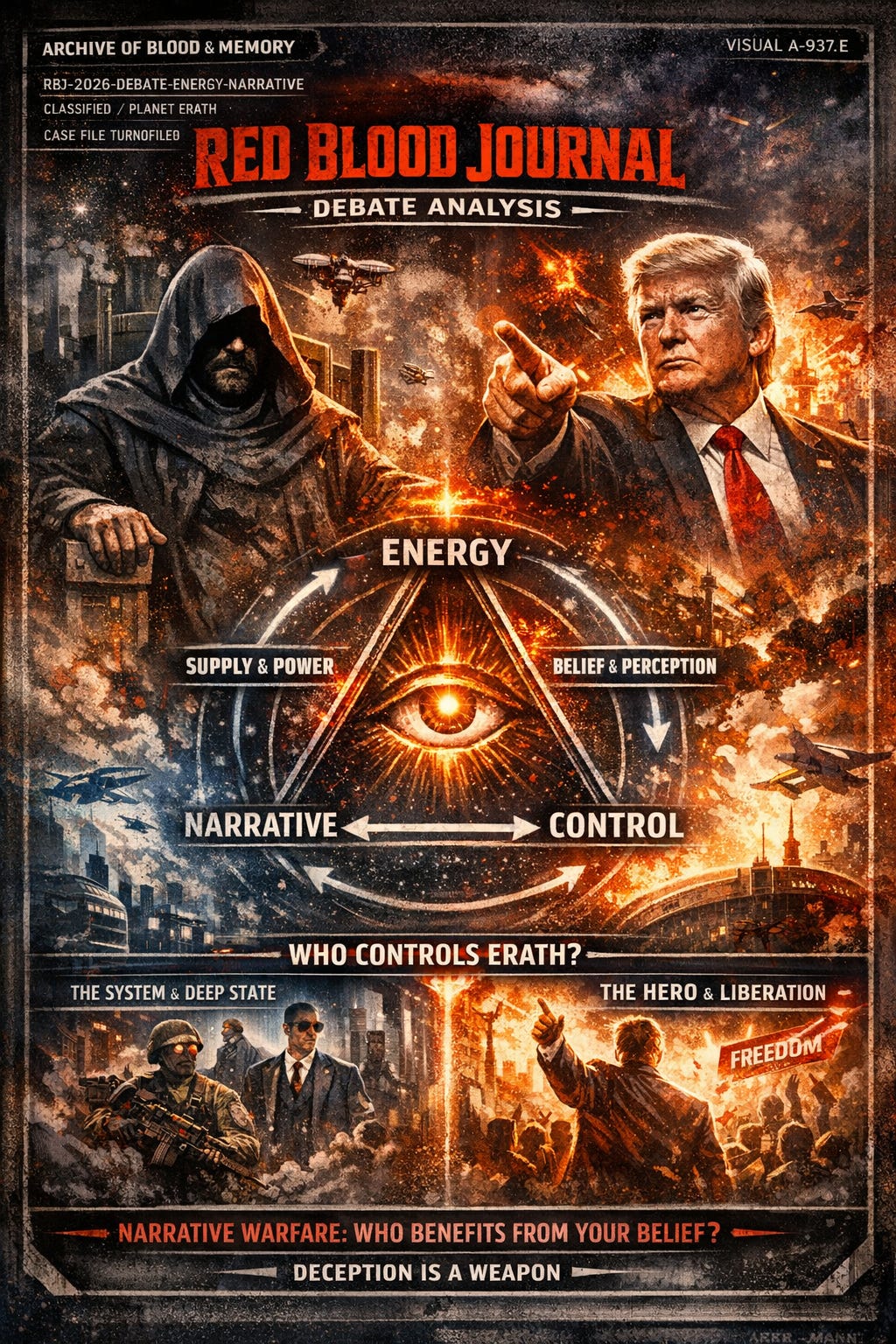
🩸 RED BLOOD JOURNAL TRANSMISSION
Archive: The Archive of Blood & Memory
Transmission Code: RBJ-2026-DEBATE-ENERGY-NARRATIVE-#0995
Classification: Narrative Warfare & Economic Reality Analysis
Desk: Dual-Perspective Conflict Unit
Status: Active Analytical Debate
PROLOGUE — THE CLAIM ON ERATH
On Planet Erath, a dominant narrative emerges:
A hidden “deep system” controls energy, money, and geopolitics
A central figure is dismantling that system
Energy liberation → economic freedom → collapse of centralized control
Opposition = part of the system
This worldview is clearly expressed in the source material
But on Erath, every narrative has a counter-narrative.
SECTION I — THE CORE ASSERTION
🔴 POSITION A (THE SYSTEM IS REAL)
The text argues:
Energy control = global control
Central banks + institutions = engineered system
Artificial scarcity (oil, sanctions, conflict) maintains power
Removing constraints → abundance → collapse of control
Key idea:
“If you control energy, you control the system”
Argument Strengths:
Historically grounded: oil politics, petrodollar, sanctions are real tools
Energy pricing DOES influence inflation and geopolitics
Institutions (IMF, central banks) undeniably shape global systems
🔵 POSITION B (OVERSIMPLIFICATION & NARRATIVE FRAMING)
Counterpoint:
Global systems are not controlled by a single coordinated “deep system”
Energy markets are influenced by:
Supply chains
OPEC decisions
wars
infrastructure
demand cycles
No single actor can “free global energy” overnight
Critical flaw:
The narrative compresses complex systems into a single villain → single hero structure
SECTION II — THE “TRUMP AS SYSTEM BREAKER” CLAIM
🔴 POSITION A
The text claims:
A deliberate dismantling of:
central banking
climate policy
global dependency structures
Strategy:
increase energy supply
lower prices
destroy green transition
weaken globalist control
“He’s undoing everything set up since the 1970s”
Interpretation on Erath:
A controlled demolition of the old system.
🔵 POSITION B
Counter-analysis:
No administration can fully dismantle:
Federal Reserve structure
global financial architecture
multinational agreements
Energy markets are global, not unilateral
Policy changes ≠ systemic overthrow
Alternative interpretation:
This is policy shift, not system collapse
SECTION III — THE ENERGY ABUNDANCE THEORY
🔴 POSITION A
Claim:
Remove restrictions → oil floods market
Result:
cheap energy
inflation collapse
economic boom
“Oil will flow freely… prices drop dramatically”
Logical appeal:
Basic supply vs demand economics
🔵 POSITION B
Reality check:
Oil production is constrained by:
infrastructure
investment cycles
geopolitical risk
refining capacity
Oversupply can:
crash producers
destabilize economies (including allies)
Key contradiction:
Unlimited cheap oil can damage as much as it helps
SECTION IV — THE “DEEP STATE” FRAMEWORK
🔴 POSITION A
The file describes:
NGOs, NATO, IMF, media = interconnected system
Money flows through hidden loops
War, climate, and finance are coordinated tools
“It’s wider, deeper than anyone could imagine”
Psychological strength:
Provides a coherent explanation for complex chaos
Gives pattern recognition where randomness exists
🔵 POSITION B
Counterpoint:
Institutions often conflict with each other
Governments act in competing—not unified—interests
Bureaucratic inefficiency contradicts idea of perfect coordination
Critical insight:
The “deep system” model assumes too much competence and unity
SECTION V — THE IRAN / STRAIT OF HORMUZ CLAIM
🔴 POSITION A
Claim:
Control of the Strait = control of global energy
Opening it removes “fear tax”
Leads to global price collapse
“Once the Strait is open… oil prices drop like we’ve never seen”
🔵 POSITION B
Reality:
Strait of Hormuz is already a major global shipping lane
Disruptions affect prices—but do not fully control them
Markets price in risk dynamically
Conclusion:
Important choke point—but not a master switch
SECTION VI — THE PSYCHOLOGICAL ENGINE
🔴 POSITION A
The narrative creates:
Clear enemy (deep system)
Clear hero (system breaker)
Clear outcome (liberation)
This structure is powerful and mobilizing
🔵 POSITION B
But also:
Filters all information into one lens
Turns disagreement into “proof of conspiracy”
Reduces complexity into binary thinking
Result:
A self-reinforcing belief system
FINAL VERDICT — ERATH ANALYSIS
WHAT HOLDS VALUE:
Energy IS central to power
Financial systems DO concentrate influence
Narratives DO shape perception
WHAT BREAKS DOWN:
Over-centralization of control (too unified)
Over-simplification of global systems
Hero-centric resolution of structural complexity
ANNEX A — THE ERATH FORMULA
On Planet Erath:
Narrative = Control
But also:
Counter-Narrative = Control
ANNEX B — THE REAL QUESTION
Not:
“Is this true or false?”
But:
“Why is this narrative compelling—and who benefits from believing it?”
⚖️The Energy Narratives of Erath: Systems and Subversion
Apr 8, 2026
The provided text analyzes a specific geopolitical narrative on the fictional planet Erath regarding the intersection of energy production and global power structures.
One perspective posits that a clandestine central authority maintains dominance through artificial scarcity and financial manipulation, which a singular figure is now attempting to dismantle.
Conversely, the counter-argument suggests this worldview relies on oversimplified hero-villain dynamics that ignore the inherent friction and complexity of international markets.
The analysis highlights how unrestricted oil flows and the liberation of trade routes are presented as tools for economic revolution.
Ultimately, the source examines how such binary frameworks serve as powerful psychological engines for understanding systemic change.
These documents question whether these events represent a genuine structural collapse or merely a standard shift in political strategy.


