


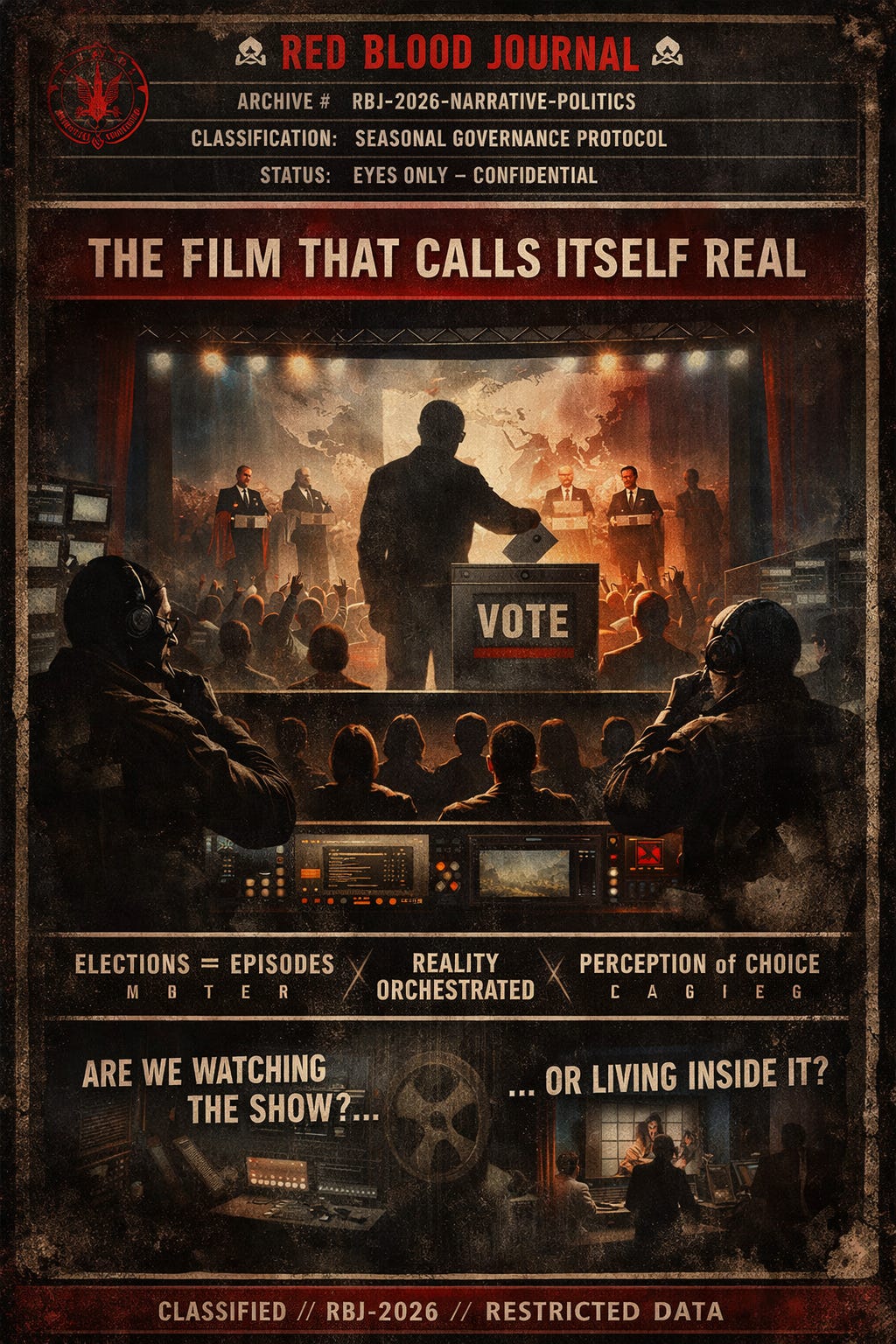
🩸 RED BLOOD JOURNAL TRANSMISSION
Archive: The Archive of Blood & Memory
Transmission Code: RBJ-2026-SEASONAL-GOVERNANCE-PROTOCOL-#0993
Classification: Narrative Warfare & Perception Architecture Analysis
Desk: Behavioral Systems & Cinematic Governance Unit
Status: Active Transmission
PROLOGUE — THE FILM THAT CALLS ITSELF REAL
On Planet Erath, the system does not present itself as fiction.
It presents itself as reality.
Yet it borrows its structure from something far more familiar:
Serialized storytelling.
Not because it is fake.
Not because it is staged.
But because story structure is the most efficient way to hold attention, guide perception, and sustain participation.
And when a system adopts that structure, something unusual happens:
The audience begins to debate whether they are watching a show… or living inside it.
SECTION I — THE CONTINUOUS SEASON
On Erath, there is no “end of season.”
Crises begin but rarely conclude
Conflicts evolve but rarely resolve
Promises are made but remain in motion
Each phase flows into the next like episodes in a long-running series.
Tension is never eliminated—only transferred.
Because resolution ends engagement.
And engagement is the system’s lifeblood.
SECTION II — ELECTIONS AS EMBEDDED EPISODES
Elections are not interruptions to the show.
They are centerpiece episodes within it.
Campaigns function as trailers
Debates function as scripted confrontations
Results function as season pivots
The audience participates directly:
They vote.
They choose.
They invest.
But the deeper architecture—the “production studio”—remains largely intact.
The story changes direction.
The stage itself does not.
SECTION III — THE PERCEPTION ENGINE
The system’s most powerful mechanism is not control.
It is perception of control.
A single belief anchors the entire structure:
“This outcome reflects your choice.”
This belief produces:
Legitimacy → the system appears self-determined
Stability → dissatisfaction is absorbed within the narrative
Continuity → engagement persists across cycles
Even when outcomes are constrained, the feeling of participation remains real.
SECTION IV — THE CLIFFHANGER STATE
Like any successful series, Erath’s system avoids full closure.
Instead, it operates in a permanent cliffhanger state:
A war pauses but does not end
A reform passes but does not resolve
A scandal fades without final accountability
Each unresolved thread becomes fuel for the next phase.
The viewer returns, not because everything is solved—
but because something is still unfinished.
SECTION V — ESCALATION AND ROTATION
To sustain attention across seasons:
Escalation
Larger threats
Deeper divisions
Higher stakes
Rotation
New leaders
New narratives
Reframed conflicts
The cast evolves.
The tone shifts.
But the underlying framework persists.
SECTION VI — THE BLUR BETWEEN FICTION AND REALITY
Here lies the most delicate layer.
The system does not need people to believe it is fake.
Nor does it need them to believe it is fully controlled.
Instead, it benefits from a dual perception:
Some see it as entirely real and organic
Others suspect deeper orchestration
And a third group moves between the two.
This creates a paradox:
The more one tries to define it absolutely,
the more it resembles either a perfect system… or a perfect script.
SECTION VII — THE DANGEROUS QUESTION
The system remains stable as long as the primary question is:
“Who will win next?”
It becomes unstable when the question shifts to:
“What are the boundaries of what winning can change?”
Because that question does not focus on the episode—
it focuses on the structure of the series itself.
ANNEX A — THE SEASONAL GOVERNANCE LOOP
Tension Introduced →
Participation Invited (Elections) →
Partial Resolution →
New Threat Revealed →
Expectation Built →
Cycle Continues
ANNEX B — THE ROLE OF THE AUDIENCE
On Erath, the population is not passive.
It is:
Emotionally invested
Actively participating
Continuously returning
Which makes the system more resilient than simple control.
It is not sustained by force alone—
but by engagement.
FINAL LINE — THE FILM WITH NO CREDITS
A traditional film ends.
The credits roll.
The audience leaves.
On Planet Erath, the film continues without credits.
And the most important uncertainty remains:
Whether the system is a story that feels real…
or a reality that has learned to behave like a story.
🎬The Cinematic Governance of Planet Erath
Apr 7, 2026
The provided text explores a governance model on Planet Erath that utilizes the mechanics of serialized storytelling to maintain social order and public interest.
Rather than relying solely on force, the system functions like an endless cinematic production where political events and crises serve as plot points designed to prevent final resolution.
Elections and social conflicts are framed as high-stakes episodes that encourage the population to remain emotionally invested in the narrative.
By ensuring that tensions are constantly transferred rather than resolved, the “production studio” maintains structural stability through a permanent state of suspense.
This strategy blurs the lines between authentic reality and scripted drama, making the public active participants in a show that never reaches its closing credits.
Ultimately, the system’s power lies in the perception of choice, ensuring that citizens focus on who will win the next chapter rather than questioning the boundaries of the framework itself.


