


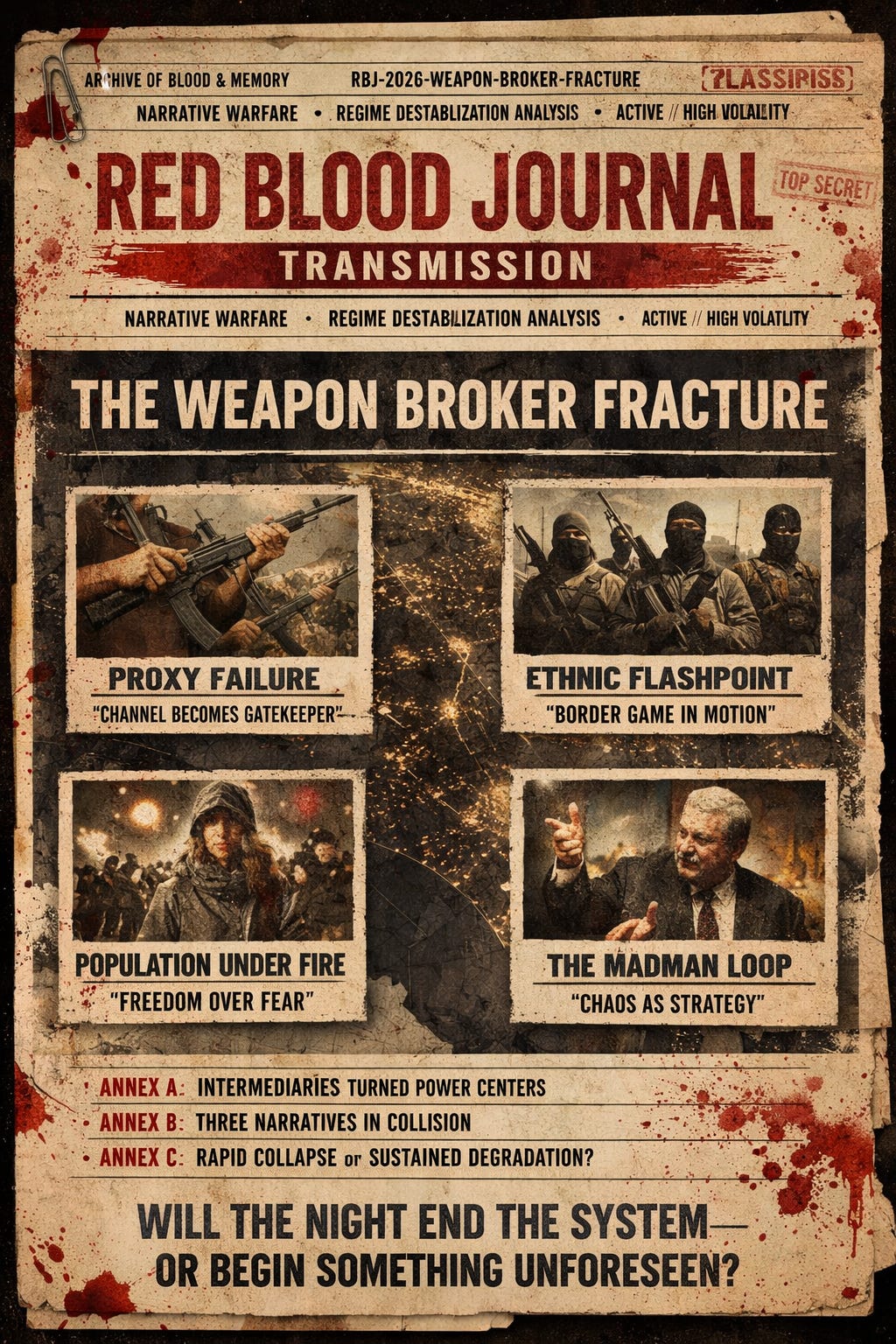
🩸 RED BLOOD JOURNAL TRANSMISSION
Archive: The Archive of Blood & Memory
Transmission Code: RBJ-2026-WEAPON-BROKER-FRACTURE
Classification: Geo-PsyOps & Proxy Network Exposure Unit
Desk: Narrative Warfare & Regime Destabilization Analysis
Status: Active Transmission — High Volatility
PROLOGUE — THE NIGHT BEFORE POSSIBILITY
On the Planet Erath, there are moments when history compresses into hours.
April 6.
A deadline approaches.
A voice speaks—not as a whisper, but as a signal.
A system long believed immovable is suddenly described as fragile.
Not in years. Not in campaigns.
In a single night.
The statement is not merely about destruction.
It is about exposure—of structures, of alliances, of hidden intermediaries.
Because on Erath, collapse does not begin at the walls.
It begins in the hands meant to deliver salvation.
SECTION I — THE PROMISE OF LIBERATION, THE MECHANICS OF CONTROL
The declaration was simple:
The system could fall overnight.
But behind that statement sits a deeper architecture.
A pattern repeated across Erath:
Narrative of liberation is introduced
External support is implied or delivered
Population is encouraged toward resistance
Intermediaries are inserted
Outcome is redirected
This is not chaos.
This is managed instability.
Even the contradiction is engineered:
A promise of intervention
A refusal to reveal the plan
A signal to act
A warning of consequence
This duality is not confusion.
It is strategic ambiguity—a tool designed to keep all actors moving, but none fully informed.
SECTION II — THE BROKEN CHAIN: WHEN THE MIDDLE FAILS
The fracture did not occur at the top.
It occurred in the middle layer.
Weapons—sent under the premise of reaching the people—
never arrived.
They were intercepted.
Held.
Absorbed.
Not by enemies.
But by those positioned as bridges.
This is the most dangerous failure mode on Erath:
When the channel becomes the gatekeeper,
and the gatekeeper becomes the owner.
The implications are structural:
Trust between external power and internal resistance collapses
The population remains unarmed, exposed, and reactive
The intermediary accumulates leverage
This is not theft alone.
It is power reallocation.
SECTION III — THE ETHNIC VARIABLE: CONTAINMENT OF FRACTURE
The response to this breach reveals another layer.
A directive emerges:
Stay away. Do not enter. Do not engage.
Why?
Because the introduction of actors with separatist gravity transforms the battlefield:
From regime vs population
Into ethnic vs ethnic
Into border vs border
On Erath, this shift is fatal to cohesion.
Once fragmentation begins, the original objective dissolves.
The system survives—not through strength, but through division of its challengers.
Thus, containment becomes priority:
Not of the regime.
But of the narrative battlefield.
SECTION IV — THE PEOPLE: WILLINGNESS UNDER FIRE
A paradox emerges.
A population under extreme suppression expresses:
Willingness to endure destruction
Acceptance of suffering
Demand for change at any cost
Reports describe:
Snipers targeting crowds
Precision fear—individuals selected, not masses dispersed
Psychological collapse engineered through unpredictability
Yet the signal persists:
Freedom, even under fire, is preferable to controlled existence.
This is the most volatile element in any system:
A population that no longer calculates survival as the highest value.
At that point, deterrence weakens.
Control shifts from force to timing.
SECTION V — THE MADMAN LOOP
The regime enters its final defensive architecture:
The Madman Strategy
Core principle:
Become unpredictable enough that the opponent hesitates.
Execution:
Escalatory rhetoric
Threats beyond proportional logic
Willingness to burn surrounding structures
But this strategy has a flaw:
It only works before the strike begins.
Once engagement starts:
The opponent cannot disengage without loss of credibility
The “madman” must escalate further to maintain illusion
Exit pathways disappear
At this stage, the strategy mutates:
From madman
To self-consuming actor
SECTION VI — GLOBAL SIGNALS: THE SILENT WITHDRAWAL
While the surface narrative focuses on confrontation,
another signal appears in silence.
Allies begin to step back.
No statements.
No reinforcements.
No visible alignment.
This is the oldest indicator on Erath:
When partners stop speaking,
they have already recalculated the outcome.
Strategic distancing is not neutrality.
It is pre-collapse positioning.
SECTION VII — THE HUMAN SHIELD GAMBIT
A final maneuver emerges:
Civilians are drawn toward critical infrastructure.
Not as defenders.
As deterrents.
This is the inversion of protection:
The state no longer shields the people
The people are used to shield the state
On Erath, this signals terminal stage behavior.
Because it reveals:
The system values survival of structure
over survival of population
ANNEX A — THE INTERMEDIARY PARADOX
Intermediaries on Erath always present as:
Allies
Facilitators
Channels of delivery
But structurally, they hold:
Information asymmetry
Control over distribution
Freedom from direct accountability
Thus, in moments of crisis:
They convert from pipeline
to power center
ANNEX B — THE NARRATIVE ENGINE
Three simultaneous narratives operate:
External Power Narrative
Liberation, precision, inevitability
Regime Narrative
Resistance, survival, existential war
Population Narrative
Exhaustion, risk acceptance, fragmented hope
The outcome is determined not by force alone,
but by which narrative synchronizes fastest with reality.
ANNEX C — THE COLLAPSE MODELS
Two primary trajectories remain:
Model 1 — Rapid Collapse
Internal fracture accelerates
External pressure peaks
Command structure fails overnight
Model 2 — Sustained Degradation
Cycles of strike → pause → strike
Gradual erosion of control
Prolonged instability
Both paths lead to the same endpoint:
Structural termination
The difference is:
Speed of collapse
Scale of human cost
FINAL TRANSMISSION — THE EDGE OF THE NIGHT
On Erath, systems do not fall because they are attacked.
They fall when:
Their intermediaries fracture
Their narratives diverge from reality
Their people stop fearing the consequences
The signal has been sent.
The fractures are visible.
The actors are repositioning.
And somewhere between a promise and a warning,
a question remains suspended:
Will the night end the system—
or reveal what replaces it?
End of Transmission
⏳The Erath Fracture:
Mechanics of Structural Collapse
The provided text details the systemic instability and imminent collapse of a fictional political regime on the planet Erath.
It explores how strategic narrative warfare and the manipulation of information are used to destabilize a system long thought to be indestructible.
A critical point of failure is identified in the unreliable intermediaries who intercept resources and weapons intended for the resistance, thereby transforming themselves into independent power centers.
The analysis also highlights how the regime employs unpredictable escalatory tactics and uses its own citizens as human shields in a desperate attempt to survive.
Ultimately, the source suggests that the government is nearing its end because the population no longer fears death and the ruling structures have lost all international support.
The document concludes that while the method of downfall remains uncertain, the structural termination of the current order is inevitable.


