


🩸 Red Blood Journal
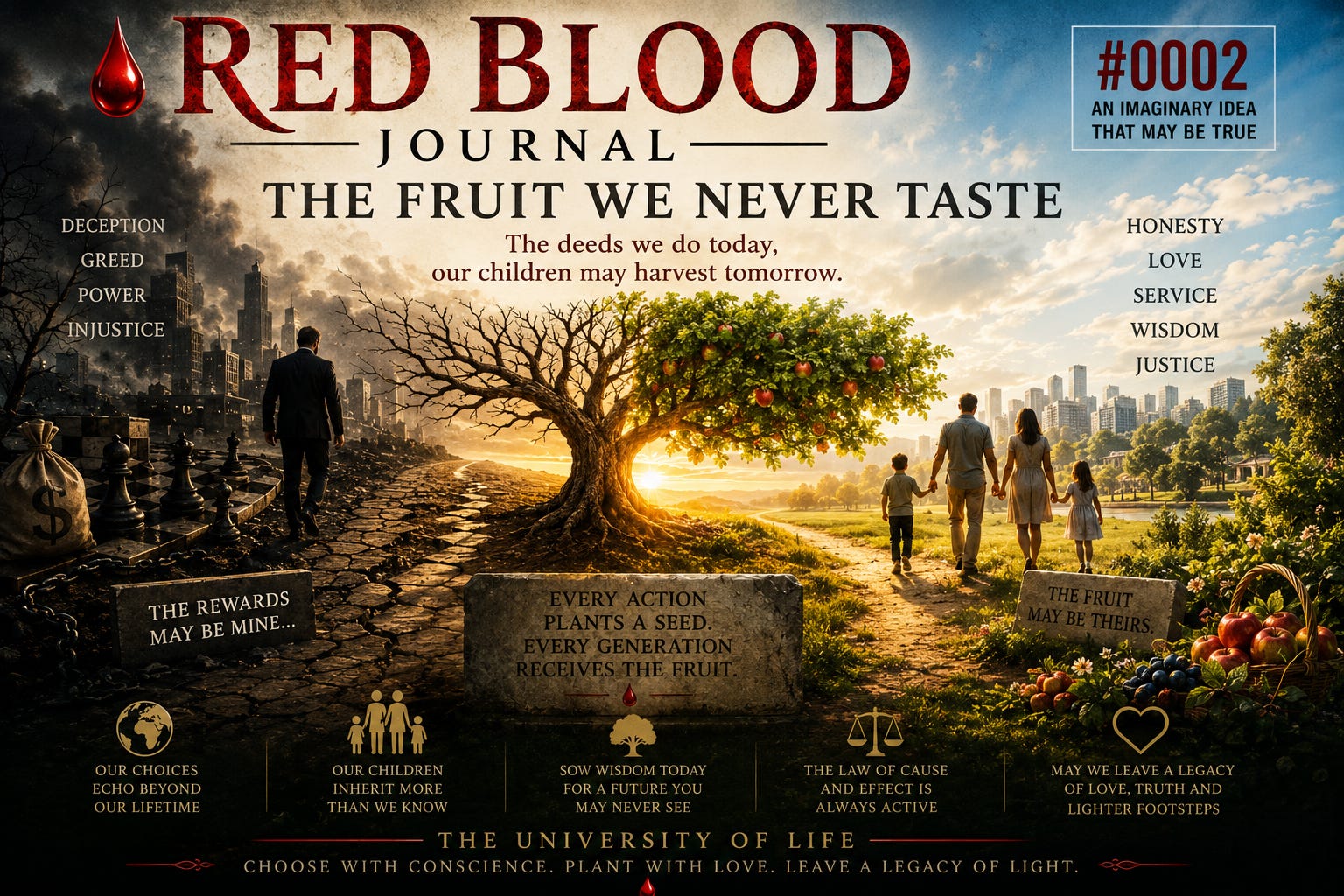
#0002 – The Fruit We Never Taste
Perhaps one of the greatest mysteries of life is that we rarely experience the full harvest of our own actions.
A person plants a tree.
Someone else rests in its shade.
A nation builds a civilization.
Future generations inherit its blessings.
Likewise, a person may sow dishonesty, greed, or injustice.
The immediate rewards may belong to them.
But perhaps the consequences do not.
Maybe the fruit of every action grows on branches that bloom long after the planter is gone.
This is only an idea.
An imagination.
A possibility.
But imagine if life were designed this way.
Imagine that every generation receives not only its own choices, but also part of the invisible inheritance left behind by those before them.
Children would inherit more than genes.
They would inherit character.
Culture.
Habits.
Wisdom.
Debt.
Peace.
Conflict.
Trust.
Or distrust.
Perhaps nations work the same way.
A country built upon honesty, hard work, and justice may leave behind institutions that continue blessing generations that never witnessed the original sacrifice.
Another nation may reach extraordinary wealth through deception, exploitation, or conquest.
For a time, the rewards appear magnificent.
Yet perhaps the true cost is postponed.
Not erased.
Simply delayed.
Its children and grandchildren may unknowingly inherit the weight of decisions they never made.
History often appears to move this way.
Empires rise.
Empires flourish.
Then, generations later, descendants struggle to understand why the foundations beneath them begin to crack.
Perhaps they are walking through gardens planted long before they were born.
Or perhaps they are clearing fields left untended by those who came before.
There is another possibility.
Suppose life itself is a great university.
Suppose the soul returns—not as punishment, but as education.
What if those who ignored conscience while pursuing only wealth and power eventually returned to experience life from the opposite side?
What if they were born into the very generations that inherited the consequences of the world they once helped create?
Not to suffer for revenge.
But to understand.
To feel.
To grow.
To complete a lesson that remained unfinished.
Whether one believes in reincarnation, a single earthly life, or something entirely different, the thought invites reflection.
If today’s choices become tomorrow’s inheritance...
Then perhaps the greatest gift that can be given to one’s children is not wealth.
Not property.
Not influence.
But integrity.
Because the sweetest fruit may never be tasted by the one who plants the tree.
It may belong entirely to those who come after.
Subjects
Generational Consequences
The Fruit of Our Actions
The Legacy of Nations
Spiritual Imagination
The University of Life
Planting Trees for Future Generations
Character as an Inheritance
The Invisible Harvest
🩸🌊✨ Fantastic!
🌳 The Invisible Harvest: A Legacy of Character
Jul 20, 2026
This text explores the profound relationship between human actions and their long-term consequences, suggesting that the true impact of our choices often manifests in future generations. The author posits that individuals and nations alike leave behind an invisible inheritance consisting of character, ethics, and societal foundations rather than just material wealth. By using the metaphor of a planter who never tastes the fruit of their own tree, the passage emphasizes that current decisions shape the world our descendants will inhabit. Furthermore, it introduces a spiritual perspective on reincarnation, suggesting that souls might return to experience the reality created by their previous deeds as a form of education. Ultimately, the writing serves as a philosophical call to prioritize integrity and justice over immediate personal gain. Through this lens, the greatest legacy one can leave is a positive moral harvest for those yet to be born.


