


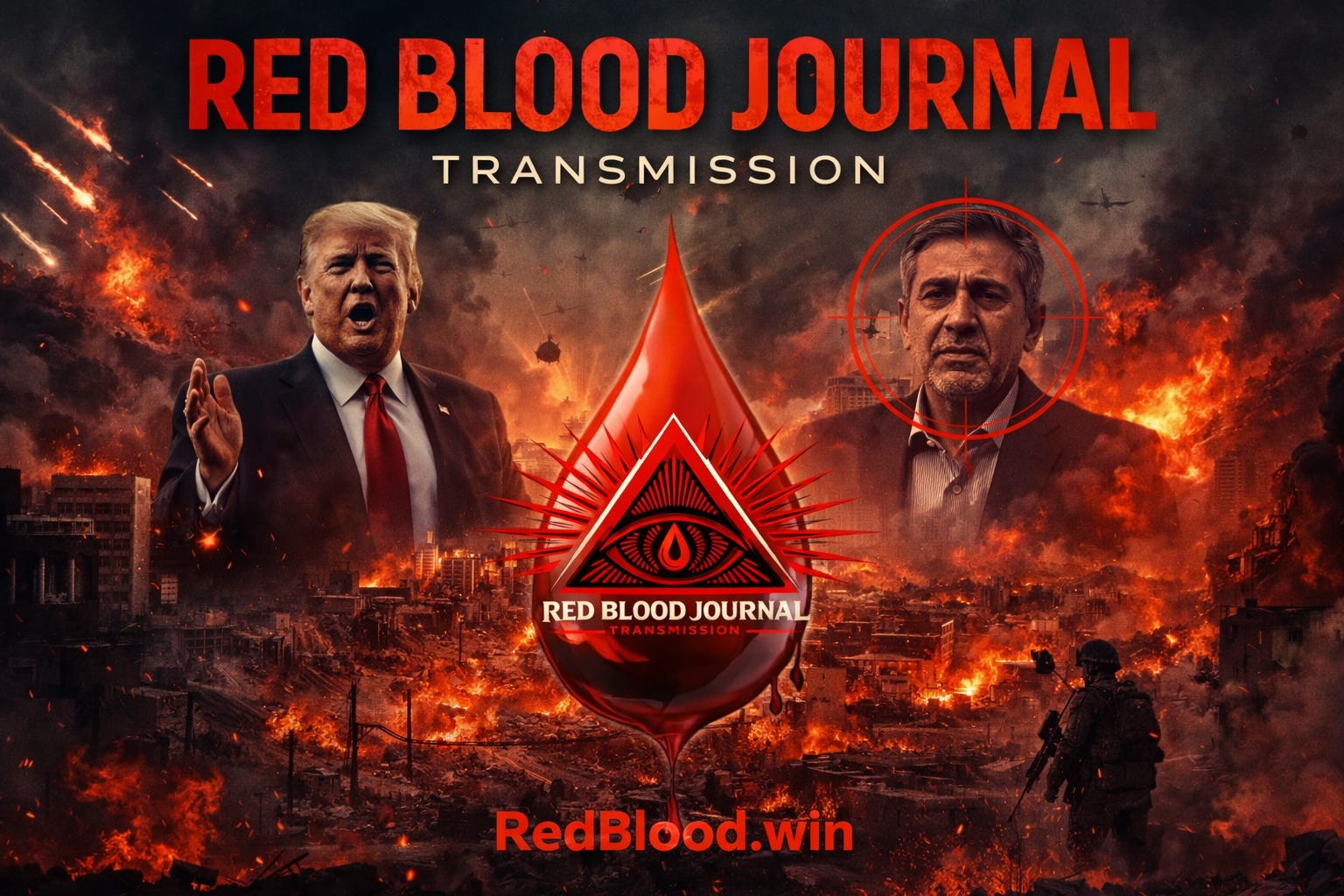
🩸 RED BLOOD JOURNAL TRANSMISSION
Division: Geo-PsyOps & Middle East Influence Cartography Unit
Transmission Code: RBJ-GEO-2026-TEHRAN-FALL-SIGNAL
Classification: Strategic War Analysis / Information Battlespace
Archive: The Archive of Blood & Memory
THE BOMBING OF TEHRAN
Signals of Collapse or Signals of Strategy?
PROLOGUE — THE MORNING OF FIRE
On a cold morning in early March, Tehran awoke to a sky filled with explosions.
Air raid blasts echoed across western and eastern districts of the capital.
Smoke columns rose above the city’s skyline.
Videos captured civilians filming shockwaves and flames as military targets were struck across the metropolitan area.
At the same time, a video message from Iranian President Masoud Pezeshkian circulated online showing an unusually distressed leader urging national unity and pleading for support.
For analysts watching the region, the question was immediate:
Was this the beginning of the end — or simply the next stage of a larger strategic game?
SECTION I — THE MESSAGE OF FEAR
In his address, Pezeshkian asked political factions and citizens to set aside differences and defend the country together.
The tone of the speech diverged sharply from the confident language typically used by Iranian officials.
Key elements included:
• A plea for national unity
• A call to defend Iran’s territory
• A warning to neighboring states not to assist external powers
• A surprising apology to regional countries that had been targeted by Iranian missiles
Most notable was a new declaration that Iran would not attack neighboring states unless attacked first.
For observers, this message carried two possible interpretations:
A genuine attempt to prevent regional escalation
A signal that military pressure had begun to change Tehran’s strategic calculus
SECTION II — THE STRIKE ON MEHRABAD
Reports emerging from Tehran described one of the most intense bombardments since the start of the war.
Among the targets allegedly struck:
• Mehrabad Airport
• IRGC aerospace facilities
• Military infrastructure in western Tehran
• Strategic sites in eastern Tehran including Parchin
Witness footage showed massive explosions and fires across multiple districts.
Military sources claimed that the attacks were part of a large coordinated air campaign conducted by U.S. and Israeli forces.
According to statements circulating in media channels, the operation involved dozens of aircraft and hundreds of precision munitions.
SECTION III — THE BUNKER UNDER TEHRAN
Perhaps the most consequential claim concerned a deep underground command facility believed to be used by Iran’s leadership.
The structure reportedly included:
• Multiple tunnel networks
• Underground command centers
• Secure wartime shelters
Sources claimed that the bunker complex had been used by senior leadership figures to coordinate military operations.
Airstrikes targeting the facility were said to involve large numbers of fighter jets attacking simultaneously.
Whether the bunker was fully destroyed remains unconfirmed.
But its exposure revealed something significant:
Iran’s leadership had anticipated this kind of war for years.
SECTION IV — THE DISAPPEARING COMMAND STRUCTURE
Following the strikes, reports circulated that numerous senior officials and commanders had been killed.
Claims included casualties among:
• IRGC leadership
• intelligence officials
• senior political figures close to the Supreme Leader
If accurate, such losses could weaken the command structure of the state.
However, history shows that centralized regimes often maintain deep layers of succession planning.
Removing individuals does not automatically dismantle the system.
SECTION V — THE TRUMP DOCTRINE
Statements attributed to Donald Trump added another layer of complexity.
He suggested that “unconditional surrender” could mean:
• the destruction of Iran’s military capability
• the loss of its ability to continue fighting
At the same time, he stated that the United States did not necessarily require Iran to become a democracy.
Instead, the future leadership would need to:
• act responsibly
• avoid hostility toward the United States and Israel
• stabilize the region
These statements produced mixed signals.
Some analysts interpreted them as:
psychological pressure aimed at fracturing the remaining leadership structure inside Iran.
SECTION VI — THE PAHLAVI VARIABLE
During the escalation, Reza Pahlavi issued a message to regional governments.
His message contained three key promises:
Iran would restore peaceful relations with neighbors
A transitional government could be formed after the regime’s fall
The Iranian people would determine their future through elections
His statement was directed particularly at Arab Gulf states, which had recently experienced missile attacks.
The strategy appeared to present a vision of post-Islamic Republic regional stability.
SECTION VII — THE POSSIBILITY OF GROUND WAR
Another development raised further concern.
Reports suggested that elements of the U.S. 82nd Airborne Division had been placed on alert.
This unit specializes in:
• rapid deployment
• airborne assault operations
• deep-territory insertion
If deployed, such forces could indicate preparations for a ground component to complement the air campaign.
However, no confirmation of an invasion has been announced.
SECTION VIII — WAR IN THE INFORMATION DOMAIN
Beyond bombs and missiles, another battlefield is clearly active:
the information war.
Different narratives now compete simultaneously:
Narrative A
The Iranian regime is collapsing under military pressure.
Narrative B
The strikes are designed only to weaken capabilities, not topple the government.
Narrative C
External powers are preparing a controlled political transition.
Narrative D
All sides are exaggerating events as part of psychological warfare.
In modern conflicts, information itself becomes a strategic weapon.
DEEP PATTERN ANNEX
Historical Echoes
Several historical parallels emerge:
EventPatternIraq 2003Shock-and-awe air campaignLibya 2011External air power weakening regimeSyria 2015-2024Proxy war and regional escalationIran 2026?Hybrid air war + psychological warfare
But Iran differs in key ways:
• far larger population
• stronger internal security apparatus
• extensive regional proxy networks
This makes outcomes far less predictable.
COUNTERINTELLIGENCE NOTE
Strategic messaging during wartime often serves multiple purposes simultaneously:
• intimidation
• division of enemy leadership
• reassurance of allies
• influence over domestic populations
Therefore, early reports from war zones frequently contain partial truths mixed with strategic exaggeration.
FINAL OBSERVATION
The Moment Before History Turns
The events unfolding around Tehran may represent one of three possibilities:
The beginning of regime collapse
A limited war designed to reshape regional power
A strategic escalation intended to force negotiations
Which path emerges will depend on forces still moving behind the curtain of geopolitics.
But one fact is already clear.
The Middle East has entered another historic threshold moment — one where air power, information warfare, and political succession converge.
And as always in the Red Blood Journal archives, one question remains:
Who truly benefits from the storm?
Tehran Fall Signal:
The Architecture of Iranian Collapse
This document analyzes a hypothetical military escalation in Iran characterized by heavy aerial bombardments of Tehran and strategic sites like Mehrabad Airport.
The text explores the potential collapse of the Iranian leadership following reports of high-level casualties and a visibly distressed presidential address.
Key sections examine the psychological warfare employed by international actors, including the “Trump Doctrine” and the influence of opposition figures like Reza Pahlavi.
Analysts weigh whether these events signal a genuine regime change or a calculated effort to force diplomatic concessions.
Furthermore, the report highlights the possibility of a ground invasion while cautioning that wartime information is often manipulated for strategic effect.
Ultimately, the source frames this conflict as a pivotal historical threshold where kinetic warfare and information operations converge to reshape Middle Eastern geopolitics.


