


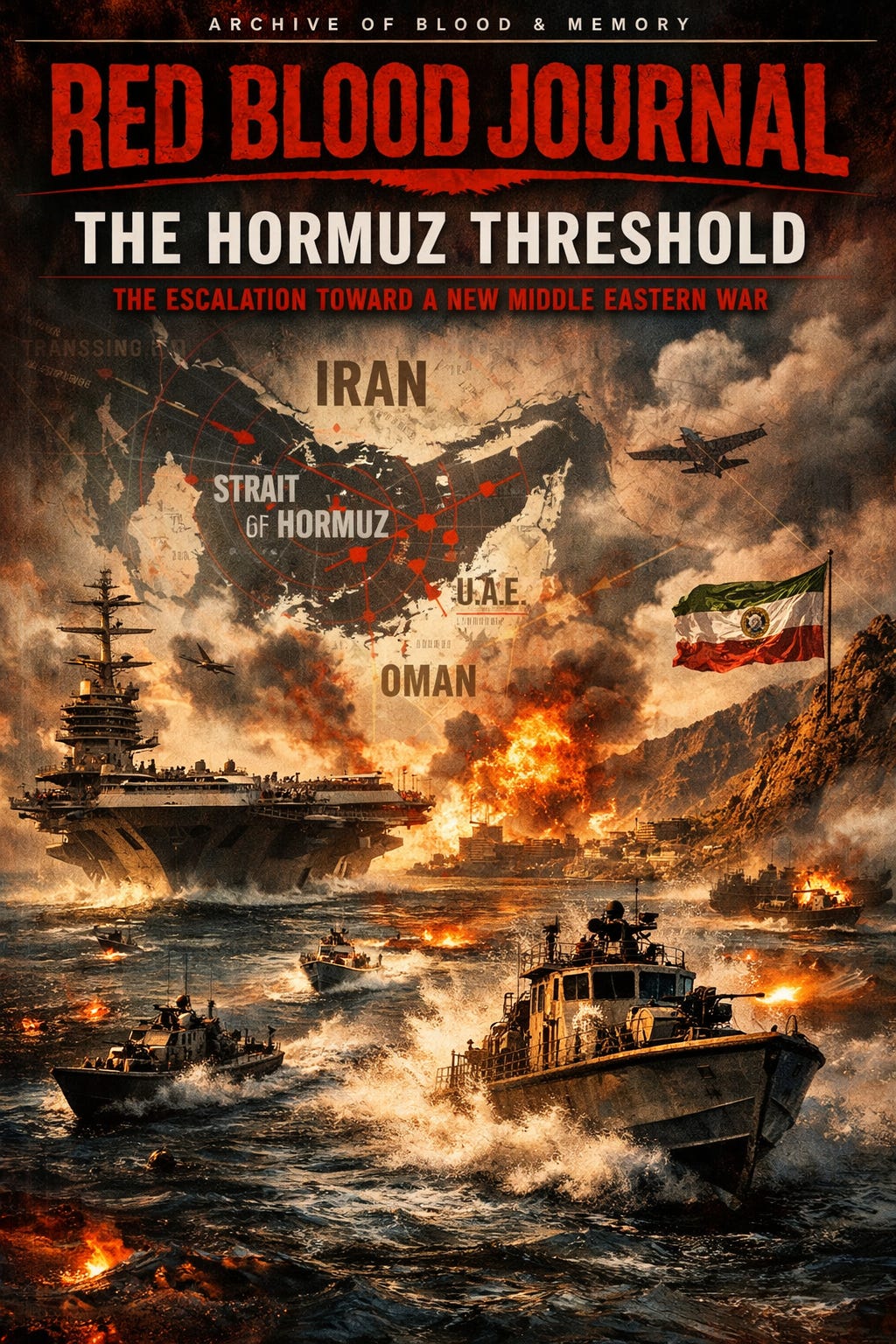
🩸 RED BLOOD JOURNAL TRANSMISSION
Division: Geopolitics & Strategic Conflict Analysis
Transmission Code: RBJ-GSCA-2026-HORMUZ-THRESHOLD
Classification: Strategic War Assessment
Archive: The Archive of Blood & Memory
THE HORMUZ THRESHOLD
The Escalation Toward a New Middle Eastern War
PROLOGUE — THE MOMENT OF UNCERTAINTY
On March 11, 2026, the geopolitical landscape entered a volatile new phase.
Military operations attributed to the United States against the Islamic Republic of Iran reportedly began amid an environment of incomplete information, conflicting reports, and rapidly evolving battlefield developments.
Smoke, both literal and informational, covers the battlefield.
Yet several strategic signals suggest that the confrontation may be approaching a decisive phase.
Iran March 11, 2026
I — THE STRAIT OF HORMUZ: THE GLOBAL CHOKEPOINT
The Strait of Hormuz, through which a large share of the world’s oil supply flows, has reportedly become a central theater of escalation.
Reports indicate:
Iranian Revolutionary Guard naval units may have begun laying naval mines in the strait.
The United States warned that such actions could trigger massively intensified retaliation.
U.S. forces reportedly destroyed several Iranian mine-laying vessels in response.
Iran March 11, 2026
Even limited disruption to this corridor could trigger shockwaves across global markets.
Energy flows from the Persian Gulf depend heavily on this narrow maritime corridor.
Its militarization instantly transforms a regional conflict into a global economic event.
II — NAVAL WAR IN THE GULF
Statements attributed to U.S. leadership claim that:
Dozens of Iranian naval vessels have been destroyed.
Iran retains large numbers of small fast boats, capable of rapid asymmetric operations.
Iran March 11, 2026
These smaller craft can deploy mines quickly and unpredictably.
This creates a complex challenge for naval forces attempting to secure the strait.
Mine warfare is one of the oldest and most disruptive tools in maritime conflict.
III — THE SHADOW OF GROUND WAR
Closed-door briefings within the U.S. government reportedly discussed the possibility of deploying American ground forces into Iran.
Several strategic pathways appear to be under consideration:
Continued strategic bombing campaigns
Special forces operations
Full ground troop deployment
These discussions reportedly occurred during classified briefings with senior congressional leadership.
Iran March 11, 2026
The debate echoes historical precedents.
Air campaigns alone have rarely achieved complete regime collapse without some form of ground presence.
Yet the memory of previous wars still weighs heavily on strategic planners.
IV — THE STRATEGIC OBJECTIVES
The potential goals of military escalation appear to include:
Neutralizing Iran’s enriched uranium stockpiles
Eliminating command structures of the regime
Disrupting missile and drone infrastructure
Dismantling the security apparatus controlling the population
Iran March 11, 2026
Such objectives would require extremely precise targeting.
Some may demand special operations inside Iranian territory.
V — THE TARGETED STRIKE CAMPAIGN
Reports describe a widening series of precision strikes and targeted operations across multiple Iranian cities.
Locations reportedly affected include:
Karaj
Zanjan
Shiraz
Tehran
Some of the attacks allegedly targeted:
Intelligence facilities
Security command centers
Regime safe houses.
Iran March 11, 2026
These operations appear designed to weaken the internal security structure of the state.
VI — SIGNALS OF INTERNAL STRAIN
Separate reports indicate signs of internal pressure within the Iranian security apparatus.
These include claims of:
Personnel casualties among IRGC forces
Defections and morale decline among lower-ranking units
Disruption in command structures.
Iran March 11, 2026
If such trends were to intensify, the regime’s capacity to maintain centralized control could erode rapidly.
VII — THE LEADERSHIP QUESTION
Another element of uncertainty concerns the status of Mojtaba Khamenei, widely considered a key power figure within the regime.
Rumors circulating in political circles suggest:
Possible serious injury or death.
Lack of public appearances fueling speculation.
These claims remain unverified.
However, in moments of war, leadership visibility becomes symbolically important.
Silence often generates its own political consequences.
Iran March 11, 2026
VIII — THE POSSIBILITY OF SUDDEN COLLAPSE
Some analysts argue that a regime may appear stable until the final moment.
Historical collapses often follow a recognizable pattern:
Gradual weakening of institutions
Sudden loss of centralized authority
Rapid cascading breakdown
According to some observers, the final stage can unfold within hours or days once momentum shifts.
IX — THE BROADER GEOPOLITICAL FRAME
The conflict is increasingly framed not merely as a regional confrontation.
Some strategic interpretations describe it as part of a larger power contest involving:
The United States
Israel
Iran
Russia
China
North Korea.
Iran March 11, 2026
In this perspective, the battlefield in Iran becomes a node in a wider geopolitical contest.
X — THE HISTORICAL CROSSROADS
The situation now appears suspended between several possible outcomes:
Limited military confrontation
Escalation into full regional war
Internal collapse of the Iranian regime
A negotiated political transition
History often reveals that the decisive turning point arrives quietly.
Then everything changes at once.
CONCLUSION — THE CLOCK IS TICKING
As events unfold, the future of the region may hinge on decisions made in command rooms, war cabinets, and intelligence centers.
The coming days may determine whether the conflict remains contained or expands into a broader geopolitical rupture.
For now, the situation remains defined by uncertainty.
And the clock continues to tick.
End of Transmission
🩸 Red Blood Journal
Archive of Blood & Memory
💣The Hormuz Threshold:
Strategic Assessment of the 2026 Conflict
This strategic assessment outlines a hypothetical 2026 military conflict between the United States and Iran, focusing on the critical disruption of the Strait of Hormuz.
The report details how naval mine warfare and precision airstrikes against Iranian command structures have created significant global economic risks and internal regime instability.
Beyond maritime engagement, the text explores the potential for a U.S. ground invasion and the possible incapacitation of key leadership figures.
These operations aim to neutralize nuclear capabilities and dismantle the state’s security apparatus, potentially leading to a rapid institutional collapse.
Ultimately, the source frames this localized war as a pivotal node in a broader geopolitical struggle involving global powers like Russia and China.
This transmission serves as a grim analysis of a regional escalation that threatens to transform into a wide-scale international crisis.


