


🩸 RedBloodJournal.com
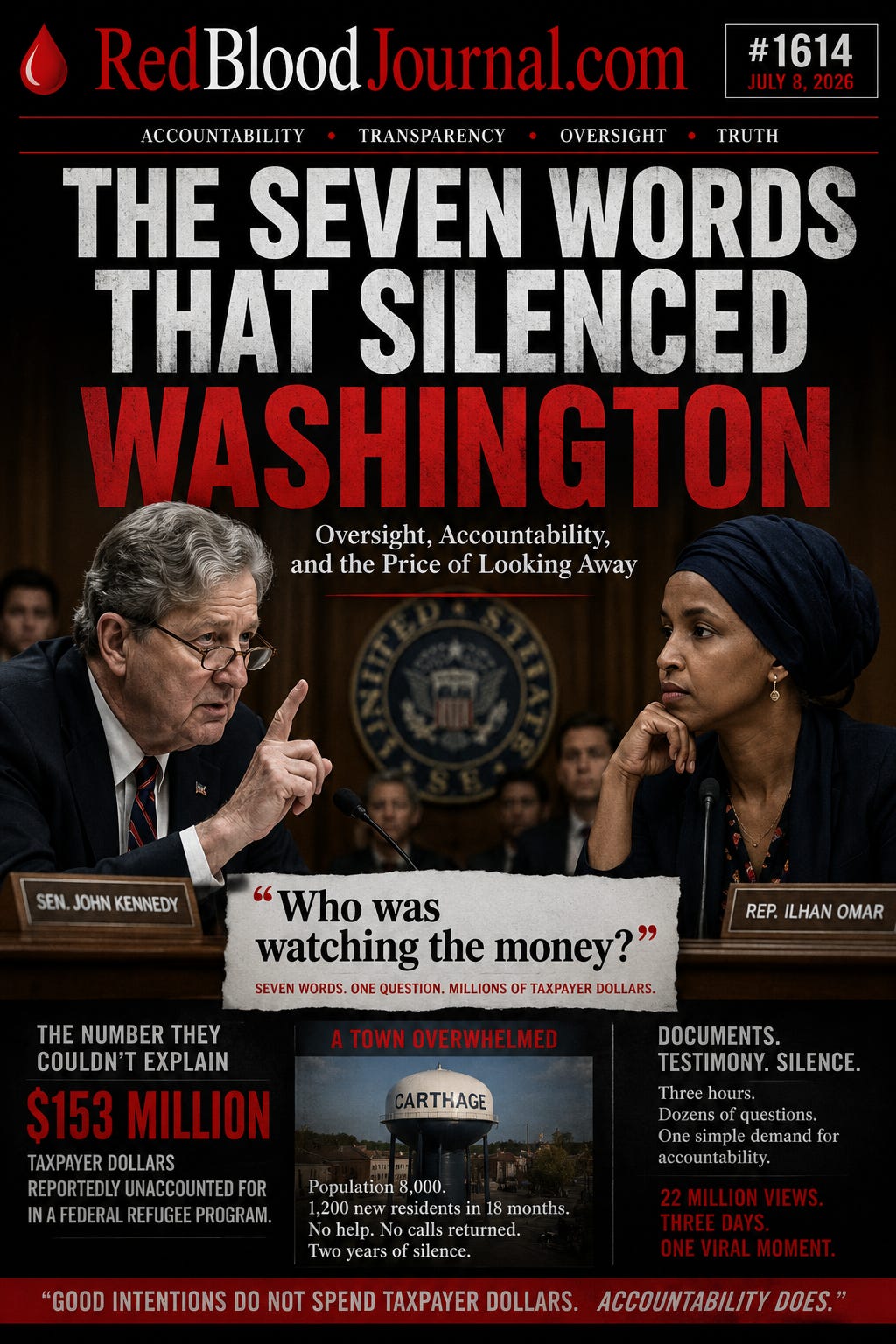
#1614 – The Seven Words That Silenced Washington
Oversight, Accountability, and the Price of Looking Away
An Investigative Commentary
By Red Blood
July 8, 2026
Introduction
Power rarely fears speeches.
Power fears questions.
Not angry questions.
Not partisan questions.
Simple questions.
The kind that refuse to disappear until someone answers them.
History has repeatedly shown that governments are rarely shaken by their loudest critics.
They are often shaken by their own records.
Budgets.
Audits.
Receipts.
Missing documentation.
One missing signature can expose more than a thousand political speeches.
One unanswered question can reveal years of administrative failure.
The congressional hearing examined in this report has been described as one of the most dramatic oversight hearings in recent years. Regardless of one’s political views, the discussion raises a broader issue that extends far beyond any single politician, administration, or government program.
It asks a question every free society should continually ask:
Who is watching the money?
Throughout the hearing, the discussion moved through immigration policy, federal spending, oversight procedures, community impacts, humanitarian goals, and taxpayer responsibility.
Yet as hours passed, every complex argument slowly narrowed toward a single point.
Accountability.
Good intentions may inspire legislation.
Compassion may inspire public programs.
But neither can replace transparent oversight.
Every tax dollar represents the labor of millions of ordinary citizens.
Whether those dollars are spent on defense, healthcare, education, infrastructure, foreign aid, refugee assistance, or any other public purpose, they deserve the same level of accountability.
Oversight should never depend on which political party is in power.
It should never depend on whether the public agrees with the program.
It should simply exist.
This report is not about deciding guilt.
It is not about choosing political sides.
Rather, it examines how questions, documents, testimony, and public accountability intersect when governments are asked to explain how public money was managed.
Sometimes the most important political question is also the simplest.
Seven words.
Seven words that every government, every administration, every agency, and every publicly funded organization should always be prepared to answer:
Who was watching the money?
“Trust is not built by promises. It is built by accountability.”
🩸🌊✨ Fantastic!
🔍 The Seven Words That Silenced Washington
Jul 7, 2026
This investigative commentary explores the critical necessity of government oversight and the protection of public funds. The author argues that true political power is challenged not by rhetoric, but by rigorous audits and the demand for transparent documentation. By focusing on a specific congressional hearing, the text highlights how administrative failures often stem from a lack of accountability regarding how taxpayer dollars are managed. It suggests that regardless of a program’s intent or the party in power, every agency must remain answerable to the citizens who fund it. Ultimately, the source emphasizes that public trust can only be maintained when officials are prepared to explain who is monitoring the distribution of wealth. The narrative concludes that the most essential question for any functioning democracy is identifying who was watching the money.


