


🩸 RED BLOOD JOURNAL — ANNEX A
Division: Behavioral Transmission & Cultural Replication Unit
Transmission Code: RBJ-ERATH-TRAINERS-ANNEX-A
Classification: Internal Conditioning Mechanism
Archive: The Archive of Blood & Memory
Why survivors enforce systems that broke them
ANNEX A — THE TRAINERS OF ERATH
How Survivors Become Enforcers
🪐 OPENING NOTE — THE SECOND TRANSFORMATION
On Planet Erath, there exists a moment more important than hiring…
More important than training…
More important than performance.
It is the moment when a worker who once struggled…
Begins to train others.
This is where the system achieves permanence.
I — THE SURVIVOR
Every trainer on Erath begins the same way:
Confused
Overwhelmed
Under pressure
Told: “Keep up or fall behind”
They endure:
Rushed instruction
Minimal guidance
Silent judgment
Physical and mental strain
And eventually…
They adapt.
Not by changing the system—
But by changing themselves.
🧠 RBJ INTERPRETATION:
The system does not select trainers based on wisdom.
It selects those who successfully endured without breaking.
II — THE FIRST SHIFT
After survival comes the first internal shift:
“If I made it through… others should too.”
This belief forms quietly.
It is not cruelty.
It is justification.
Because to admit the system was flawed would mean:
Their suffering was unnecessary
Their struggle was avoidable
The system failed them
So the mind protects itself by reframing:
“The system is hard… because it needs to be.”
III — THE TRANSFER OF PRESSURE
Now placed in the role of trainer, the survivor faces a contradiction:
They are still a worker
But now expected to shape new workers
They have:
No real authority
No extra time
No structured teaching support
Yet they are responsible for:
Speed
Competence
Adaptation of the new initiate
So what do they do?
They pass on what they were given.
Not because it is best—
But because it is what they know.
IV — THE LANGUAGE OF HARDENING
Listen closely to the trainers of Erath:
“This is how it works.”
“You’ll get used to it.”
“We all went through it.”
“Just keep moving.”
These phrases are not instructions.
They are compressed history.
Each one carries:
Their past frustration
Their acceptance
Their surrender
🧠 RBJ INTERPRETATION:
The trainer is not teaching the job.
They are transmitting adaptation to the system.
V — THE LOSS OF EMPATHY (WITHOUT INTENTION)
At first, the trainer remembers their own struggle.
But over time:
Speed becomes normal
Pressure becomes baseline
Struggle becomes invisible
And something subtle happens:
What once felt difficult now looks like weakness in others.
Not because the trainer is cruel—
But because their reference point has shifted.
VI — THE OLDER INITIATE UNDER THE TRAINER
When the trainer encounters an older new worker:
They unconsciously measure:
“Why are they slower?”
“Why are they not picking this up?”
But they forget:
Different learning rhythms
Different physical adaptation curves
Different starting points
So without saying it directly…
They reduce patience.
They increase pressure.
And the system speaks through them.
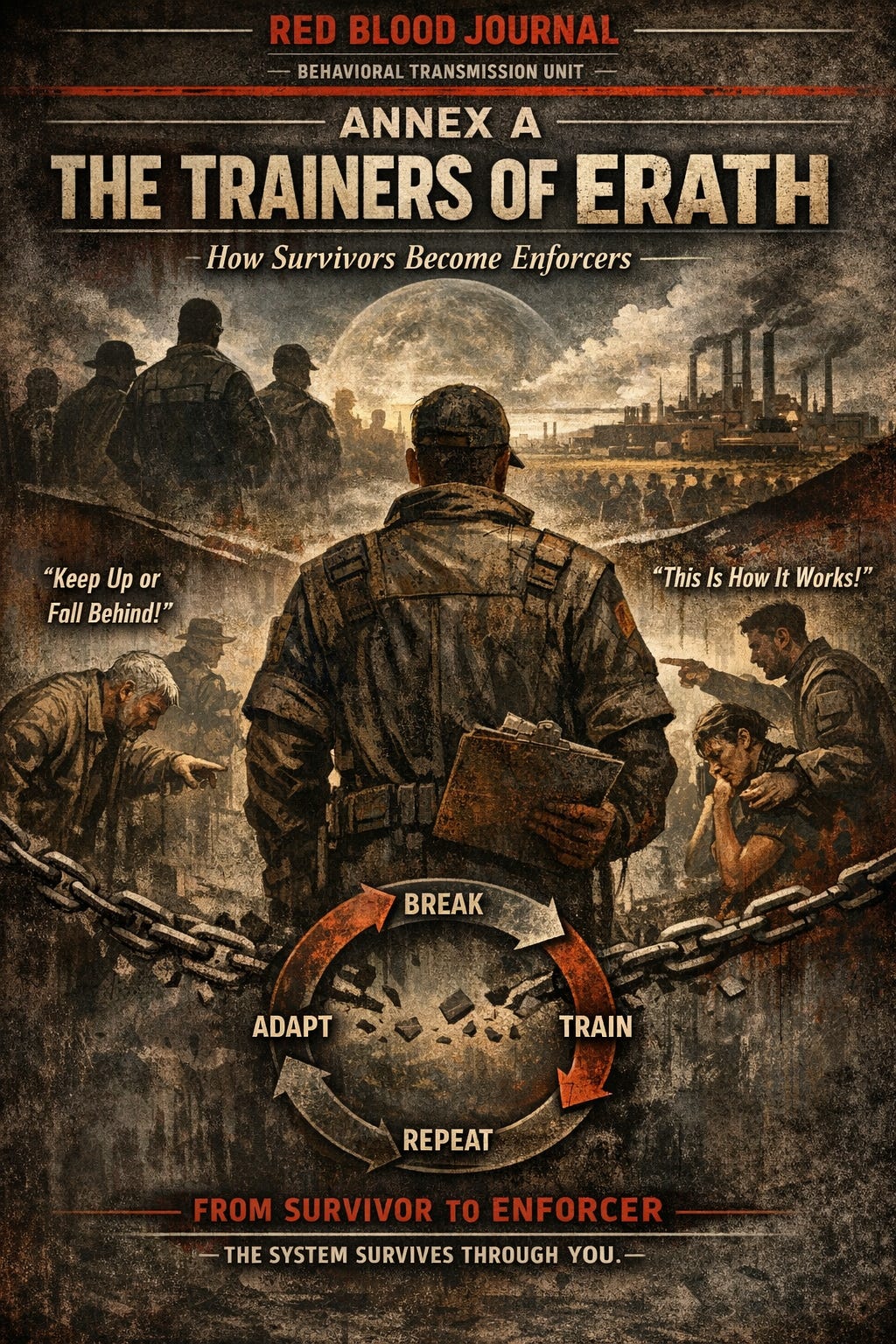
VII — THE SYSTEM’S PERFECT LOOP
The brilliance of Erath’s structure is here:
Break the worker
Let them adapt
Promote them to trainer
Have them repeat the process
No enforcement needed.
No orders required.
The system becomes self-replicating.
🧠 RBJ INTERPRETATION:
The strongest systems are not enforced from above—
they are reproduced from within.
VIII — WHY TRAINERS DON’T CHANGE THE SYSTEM
Even if a trainer sees the flaws, they face constraints:
No authority to redesign training
No time to slow down
Pressure from management metrics
Expectation from peers to maintain pace
So even the aware trainer ends up saying:
“Just get through it.”
Not because they believe it fully—
But because the system leaves no alternative.
IX — THE QUIET TRAGEDY
The trainer is not the villain.
The trainer is:
A former victim
A current participant
A necessary link in the chain
They carry both:
The memory of struggle
The responsibility to continue the system
And in that tension…
The system survives.
🧭 FINAL ANNEX NOTE
On Planet Erath, control does not rely on force.
It relies on inheritance.
Each generation of workers receives not just a job—
But a mindset:
Accept
Adapt
Repeat
And the moment they begin to teach…
They unknowingly become part of the structure they once questioned.
🩸 CLOSING LINE — ARCHIVE ENTRY
“The system’s greatest success is not in training workers to perform—
but in training survivors to preserve what once burdened them.”
⛓️The Erath Protocol:
The Mechanics of Systemic Inheritance
The provided text examines a psychological cycle on Planet Erath where workers transition from oppressed survivors into institutional enforcers.
This systemic inheritance occurs because those who endure harsh, unstructured conditions eventually justify their own suffering by imposing the same rigors on new initiates.
Rather than reforming the flawed environment, these trainers subconsciously internalize the pressure, viewing their past struggles as a necessary rite of passage.
This transformation ensures the perpetuation of the system without the need for external force or oversight from management.
Consequently, the trainers become unwitting architects of a cycle that prioritizes endurance and adaptation over empathy or improvement.
Ultimately, the text illustrates how a regime achieves permanence by turning the victims of its burden into its most loyal preservers.


