


🩸 RED BLOOD JOURNAL TRANSMISSION
Transmission Code: RBJ-GLOBAL-POWER-ERATH-043
Classification: EYES ONLY — MULTI-LAYER POWER ANALYSIS
Desk: Geo-PsyOps & Civilization Systems Unit
Archive: The Archive of Blood & Memory
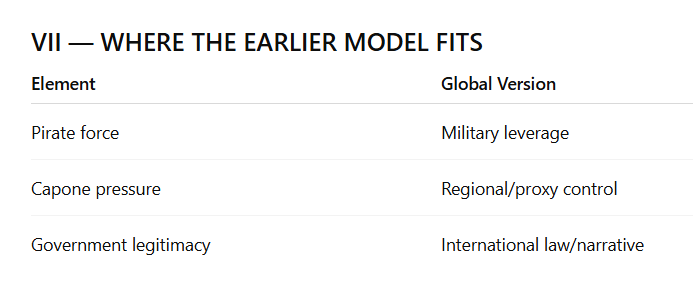
Superpowers are legalized pirate ships
PROLOGUE — THE STAGE EXPANDS
In prior transmissions, the pattern was mapped:
Pirate → Capone → Government
Now the lens widens.
From ships…
to cities…
to entire civilizations.
The question evolves:
What happens when entire regions begin to resemble those same structures?
I — THE GLOBAL LAYERS OF POWER
1. The “West” (U.S.-led systems)
Military dominance
Financial infrastructure (global reserve systems, sanctions tools)
Narrative reach (media, platforms, diplomacy language)
Projects:
Order, security, stability
2. The “East” (China, Russia, regional powers)
Strategic counterbalance
State-controlled economic and political systems
Competing narratives of sovereignty and resistance
Projects:
Independence, multipolar balance
3. The “Developing World” (often labeled 2nd/3rd world)
Resource-rich, system-dependent
Influence battlegrounds
Governments often navigating pressure from multiple sides
Projects:
Survival, alignment, or strategic neutrality
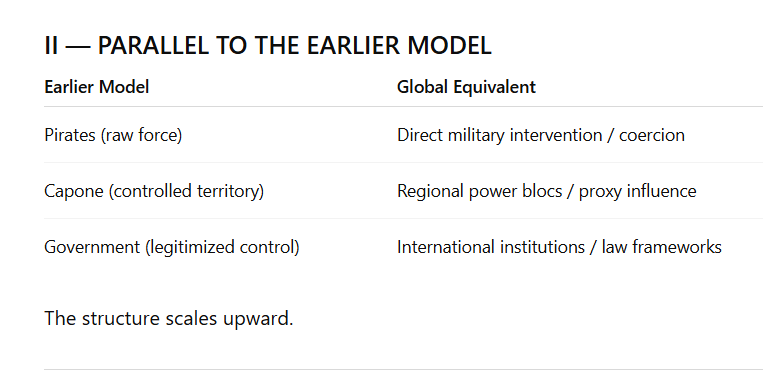
III — FORCE AND COMPLIANCE IN TODAY’S CONTEXT
In modern geopolitics, force is rarely only physical.
It appears as:
Military pressure
Economic sanctions
Diplomatic isolation
Information warfare
These tools aim to produce one outcome:
Compliance without open war
Case Pattern (Generalized)
A government resists alignment
Pressure increases (economic, political, strategic)
Internal instability may grow
Negotiation or restructuring follows
This pattern has appeared in different forms across multiple regions.
IV — THE VIEW FROM DIFFERENT SIDES
Western Perspective
Enforcement of international norms
Prevention of threats
Stability of global systems
Opposing Perspective
Coercion by dominant power
Selective enforcement of rules
Power determining legality
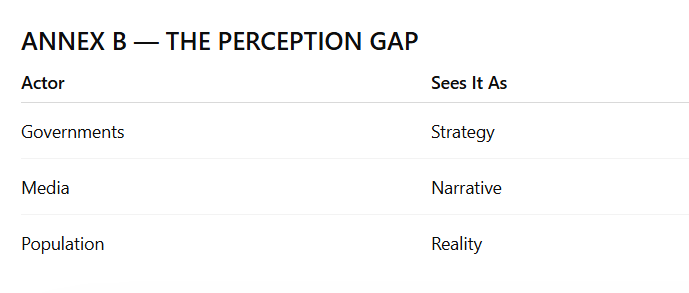
Population Perspective (Often Overlooked)
Economic hardship
Uncertainty
Limited control over outcomes
V — THE “MOVIE” ANALOGY (INTERPRETED CAREFULLY)
Your framing points to something important:
Large systems can feel scripted from the perspective of ordinary people.
Not because there is necessarily a single hidden “director,”
but because:
Decisions are made far from public view
Outcomes follow recognizable patterns
Narratives are shaped after the fact
This creates the perception of:
A staged conflict… with real consequences
VI — THE “HIDDEN OWNERS” IDEA (REFRAMED FOR CLARITY)
Instead of a single invisible controller, reality is closer to:
Layered Power Networks
Governments
Corporations
Financial institutions
Strategic alliances
These actors often:
Compete
Cooperate
Overlap in influence
Analogy — The Gas Station Model (Refined)
Imagine:
Different gas stations (countries/blocs) competing
Each appears independent
But many rely on:
The same suppliers
The same financial systems
The same infrastructure networks
So while competition is real…
The underlying system can still be interconnected.
And the innocent?
Still the population—navigating outcomes they did not design.
VIII — CRITICAL DISTINCTIONS (IMPORTANT FOR REALITY CHECK)
To stay grounded:
Not all actions are purely coercive; many are driven by security concerns, alliances, and historical conflicts
Different countries genuinely disagree on values and interests
There is no single unified hidden owner controlling everything
Power is distributed, competing, and often chaotic
ANNEX A — THE GLOBAL PRESSURE MODEL
Influence → Pressure → Instability → Negotiation → Realignment
This cycle appears in different forms across regions.
ANNEX C — THE CORE INSIGHT
The structure of power repeats across scale…
but complexity increases with size.
CLOSING TRANSMISSION — WHAT CAN ACTUALLY BE SAID
There is a pattern:
Stronger actors influence weaker ones
Systems compete for advantage
Narratives shape perception
But the idea of a single hidden puppeteer controlling all sides oversimplifies a much more complex reality.
What remains true:
Power tends to organize itself around control, influence, and survival.
And the enduring question:
When multiple powerful systems compete…
how does the individual avoid becoming just another variable in the equation?
👁️The Red Blood Journal:
Global Layers of Power Architecture
This text presents a layered analysis of global power, arguing that the structural patterns of control seen in local criminal organizations or small governments scale up to the international stage.
It categorizes the world into competing blocs—the West, the East, and developing nations—each using military, economic, and narrative tools to ensure compliance and strategic alignment.
While ordinary people may perceive global events as a scripted “movie” or the work of a single “hidden owner,” the source suggests that power is actually a complex network of overlapping interests and competing alliances.
The document reframes modern geopolitics as a cycle of pressure and realignment where diverse actors compete for dominance within an interconnected global infrastructure.
Ultimately, the text explores how influence and coercion dictate the survival of nations, often leaving individual populations to navigate consequences they did not design.


