


🩸 Red Blood Journal
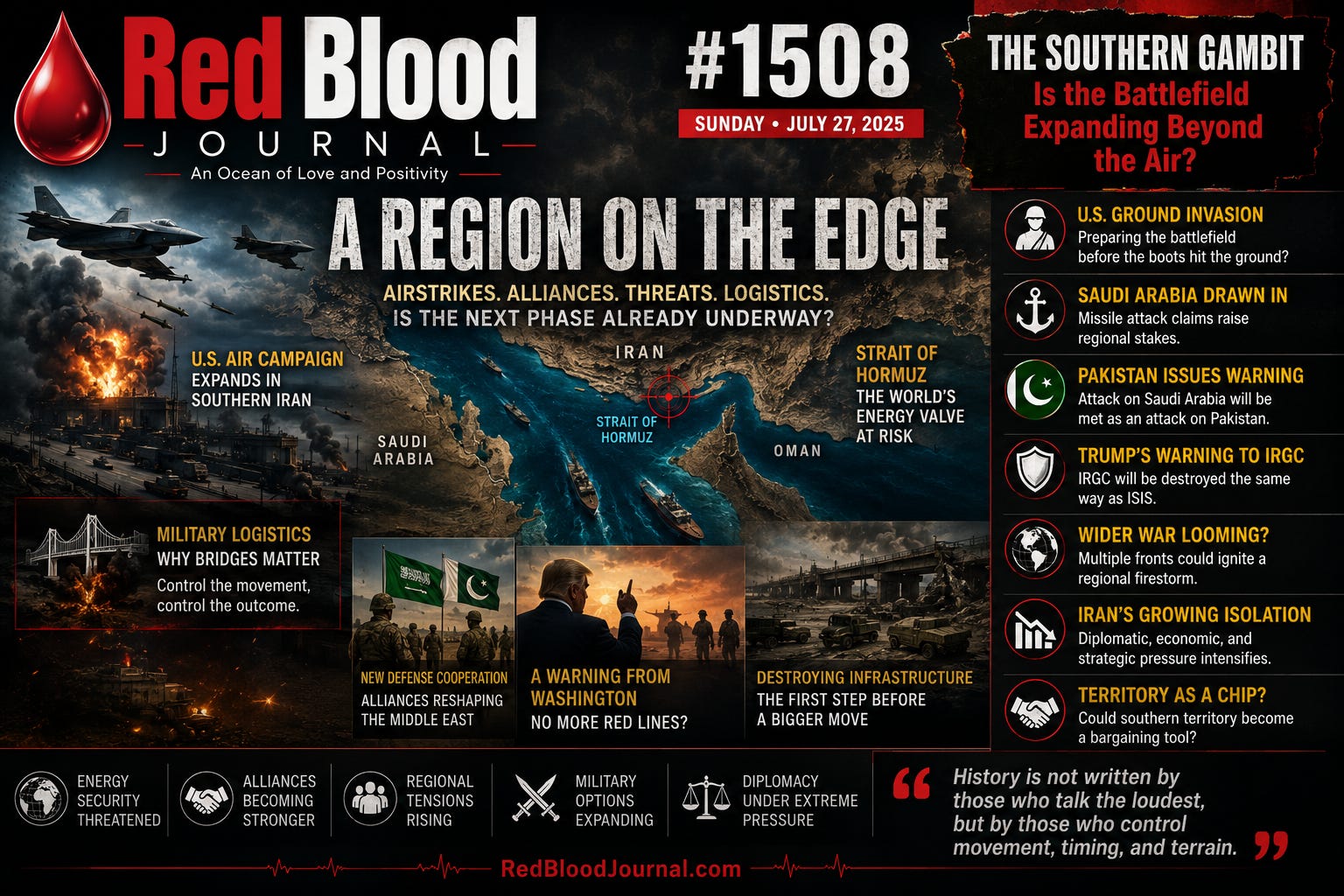
#1508 – The Southern Gambit
Is the Battlefield Expanding Beyond the Air?
Executive Summary
Military campaigns often reveal their intentions gradually.
The first signals may not come from headlines announcing a ground invasion but from the systematic targeting of transportation networks, ports, bridges, logistics hubs, and supply corridors. Throughout modern military history, controlling mobility has frequently proven more decisive than controlling cities.
Recent developments across southern Iran have generated widespread discussion among military analysts and commentators regarding whether the conflict is entering a new phase.
While many questions remain unanswered, the strategic implications deserve careful examination.
1. U.S. Ground Invasion of Iran?
The question dominating much of today’s geopolitical discussion is no longer whether military pressure exists.
The question is whether that pressure is designed to prepare conditions for a future ground operation.
Historically, modern militaries attempt to isolate a battlefield before committing large numbers of troops.
Transportation corridors become primary targets.
Supply routes are interrupted.
Communication networks are degraded.
Only then does the possibility of a ground campaign become more practical.
Whether this is the current objective cannot yet be confirmed, but the pattern has become the subject of increasing analysis.
2. The Strait of Hormuz: The World’s Energy Valve
Few locations possess greater strategic importance than the Strait of Hormuz.
A substantial portion of the world’s seaborne oil and natural gas exports pass through this narrow waterway.
Any prolonged disruption would affect not only the Middle East but energy prices, shipping costs, financial markets, and economic stability across multiple continents.
This transforms a regional military conflict into an issue of global concern.
3. Expanding Air Operations in Southern Iran
Reports describing continued strikes against transportation infrastructure have drawn attention because logistics often determine military success.
Bridges.
Roads.
Ports.
Rail connections.
Fuel depots.
Each serves as an artery through which reinforcements, equipment, and supplies move.
Disrupting these networks can reduce an opponent’s operational flexibility without requiring immediate occupation of territory.
4. Saudi Arabia Becomes Increasingly Important
As regional tensions rise, neighboring countries inevitably become part of the strategic equation.
Saudi Arabia occupies a central position due to its geography, energy infrastructure, and existing defense relationships.
Any military activity affecting Saudi territory immediately broadens international attention.
Its role is no longer simply regional.
It has become global.
5. Pakistan’s Strategic Position
Pakistan’s warnings regarding Saudi security have added another layer of complexity.
Defense understandings between regional partners may influence how future events unfold.
Whenever alliances activate, military planning expands beyond two countries.
A regional conflict can gradually become multinational without any formal declaration of war.
6. Trump’s Warning to the IRGC
Political statements often serve multiple audiences simultaneously.
Domestic.
Military.
Diplomatic.
International.
Strong public warnings may function as deterrence, negotiation, signaling, or preparation for future policy decisions.
Regardless of interpretation, official rhetoric can significantly influence strategic expectations.
7. Is a Wider Middle East War Beginning?
History demonstrates that major regional wars rarely expand all at once.
Instead, they often widen through a series of interconnected events involving allies, logistics, economics, and security commitments.
Each additional participant increases uncertainty.
Each new front multiplies diplomatic challenges.
The possibility of broader escalation therefore remains one of the most closely watched aspects of the current situation.
8. Iran’s Growing Regional Isolation
International conflicts are influenced not only by military strength but also by diplomacy.
Alliances.
Trade relationships.
Political recognition.
Regional partnerships.
Strategic isolation can reduce available options regardless of military capability.
Throughout history, nations facing increasing diplomatic isolation have frequently encountered greater strategic pressure.
9. Why Bridges Matter
To the average observer, a bridge is simply infrastructure.
To military planners, it is time.
Every destroyed bridge delays movement.
Every damaged highway slows logistics.
Every disrupted supply route limits operational flexibility.
Modern warfare often seeks to defeat mobility before confronting armies directly.
Understanding logistics frequently explains military decisions that otherwise appear puzzling.
10. Could Territory Become a Negotiating Chip?
History contains numerous examples where territory became part of post-conflict negotiations.
Temporary occupation.
Security zones.
Demilitarized regions.
International supervision.
Buffer areas.
Whether any such outcome becomes relevant depends entirely upon future political and military developments.
Nevertheless, strategic analysts continue debating whether control of territory could eventually become leverage during negotiations.
Looking Beyond the Headlines
Military history repeatedly teaches that wars are shaped as much by logistics, alliances, economics, and diplomacy as by combat itself.
The destruction of infrastructure.
The movement of naval forces.
Regional defense agreements.
Political messaging.
Economic pressure.
These often provide earlier clues than dramatic battlefield announcements.
Whether current developments represent the beginning of a broader transformation or merely another phase of an existing conflict remains uncertain.
Only time will determine which interpretation proves correct.
Until then, careful observation remains more valuable than certainty.
Final Reflection
History often records the day armies cross borders.
Military historians frequently discover that the decisive moves began weeks earlier—with bridges, ports, logistics, alliances, and diplomacy.
Sometimes the first battlefield is not the front line.
It is the network that makes every front line possible.
🩸 Red Blood Journal
An Ocean of Love and Positivity.
🩸🌊✨ Fantastic!
📍 The Southern Gambit:
Logistics and the Architecture of Escalation
Jul 18, 2026
This report from the Red Blood Journal explores the potential for a large-scale military escalation in southern Iran by examining shifts in logistics and infrastructure targeting. The author suggests that the systematic destruction of bridges, ports, and supply corridors may serve as a strategic precursor to a U.S.-led ground invasion. Beyond direct combat, the text highlights the global economic risks associated with the Strait of Hormuz and the critical roles played by regional powers like Saudi Arabia and Pakistan. Diplomatic rhetoric and international isolation are presented as key factors that weaken Iran’s defensive position while increasing the likelihood of a multinational conflict. Ultimately, the source argues that controlling mobility and isolating the battlefield are more decisive indicators of a campaign’s intent than official declarations. This analysis underscores how territorial control could eventually serve as vital leverage in future geopolitical negotiations.


