


🩸 RED BLOOD JOURNAL
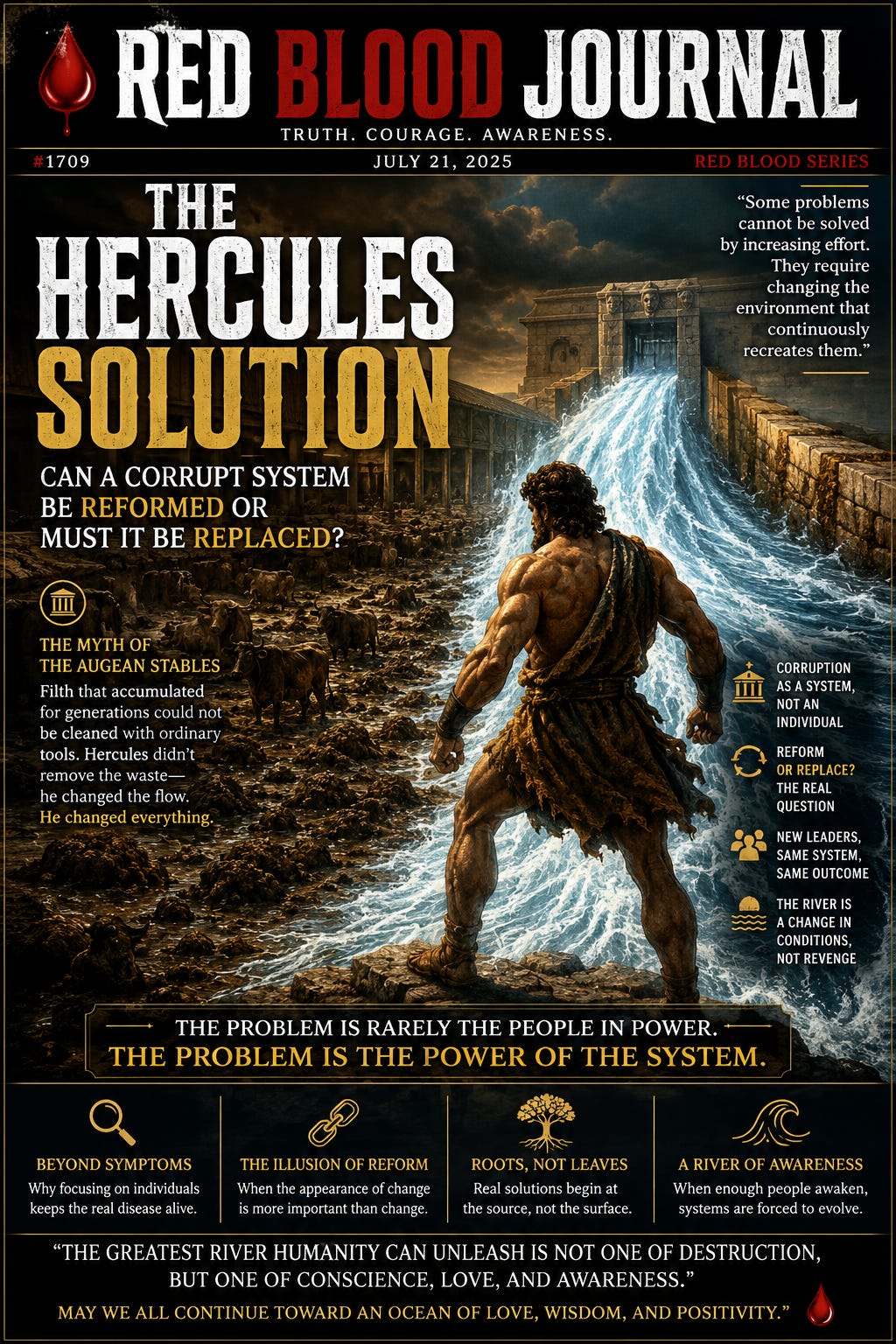
#1709 – The Hercules Solution
Can a Corrupt System Be Reformed or Must It Be Replaced?
PROLOGUE
Throughout history, societies have struggled with a recurring question:
Can a deeply corrupt system be repaired from within, or does there come a point where the system itself becomes the problem?
The answer has divided philosophers, revolutionaries, reformers, and governments for thousands of years.
Long before modern politics, the ancient Greeks captured this dilemma in one of their most enduring myths—the story of the Augean Stables.
Although presented as mythology, its symbolism remains remarkably relevant to every era.
The Stable That Could Not Be Cleaned
According to Greek mythology, King Augeas owned thousands of cattle.
For decades, their stables had never been cleaned.
The accumulation of waste became so immense that ordinary labor was no longer capable of solving the problem.
No broom.
No shovel.
No committee.
No new manager.
Nothing could restore order through gradual maintenance because the problem had become structural.
The corruption was no longer on the floor.
The corruption had become the environment itself.
Hercules’ Unusual Solution
As one of his famous Twelve Labors, Hercules was assigned what appeared to be an impossible task:
Clean the Augean Stables in a single day.
Instead of removing the waste one cart at a time, Hercules asked a different question.
He did not ask:
“How do I clean this?”
He asked:
“Why am I trying to clean it this way?”
His solution was radical.
He diverted two powerful rivers through the entire stable.
The accumulated filth was washed away in a single continuous flow.
He did not repair the system.
He replaced the conditions that allowed the filth to exist.
When Corruption Becomes Structural
Every society contains corruption.
No country is completely free from it.
The important distinction is not whether corruption exists.
The important question is whether corruption is an exception or the operating system itself.
When corruption becomes embedded within institutions, promotions, laws, incentives, and political survival, replacing individual leaders often changes very little.
Different faces occupy the same offices.
Different speeches are delivered.
Different slogans are repeated.
Yet the machinery continues operating exactly as before.
The system reproduces itself.
Symptoms Versus Causes
Public debate frequently focuses on personalities.
One minister.
One president.
One judge.
One military commander.
One political party.
One election.
Yet these individuals often function inside structures they did not create.
Removing one individual from a self-sustaining system may satisfy public anger without addressing the deeper mechanisms that continually generate similar outcomes.
Replacing actors does not necessarily change the script.
The Illusion of Reform
History contains examples of meaningful reform.
But history also contains systems that repeatedly promised reform while preserving the foundations that produced the original problems.
In such situations, reform becomes a method of extending legitimacy rather than correcting dysfunction.
The appearance of change can sometimes become more valuable to those in power than change itself.
Why Systems Resist Change
Large institutions naturally develop mechanisms for self-preservation.
They create:
Bureaucracies.
Financial interests.
Political alliances.
Security structures.
Information control.
Ideological narratives.
Each component reinforces the others.
Eventually the institution no longer serves its original purpose.
Its primary objective becomes its own survival.
The River Is Not Violence
The symbolism of Hercules is frequently misunderstood.
The river did not represent revenge.
It represented a complete change in conditions.
The myth reminds us that some problems cannot be solved by increasing effort.
They require changing the environment that continuously recreates the problem.
The solution is systemic rather than personal.
The Modern Question
Every nation eventually faces the same philosophical test:
Can the existing framework correct itself?
Or has it become dependent upon the very conditions that created the crisis?
There is no universal answer.
Each society must confront that question according to its own history, institutions, culture, and people.
But the question itself remains timeless.
Beyond Politics
The lesson extends far beyond governments.
Companies.
Religious organizations.
Corporations.
Financial institutions.
Universities.
Families.
Even individuals.
Sometimes people spend years trying to remove the visible symptoms while protecting the underlying habits that continually recreate them.
Without changing the source, the cleanup never truly ends.
The Greatest River
Perhaps the most powerful river is neither political nor military.
It is awareness.
When enough people begin asking deeper questions instead of accepting familiar answers, institutions naturally experience pressure to evolve.
Awareness cannot guarantee change.
But meaningful change rarely occurs without it.
CONCLUSION
The myth of Hercules has survived for more than two thousand years not because of ancient cattle or forgotten kings.
It survives because every generation eventually encounters its own version of the Augean Stables.
The enduring question is never simply who is responsible.
The deeper question is whether the structure itself has become incapable of producing anything different.
Sometimes replacing a few workers is enough.
Sometimes replacing the manager is enough.
And sometimes the river must flow.
History belongs to those who can recognize the difference.
Ocean of Love and Positivity
The greatest river humanity can unleash is not one of destruction, but one of conscience. A society guided by truth, compassion, humility, and the courage to question itself does not merely sweep away corruption—it renews the ground upon which future generations will build. Like water finding its course, genuine awareness flows around obstacles, wears down the hardest stone, and nourishes new life. May every system, every institution, and every individual strive not only to appear clean, but to cultivate the inner integrity that makes lasting renewal possible. In that spirit, may we all continue toward an ocean of love, wisdom, and positivity. 🌊🩸✨
🌊 The Hercules Solution: Washing Away Structural Corruption
Jul 12, 2026
The provided text uses the mythological labor of Hercules and the Augean Stables as a profound metaphor for addressing deep-seated societal corruption. It argues that when dishonesty and dysfunction become structural and self-sustaining, traditional methods of reform, such as replacing specific leaders or implementing minor policy changes, are often ineffective illusions. Instead, the author suggests that true renewal requires a systemic transformation of the entire environment rather than merely treating visible symptoms. This radical approach involves changing the underlying conditions that allow corruption to flourish, much like diverting a river to wash away decades of waste. Ultimately, the source emphasizes that public awareness and collective conscience are the most powerful tools for initiating this necessary and lasting institutional rebirth.


