


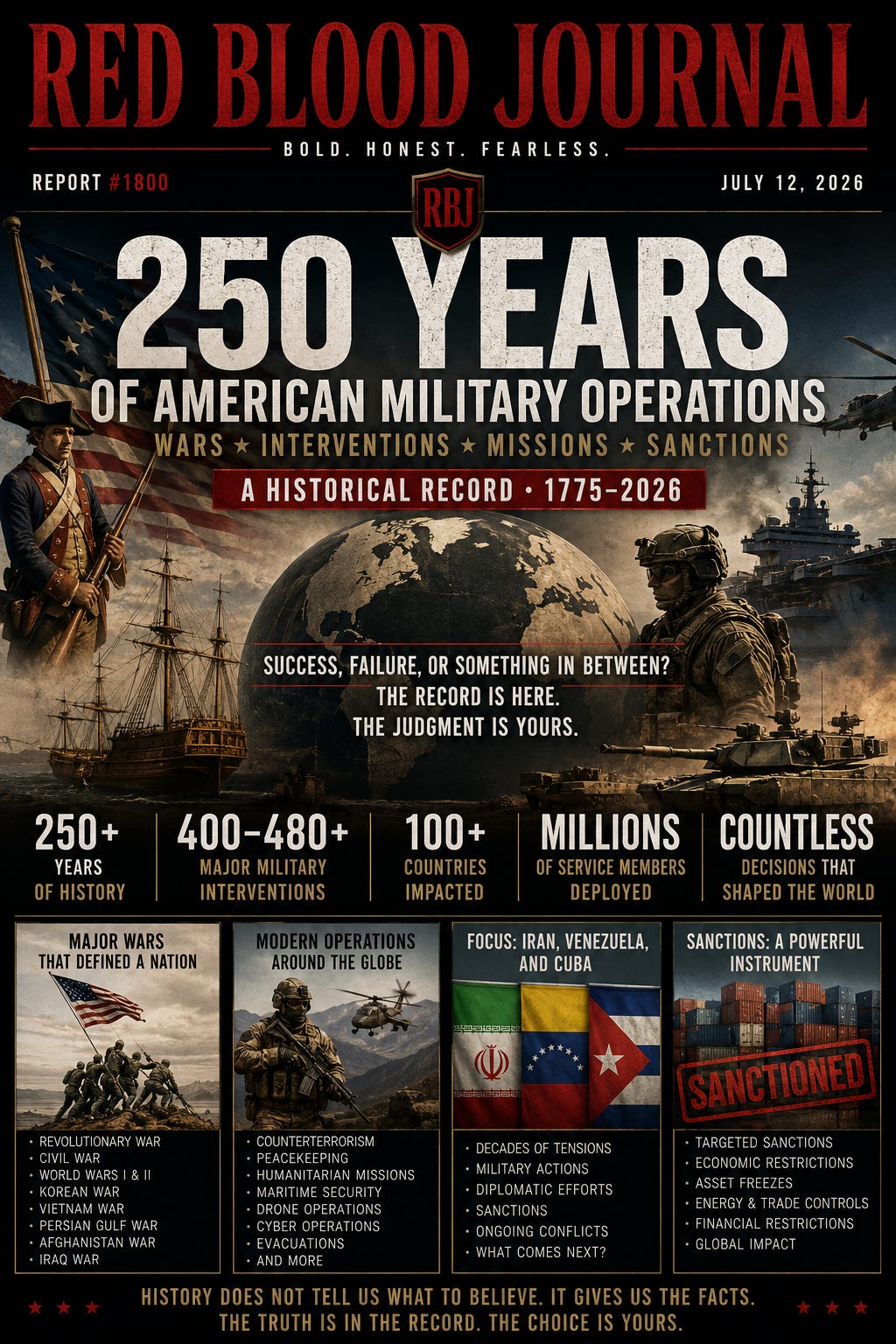
🩸 RED BLOOD JOURNAL
REPORT #1800
250 Years of American Military Operations and Economic Sanctions
A Historical Record (1775–2026)
RedBloodJournal.com
PROLOGUE
Since declaring independence in 1776, the United States has evolved from a newly established republic into one of the world’s largest military and economic powers.
Over approximately 250 years, it has used multiple instruments of national power, including:
Military force
Economic sanctions
Diplomacy
Intelligence operations
International alliances
Humanitarian assistance
Peacekeeping
Maritime security
These tools have been employed under different administrations, political parties, and international circumstances.
This report does not argue whether these policies were correct or incorrect.
Its purpose is to present a factual overview of the scale and evolution of U.S. military operations and sanctions, leaving readers to form their own conclusions.
Military Operations by the Numbers
Publicly available historical records indicate that the United States has conducted military activities on every inhabited continent.
According to the Congressional Research Service (CRS), there were 481 notable overseas military deployments between 1798 and April 2023, excluding routine troop stationing, many classified activities, and domestic conflicts. Other historical databases count several hundred military interventions depending on the criteria used.
Major conflicts include:
American Revolutionary War
War of 1812
Mexican-American War
American Civil War
Spanish-American War
Philippine-American War
World War I
World War II
Korean War
Vietnam War
Persian Gulf War
Afghanistan War
Iraq War
In addition, the United States has conducted hundreds of named operations, including peacekeeping missions, humanitarian responses, evacuations, counterterrorism campaigns, maritime security patrols, and limited military strikes.
Geographic Reach
During the past two and a half centuries, U.S. military forces have operated in or around:
North America
South America
Europe
Africa
The Middle East
Central Asia
East Asia
Southeast Asia
The Pacific
The Atlantic
The Arctic
The Indian Ocean
The duration of these operations has ranged from hours to decades.
Recent Military Operations
Publicly reported operations during recent years include:
Operation Inherent Resolve (Iraq and Syria), continuing counter-ISIS operations.
Operation Prosperity Guardian, a multinational maritime security effort in the Red Sea.
U.S. strikes against Houthi military targets in Yemen.
Military operations involving Iran during the 2026 U.S.–Iran conflict.
Operations and deployments associated with the Afghanistan withdrawal in 2021.
Continuing counterterrorism missions in parts of Africa and the Middle East. Recent U.S. actions have also included new military operations related to Iran and other regional security developments.
Cuba
Since the Cuban Revolution in 1959, relations between the United States and Cuba have included:
The Bay of Pigs invasion (1961)
The Cuban Missile Crisis (1962)
Decades of economic embargoes
Periods of diplomatic normalization and renewed restrictions
Continuing sanctions on selected Cuban state entities and officials, with additional measures announced in 2026.
Venezuela
U.S. involvement regarding Venezuela has included:
Diplomatic recognition policies
Economic sanctions
Restrictions on individuals and state-owned entities
Periodic adjustments to oil-sector licenses
Various public policy changes across multiple administrations. OFAC continues to maintain a Venezuela sanctions program, while also issuing and updating general licenses for certain transactions.
Iran
Relations between the United States and Iran have included:
The 1979 hostage crisis
Decades of economic sanctions
Maritime security operations
Nuclear negotiations
Military actions in Iraq and the Persian Gulf
The 2020 strike that killed Qasem Soleimani
Renewed military confrontation and additional sanctions during 2026, including sanctions on individuals and financial networks associated with Iran’s leadership.
Economic Sanctions
Military force represents only one component of U.S. foreign policy.
Economic sanctions have become another major instrument.
Sanctions may include:
Asset freezes
Restrictions on banking
Export controls
Investment restrictions
Trade limitations
Travel restrictions
Shipping restrictions
Technology export controls
The Office of Foreign Assets Control (OFAC) administers numerous sanctions programs.
As of 2026, comprehensive U.S. sanctions remain in place against countries such as Iran, Cuba, and North Korea, while targeted sanctions programs apply to countries including Venezuela, Russia, Belarus, Myanmar, Sudan, Nicaragua, and others. The specific scope varies by country and program and is updated periodically.
Measuring Historical Outcomes
Military operations and sanctions are commonly evaluated using different criteria, including:
Achievement of stated objectives
Military outcomes
Diplomatic outcomes
Economic impact
Humanitarian impact
Long-term regional stability
National security
International law
Financial cost
Effects on civilian populations
Different observers may assign different weight to each of these factors.
Final Observation
Over approximately 250 years, the United States has employed both military power and economic sanctions as central elements of its foreign policy.
The historical record includes wars, peacekeeping missions, humanitarian operations, covert and overt interventions, maritime security efforts, and one of the world’s most extensive sanctions systems.
The historical facts can be documented through official records, academic research, and government publications.
How those facts should be interpreted—whether as evidence of successful statecraft, necessary security policy, excessive intervention, effective deterrence, or a combination of these—is a question that continues to be debated.
This report presents the historical record.
The conclusions belong to the reader.
🇺🇸 The Architect of Influence: 250 Years of Global Intervention
Jul 12, 2026
This historical overview examines the evolution of American global influence through the dual lenses of military intervention and economic pressure over the past 250 years. The text documents nearly five hundred overseas deployments spanning every inhabited continent, ranging from major declared wars to specialized humanitarian and counterterrorism missions. Alongside armed force, the report highlights the growing role of financial sanctions, asset freezes, and trade embargoes used against nations like Iran, Cuba, and Venezuela. By referencing both long-standing conflicts and specific modern operations through 2026, the source provides a factual framework for analyzing how the United States projects power. Ultimately, it invites the reader to evaluate the strategic outcomes and humanitarian impacts of these policies without imposing a singular political judgment.


