


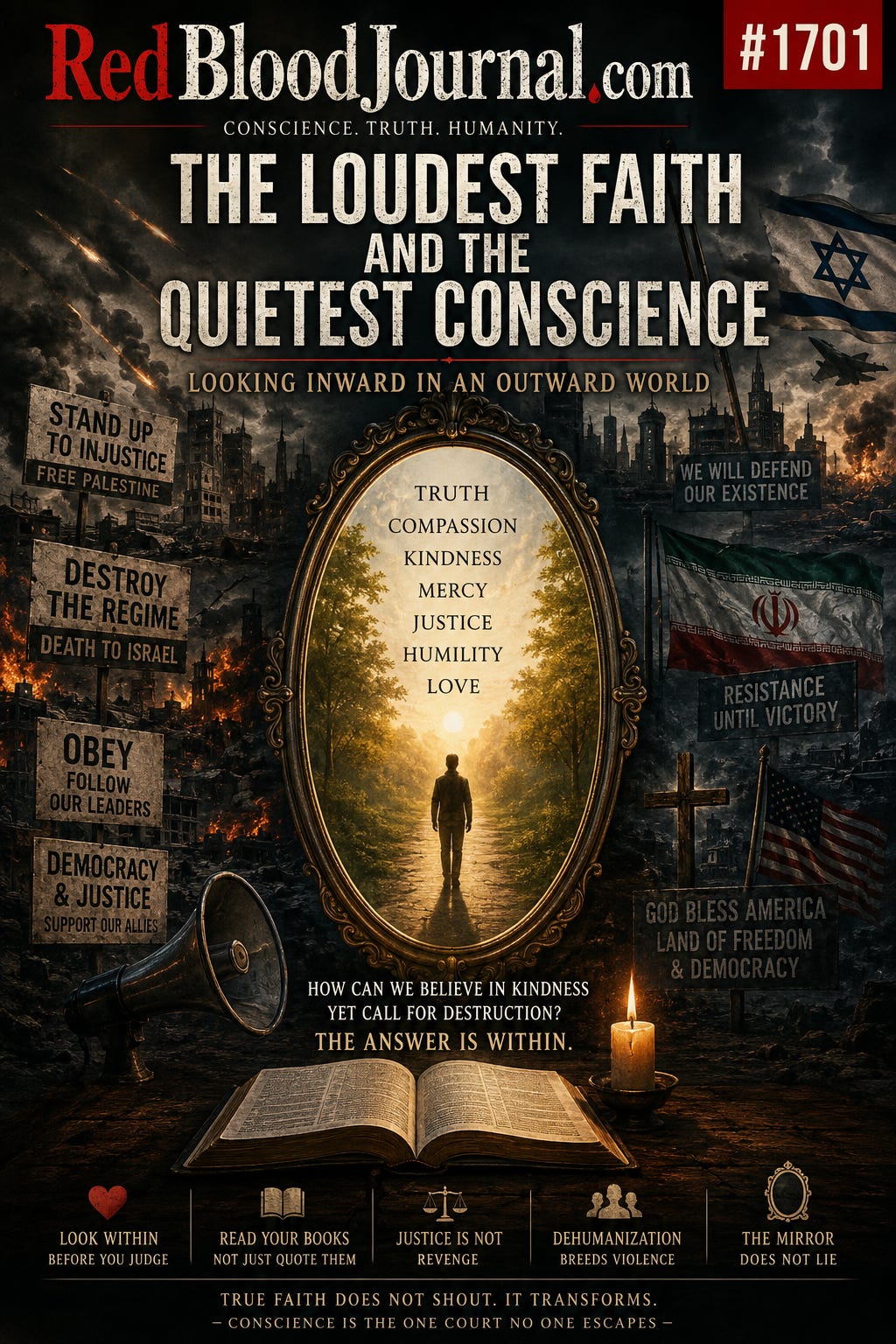
🩸 RedBloodJournal.com
#1701 – The Loudest Faith and the Quietest Conscience
Looking Inward in an Outward World
Throughout history, humanity has spoken endlessly about God.
We build temples, churches, synagogues, and mosques.
We write books, preach sermons, argue over doctrine, defend traditions, and declare ourselves followers of truth.
Yet one question refuses to disappear.
If we believe in a compassionate Creator, why do so many of us become comfortable calling for the destruction of others?
How can a heart that speaks of mercy also celebrate death?
This question belongs to no single religion.
It belongs to every human being.
The Mirror of Conscience
Christians speak of love and forgiveness.
Jews speak of justice, mercy, and the sanctity of life.
Muslims speak of compassion and the mercy of God.
Every major faith contains teachings that call believers to examine themselves before condemning others.
Yet history repeatedly shows something different.
People often invoke God while defending hatred.
They speak of peace while preparing for war.
They pray for mercy while refusing to extend mercy to those they consider enemies.
The contradiction is not found in sacred words alone.
It is found in the human heart.
The Loudest Voices
One observation continues to surface.
Those who speak the loudest about religion are not always those who have examined themselves the most.
Volume is not conviction.
Sometimes it is insecurity.
When inner certainty is absent, people often seek certainty through external authority.
Their identity becomes attached to a preacher.
A political leader.
A religious institution.
A movement.
A nation.
A flag.
Question that authority, and something remarkable often happens.
Reason gives way to repetition.
Questions are answered with slogans.
Dialogue becomes shouting.
If shouting fails, anger follows.
Sometimes hostility.
Sometimes silence.
Yet truth has never needed to fear questions.
Truth invites examination.
It does not depend upon suppressing it.
The Outward Trap
Perhaps humanity’s greatest mistake has been looking outward before looking inward.
We are taught whom to admire.
Whom to hate.
Whom to fear.
Whom to defend.
Our conscience slowly becomes outsourced.
Instead of asking, “What do I know to be true within?”
We ask,
“What does my group expect me to believe?”
The louder the crowd becomes, the quieter the individual conscience grows.
The Upside-Down World
Consider today’s conflicts.
The leadership of the Islamic Republic has justified hostility toward Israel as resistance to what it sees as injustice against Palestinians.
Israel presents its military actions as necessary to protect its citizens from those who threaten its security.
Many American Christians support policies they believe defend freedom, democracy, allies, and peace.
Each side speaks the language of morality.
Each believes it stands on the side of justice.
Each asks God to bless its cause.
Yet mothers bury children on every side.
Cities are destroyed.
Families grieve.
Fear spreads farther than compassion.
The language changes.
The suffering does not.
This report is not asking readers to choose one side over another.
It asks something more difficult.
What happens when every side claims God while human beings continue to die?
The Consistency Test
Perhaps the greatest spiritual test is consistency.
If I believe every human life possesses dignity, does that belief disappear when the person belongs to another nation?
If I believe in compassion, does compassion end where politics begins?
If I condemn violence when my enemies commit it but celebrate it when my allies do, have I remained faithful to my principles—or only to my tribe?
These questions cannot be answered by politicians.
Nor by journalists.
Nor by religious authorities.
Only conscience can answer them honestly.
Looking Within
The person who begins looking inward discovers something remarkable.
Truth no longer depends upon winning debates.
It becomes something lived rather than merely defended.
There are no slogans inside conscience.
No applause.
No political party.
No audience.
Only the quiet conversation between one’s actions and one’s soul.
That conversation cannot be manipulated by propaganda.
It cannot be purchased.
It cannot be voted into existence.
It either exists...
or it does not.
The Quiet Revolution
Perhaps the deepest spiritual revolution is not converting others.
It is examining ourselves.
The world constantly tells us to look outward.
Toward governments.
Toward religious institutions.
Toward political movements.
Toward media.
Toward leaders who promise certainty.
Yet the one place least explored is the place where every great teacher has ultimately pointed:
Within.
A conscience that has been honestly examined has little need to shout.
It has little need to hate.
It has little need to celebrate another person’s destruction.
Because once compassion becomes conditional, it is no longer compassion.
Once justice belongs only to our own side, it is no longer justice.
And once God becomes a justification for hatred instead of a call to self-examination, we may have stopped following God and begun following ourselves.
Perhaps the greatest question is not whether God is on our side.
Perhaps the greatest question is whether our conscience still reflects the compassion, humility, and mercy we claim God represents.
For the loudest faith is not always the strongest.
Sometimes the quietest conscience speaks the deepest truth.
🪞 The Loudest Faith and the Quietest Conscience
Jul 12, 2026
This text explores the profound disconnect between religious rhetoric and moral actions in the modern world. The author argues that many individuals use faith as a shield for hatred or political tribalism rather than a tool for genuine self-reflection. By examining global conflicts, the source highlights how groups often outsource their ethics to institutions or leaders, leading to a loss of personal accountability. True spiritual integrity requires a consistent application of compassion that transcends national, political, or religious boundaries. Ultimately, the writing suggests that a quiet, examined conscience holds more truth than the loud, performative certainty of public belief. One must look inward to ensure their values remain rooted in humanity rather than ideological convenience.


