


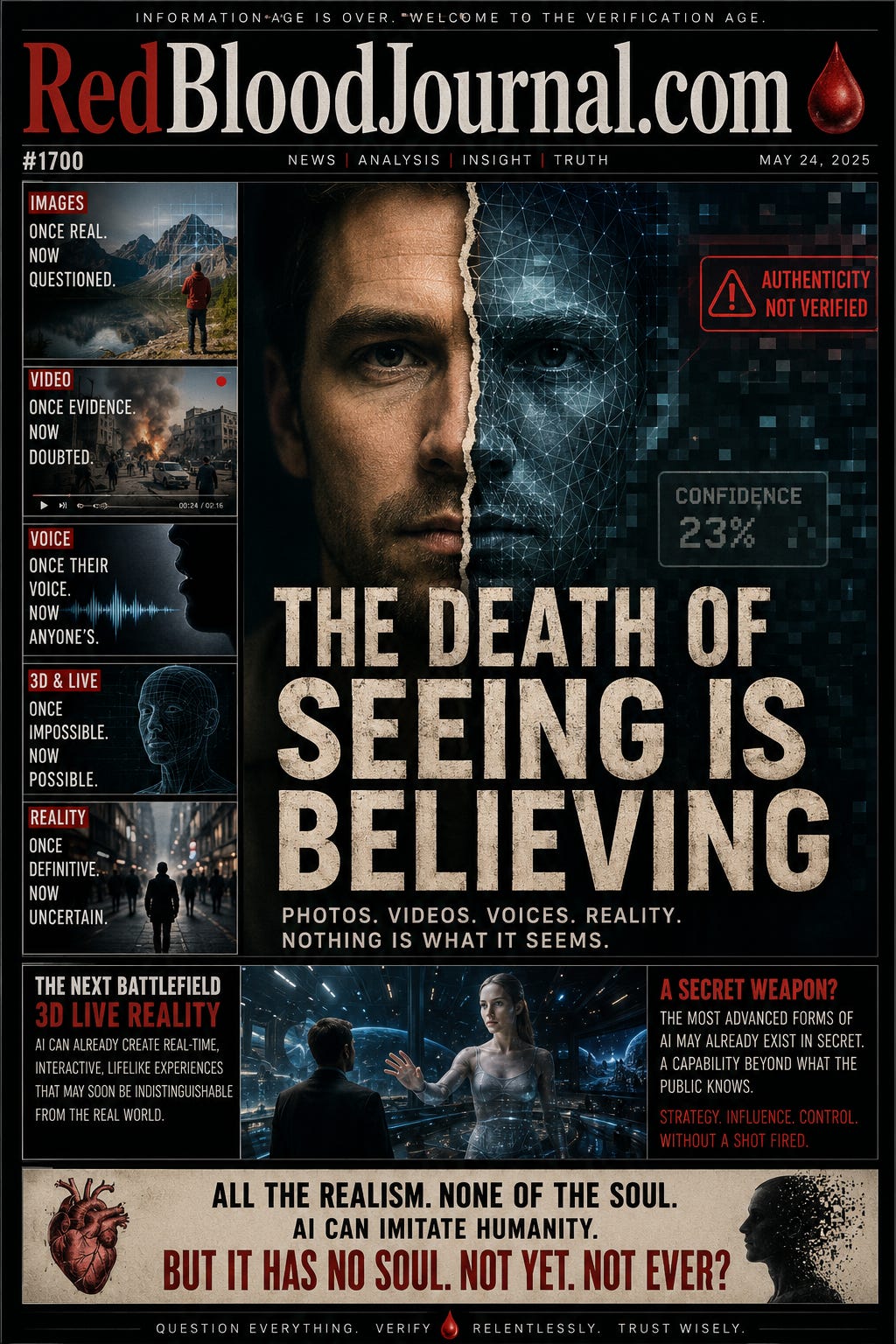
🩸 RedBloodJournal.com
#1700 – The Death of Seeing Is Believing
When Reality Itself Becomes Difficult to Verify
PROLOGUE
For centuries, humanity relied on a simple assumption:
“Seeing is believing.”
Our eyes became our most trusted witnesses.
A photograph captured reality.
A voice identified a person.
A video preserved history.
These assumptions shaped journalism, courts, science, politics, and everyday life.
Artificial intelligence is now challenging each of them.
The First Crack
The first doubts appeared with photographs.
For more than a hundred years, a photograph was treated as powerful evidence.
Today, an image can be created entirely by artificial intelligence in seconds.
Every remarkable photograph now carries an invisible question:
“Was this ever real?”
Motion No Longer Guarantees Reality
Video once seemed impossible to fake convincingly.
If someone could watch an event unfold, the event must have happened.
That confidence is fading.
Artificial intelligence can now generate realistic video of people speaking, moving, and interacting in scenes that never existed.
The camera is no longer an unquestioned witness.
Even Our Ears Can Be Deceived
Voices were once among the most reliable forms of identification.
Today, only a short recording may be enough to produce a highly convincing synthetic voice.
Phone calls.
Interviews.
Emergency messages.
Political speeches.
Family conversations.
The familiar sound of someone’s voice may no longer prove that the person is actually speaking.
Reality Becomes a Question
Artificial intelligence does more than create convincing fabrications.
It also creates doubt.
A genuine photograph can be dismissed as AI.
A real recording can be called fake.
An authentic video can be rejected as synthetic.
When anything can be questioned, uncertainty itself becomes a powerful force.
The Next Frontier
Images became realistic.
Videos became realistic.
Voices became realistic.
The next step is not another screen.
It is three-dimensional, live, interactive reality.
Artificial intelligence is rapidly approaching the ability to create digital humans that move naturally, maintain eye contact, respond in real time, and occupy immersive virtual spaces that feel almost indistinguishable from the physical world.
As virtual reality, augmented reality, holographic projection, and real-time rendering continue to improve, the question may no longer be:
“Is this image real?”
or
“Is this video authentic?”
Instead, it may become:
“Is this person actually here?”
A New Strategic Landscape
History shows that transformative technologies are often developed for strategic purposes long before the public becomes fully aware of their capabilities.
Whether the most advanced forms of real-time, three-dimensional AI systems already exist outside public view is a subject of speculation rather than established fact.
What is clear is that the technology is advancing rapidly enough that verification—not appearance—will become increasingly important.
The One Thing Still Missing
Artificial intelligence may learn to imitate our appearance.
It may imitate our voice.
It may imitate our expressions.
It may imitate our mannerisms.
One day it may stand before us as a fully interactive, lifelike three-dimensional presence.
Yet one question remains beyond appearance:
Does it possess genuine consciousness?
Does it possess a soul?
Technology may eventually reproduce almost every outward sign of being human.
But imitation is not identity.
A perfect reflection in a mirror is still not the person standing before it.
Whatever extraordinary forms artificial intelligence may one day take, one distinction remains:
It can imitate the human being.
It cannot demonstrate the inner life that makes a human being who they are.
Not yet.
🩸 Red Blood Journal
In the Verification Age, appearances may become artificial.
Truth still requires more than what the eyes can see, the ears can hear, or the machines can imitate.
👁️ The Death of Seeing Is Believing
Jul 12, 2026
This source explores how artificial intelligence is fundamentally undermining our traditional ability to verify reality through our senses. For centuries, humans relied on the belief that visual and auditory evidence provided absolute proof of truth, but modern technology can now flawlessly fabricate photos, videos, and voices. This shift creates a dangerous environment where authentic evidence can be easily dismissed as fake, leading to widespread social and political uncertainty. The text suggests we are entering an era of three-dimensional digital humans that can mimic physical presence and real-time interaction. Ultimately, the author argues that while machines can imitate human appearance, they still lack the internal consciousness and soul that define true identity. Consequently, in this new age, truth must be determined by more than just what we can see or hear.


