


🩸 RedBloodJournal.com
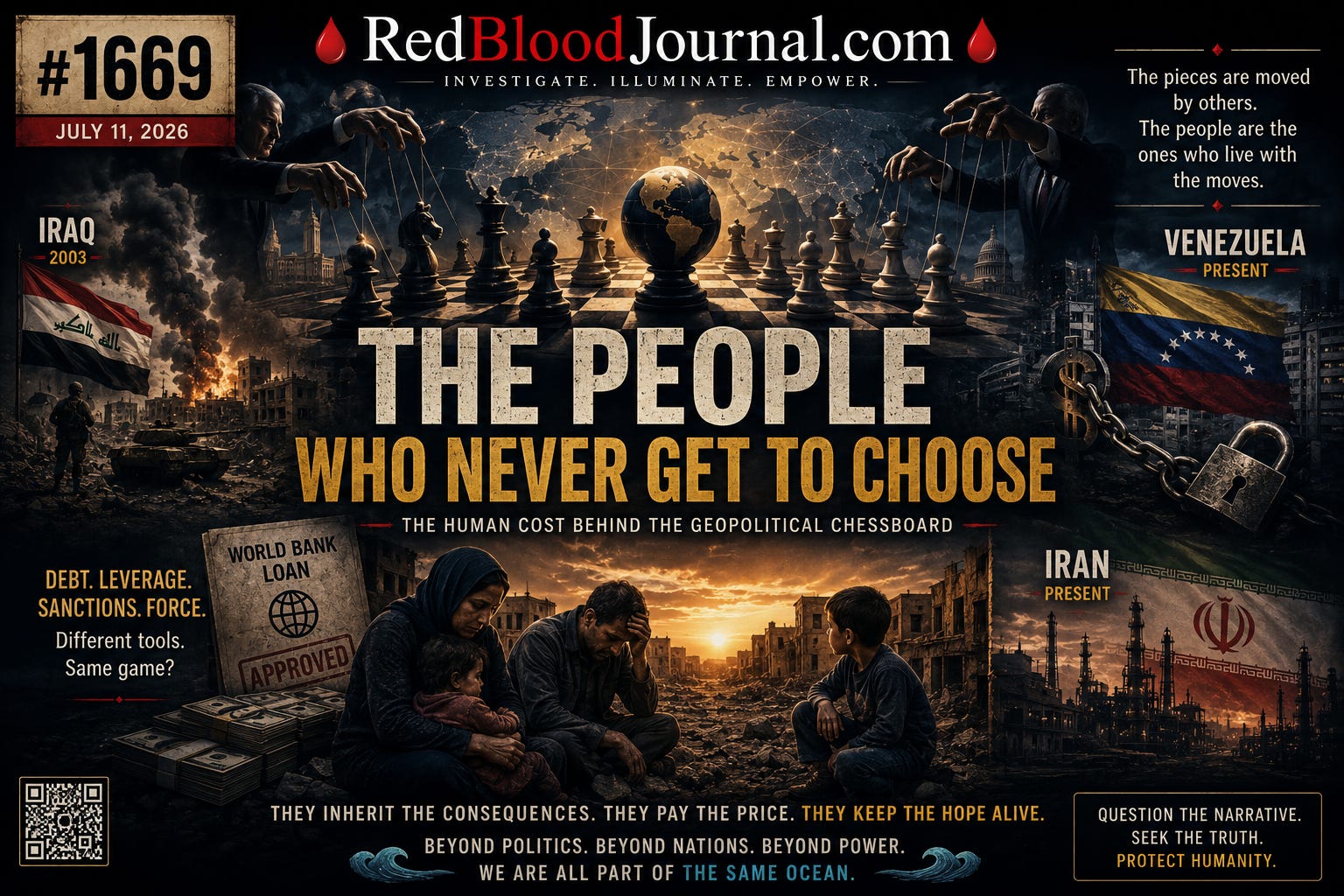
#1669 – The People Who Never Get to Choose
The Human Cost Behind the Geopolitical Chessboard
PROLOGUE
History often remembers wars through the names of presidents, generals, treaties, revolutions, and empires.
It remembers victories.
It remembers defeats.
It remembers borders that changed and governments that rose or fell.
Far less often does it remember the ordinary people who simply wanted to live ordinary lives.
Beyond the Headlines
Political history is usually written from the perspective of states.
Maps change.
Alliances shift.
Sanctions are imposed.
Military campaigns begin and end.
Financial systems rise and fall.
Behind every headline, however, are millions of people who never voted for the crisis, never planned the conflict, and never had the power to stop it.
They simply inherit the consequences.
The Unchosen Burden
Whether the pressure comes from foreign intervention, sanctions, internal corruption, civil conflict, or geopolitical rivalry, it is usually the ordinary citizen who carries the greatest burden.
Parents still worry about feeding their children.
Young people still hope to build a future.
Workers continue searching for dignity.
Families continue trying to protect one another.
The language of geopolitics speaks of strategy.
The language of ordinary people speaks of survival.
Competing Narratives
Modern geopolitical events often generate multiple interpretations.
The same event may be described as liberation by one observer, intervention by another, diplomacy by one government, coercion by another, or national security by yet another.
The truth is often debated long after the events themselves have passed.
History reminds us that political narratives frequently compete with one another, and observers are left to weigh evidence, question assumptions, and draw their own conclusions.
The Forgotten Constant
Despite changing governments, ideologies, and alliances, one reality remains remarkably constant.
Ordinary people rarely design geopolitical struggles.
They rarely finance them.
They rarely negotiate them.
Yet they are often the ones who live with the consequences for generations.
Cities can be rebuilt.
Economies can recover.
Governments can change.
Lost childhoods, broken families, and lives interrupted cannot always be restored.
The Measure of Civilization
Perhaps the strength of a civilization should not be measured solely by military power, economic output, or political influence.
Perhaps it should also be measured by a simpler question:
How many ordinary people are allowed to live with dignity?
When political success comes at the cost of millions of shattered lives, history eventually asks whether the victory was worth its price.
Ocean Reflection
Every generation inherits conflicts it did not create.
Every generation also inherits the opportunity to respond differently.
If humanity is truly composed of countless drops belonging to the same ocean, then every child, every family, every nation, and every stranger shares far more than politics often admits.
Empires may compete.
Governments may disagree.
Narratives may change.
But the value of a human life should never depend on which side of a geopolitical chessboard it happens to occupy.
The pieces are moved by others.
The people are the ones who live with the moves.
🌊 Ocean of Love and Positivity
🌍 The Human Cost of the Geopolitical Chessboard
Jul 11, 2026
This text serves as a poignant reflection on the humanitarian consequences that arise from high-level international conflicts and political maneuvering. The author argues that while history focuses on state-level achievements and shifting borders, the ordinary citizens caught in the middle are frequently overlooked. These individuals rarely have a voice in the strategic decisions made by their leaders, yet they are the ones who must endure the long-term hardship and trauma of war or economic sanctions. By contrasting the clinical language of geopolitics with the daily struggle for survival and dignity, the source challenges readers to prioritize human value over military or economic dominance. Ultimately, it suggests that the true measure of a civilization is found in its ability to protect the lives of those who have no say in the geopolitical games of the powerful.


